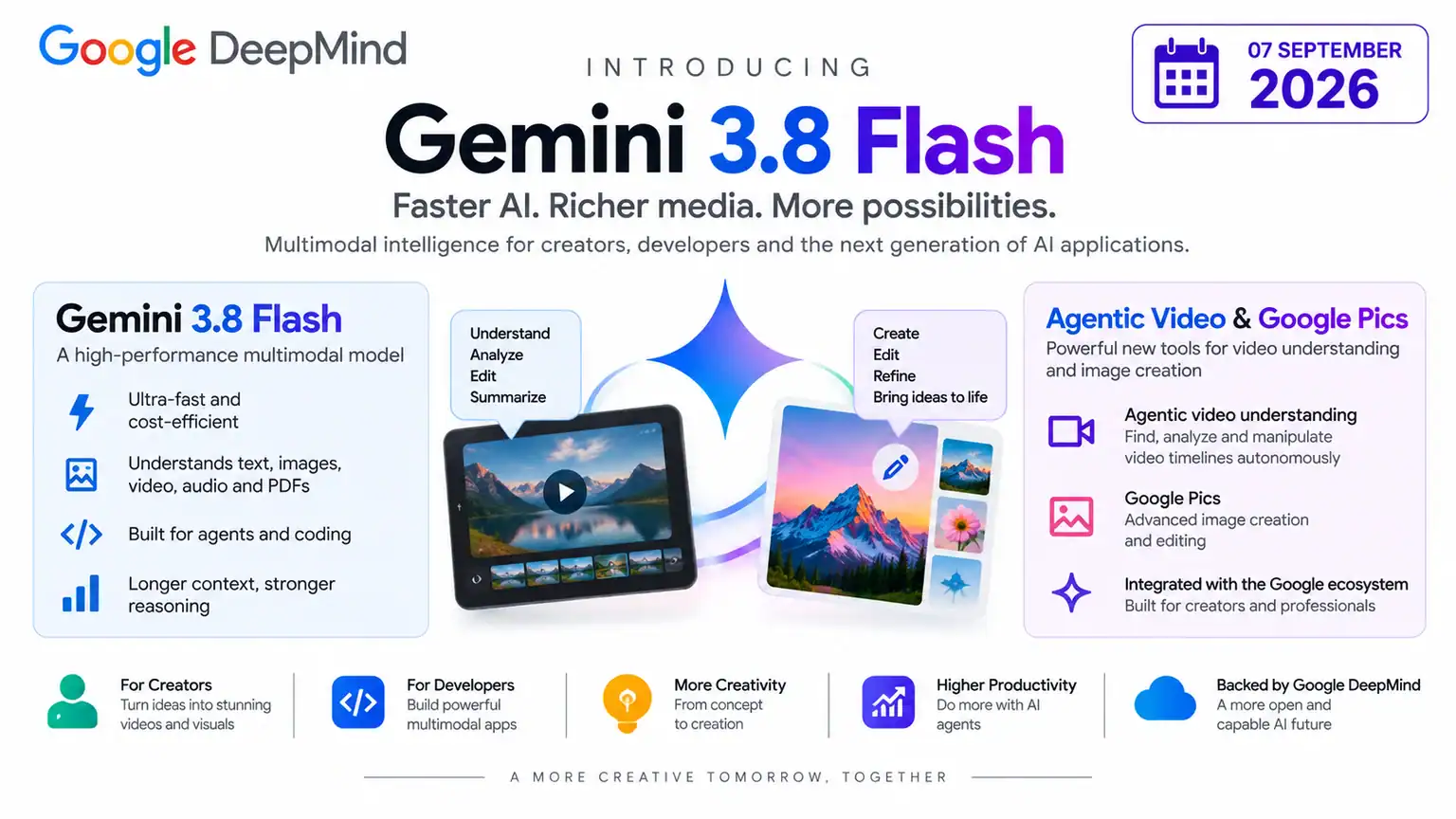
Google is accelerating its push into multimodal and agentic artificial intelligence with Gemini 3.8 Flash, a new model designed for coding, autonomous agents, complex reasoning and multimodal understanding. The launch arrives alongside Google’s new agentic video understanding technology and Google Pics, an AI-powered image creation and editing tool integrated with Google Workspace.
There is one important clarification to the original report: agentic video understanding was announced on September 1, 2026 for Gemini 3.7 Flash, Gemini 3.6 Flash and Gemini 3.5 Flash-Lite—not specifically as a new Gemini 3.8 Flash feature. Google then officially announced Gemini 3.8 Flash on September 2, 2026.
Together, however, these announcements show Google’s broader strategy: build AI that can understand text, images, audio and video, perform multi-step tasks autonomously, and integrate those capabilities into tools creators and developers already use.
For content creators in particular, the combination of intelligent video analysis and Google Pics could make Google’s ecosystem considerably more useful for producing YouTube videos, social-media graphics, marketing content and other digital media.
What Is Gemini 3.8 Flash?
Gemini 3.8 Flash is Google DeepMind’s newest Flash-class AI model. Google calls it its “most intelligent workhorse model yet for coding and agents,” designed to deliver advanced reasoning while retaining the speed and scalability associated with its Flash family.
The model accepts multiple types of input, including text, images, video, audio and PDFs, while producing text output. It has a context window of more than 1 million input tokens and supports up to 65,536 output tokens through the Gemini API.
Google is positioning Gemini 3.8 Flash for several demanding applications:
- Agentic coding and software engineering
- Autonomous AI agents
- Advanced reasoning
- Multimodal understanding
- Knowledge work
- Complex enterprise workflows
- Computer-use applications
- Function calling and tool use
- Search-grounded applications
Google says Gemini 3.8 Flash significantly improves on Gemini 3.7 Flash across software engineering, agentic tasks and critical multi-step reasoning.
Gemini 3.8 Flash Is Designed for Agentic AI
One of the most significant aspects of Gemini 3.8 Flash is Google’s emphasis on autonomous agents.
Traditional chatbots largely follow a request-response pattern. You ask something, the AI generates an answer, and the interaction ends until you provide another instruction.
An AI agent can operate differently.
It can potentially understand an objective, formulate a plan, use tools, retrieve information, perform actions, evaluate the results and continue working toward the objective.
For software developers, this could mean asking an AI agent to investigate a bug, inspect a codebase, modify files, execute code and test whether its solution actually works.
Google says Gemini 3.8 Flash is engineered specifically for long-horizon software engineering, autonomous agents and complex enterprise workflows.
That makes it more than simply a faster chatbot. It is increasingly becoming an execution layer for AI-powered applications.
What Is Google’s Agentic Video Understanding?
The second major development is Google’s new agentic video understanding technology.
Most conventional AI video-analysis systems process videos at a predetermined sampling rate. Google explains that its normal static approach can ingest video at a fixed rate such as one frame per second.
That can create two problems.
First, the AI may process large numbers of frames that are irrelevant to the user’s question. Second, important events occurring between sampled frames may be missed.
Google’s new agentic approach allows Gemini to decide what part of the video it needs to inspect, how quickly it should examine it and whether it needs information from the visual frames, audio or transcript.
Instead of watching everything in exactly the same way, Gemini can actively search through a video for the information required to answer the user’s question.
Agentic Video Can Reduce Tokens and Costs
Efficiency is one of the biggest advantages.
According to Google, its agentic video approach can reduce token consumption by up to 88%, lower costs by up to 66% and improve quality by up to 7% in its evaluations.
Those are Google-reported figures rather than independent benchmarks, but they demonstrate why this approach could be important.
Imagine analyzing hundreds of hours of video.
Processing every part of every video at high resolution could consume enormous amounts of computing resources and tokens.
An agentic system can instead search for the relevant moments and inspect those sections more closely.
Google says the system supports capabilities including sub-second moment retrieval, more accurate anomaly detection and precise counting.
How Agentic Video Can Help YouTube Creators
For creators, agentic video understanding could eventually become particularly valuable.
A YouTube creator may have hours of raw footage but only need a few minutes for the final video. An AI system capable of understanding the footage could potentially help identify:
Important moments: Find specific scenes or events without manually watching the entire recording.
Precise editing points: Google’s sub-second moment retrieval could help locate tight transitions and cut boundaries.
Content analysis: AI could examine visual information, speech and transcripts together.
Video search: Creators could potentially search large media libraries conversationally—for example, asking for moments where a particular product, location or event appears.
Quality control: Agentic video analysis could help identify unusual events, inconsistencies or other moments requiring review.
Google explicitly says the technology can make precise automated video editing possible by identifying state changes and cut boundaries that fixed one-frame-per-second processing may miss.
That could eventually make AI-assisted editing significantly more sophisticated.
Is Agentic Video Already Available?
Yes, but primarily as a developer capability, rather than a complete consumer video editor.
Google says agentic video understanding is available for uploaded videos and YouTube videos through the Gemini API in Google AI Studio and the Gemini Enterprise Agent Platform.
Developers can configure the video-processing mode as agentic and build applications around it.
It is therefore important not to interpret Google’s announcement as meaning Gemini now automatically edits complete YouTube videos for every consumer.
The underlying technology makes more sophisticated AI video applications possible, but developers still need to build workflows and products around those capabilities.
Google Pics Brings AI Image Creation Into Workspace
For creators who primarily work with images, Google has also launched Google Pics.
Google Pics is an AI-powered image generation and editing application built into the Google Workspace ecosystem and powered by Google’s Nano Banana image technology.
Users can generate entirely new visuals from text prompts or upload existing images and modify them.
Among its most useful features are:
Object-level editing: Users can isolate individual elements and modify them without changing the entire image.
In-image text editing: Google Pics can detect text and allow users to modify it.
Translation: Text contained inside an image can be translated while maintaining the design.
Targeted editing: Users can select a specific area and describe the desired change.
Multiple generations: Pics can create several variations from a prompt.
Workspace integration: Google is integrating Pics with Docs, Slides and Drive.
For creators, this could reduce the need to switch constantly between separate AI image generators, design software and productivity applications.
How Google Pics Can Help Content Creators
Google Pics may be especially interesting for YouTubers, bloggers, social-media creators and small businesses.
A creator could potentially use it to produce:
- YouTube graphics
- Blog illustrations
- Social-media posts
- Promotional banners
- Posters
- Infographics
- Product mockups
- Marketing visuals
- Presentation graphics
Because Pics supports targeted editing, creators don’t necessarily have to regenerate an entire image when one small element is wrong.
For example, a blogger could generate an illustration, select a particular object and ask Gemini to replace it. A social-media creator could modify text inside a design or translate it into another language.
Google also says Pics creations can be shared with other people for collaborative editing, similar to other Workspace applications.
Is Gemini 3.8 Flash Free?
For developers, there is some particularly good news.
Gemini 3.8 Flash currently has a free API tier.
Google’s official Gemini API pricing page lists standard Gemini 3.8 Flash input and output as free of charge on the Free Tier, subject to Google’s applicable limits.
For paid API usage, Google currently charges:
| Gemini 3.8 Flash API | Price per 1M tokens |
|---|---|
| Free Tier input | Free |
| Free Tier output | Free |
| Paid input | $0.75 |
| Paid output, including thinking | $3.75 |
| Paid context caching | $0.075 |
These are introductory prices through December 31, 2026. Google says that beginning January 1, 2027, the paid prices will rise to $1.50 per million input tokens and $7.50 per million output tokens.
This makes Gemini 3.8 Flash particularly attractive to developers who want to experiment before committing to significant API spending.
Gemini 3.8 Flash Subscription Plans
There is an important distinction between API pricing and Google’s consumer subscriptions.
The Gemini API is usage-based. Google AI subscriptions, meanwhile, provide higher usage limits and access to various premium Google AI products.
Google currently offers plans including Google AI Plus, Google AI Pro and Google AI Ultra. The exact prices, storage allowances and features can vary by country.
For reference, Google’s pricing page currently lists Google AI Pro at $19.99 per month in its USD pricing view, with 5 TB of storage and higher Gemini usage limits.
Google AI Pro includes expanded access to Google’s creative models and AI Studio, while Ultra provides still higher limits and access to additional premium capabilities.
For developers primarily interested in Gemini 3.8 Flash, however, an AI subscription isn’t necessarily the right comparison—the API has its own free and paid usage tiers.
Is Google Pics Free?
This is where the situation differs.
Google says Google Pics is generally available to Workspace customers with Business Standard and higher plans, as well as Google AI Pro and Ultra subscribers.
Google’s Help Center similarly states that Pics requires an eligible Google Workspace or Google AI plan.
Therefore, ordinary free Google accounts should not assume that full Google Pics access is included for free. Google does have Workspace Experiments for some personal accounts, but that is a trusted-tester program rather than general free availability.
For an individual creator who specifically wants Google Pics, Google AI Pro is therefore one of the relevant consumer subscription options.
Why This Matters for Creators
Google’s announcements become more interesting when viewed together.
Imagine a future content workflow where a creator can use Google’s AI ecosystem to:
- Analyze hours of source footage.
- Locate the best moments automatically.
- Identify precise editing points.
- Analyze dialogue and transcripts.
- Generate supporting research.
- Create custom illustrations.
- Modify individual objects in images.
- Produce social-media graphics.
- Integrate visuals into Docs or Slides.
- Build custom automation using Gemini APIs.
The individual components already exist in different forms.
Agentic video provides sophisticated video understanding. Gemini 3.8 Flash supplies multimodal reasoning and agentic capabilities. Google Pics handles visual generation and editing.
For YouTubers and other multimedia creators, the combination could ultimately be more significant than any one feature by itself.
Why Gemini 3.8 Flash Matters for Developers
For developers, Gemini 3.8 Flash combines three qualities that are increasingly important: intelligence, speed and cost efficiency.
Its multimodal inputs mean applications can reason over text, images, audio, video and documents. Its tool capabilities include function calling, code execution, search grounding and computer use in preview.
That creates opportunities to build AI applications capable of working with much richer real-world information.
A developer could, for example, build an application that searches long videos for specific moments, extracts relevant information and sends those findings into a broader agentic workflow.
The free API tier also lowers the barrier for independent developers and small teams experimenting with Gemini 3.8 Flash.
Final Verdict
Gemini 3.8 Flash is an important addition to Google DeepMind’s rapidly evolving AI lineup. It is designed not merely as a fast chatbot but as a multimodal model for agentic coding, autonomous workflows, advanced reasoning and enterprise-scale applications.
For creators, Google’s broader announcements may be even more exciting.
Agentic video understanding gives Gemini the ability to intelligently decide which parts of a video need closer examination instead of processing everything uniformly. Google reports substantial reductions in token consumption and cost, alongside improved accuracy.
Meanwhile, Google Pics provides AI-powered image generation and precision editing directly inside the Workspace ecosystem, potentially simplifying the creation of graphics, illustrations and social-media content.
The pricing story is also attractive for developers: Gemini 3.8 Flash has a free API tier, while paid API pricing starts at an introductory $0.75 per million input tokens and $3.75 per million output tokens through the end of 2026.
Google Pics, however, generally requires an eligible Google AI or Workspace subscription.
Taken together, Gemini 3.8 Flash, agentic video understanding and Google Pics demonstrate Google’s broader direction: AI that doesn’t just generate content, but can understand multimedia, search through it intelligently, reason about it, use tools and help creators turn ideas into finished digital assets.
Official Sources
Google DeepMind — Gemini 3.8 Flash
Google — Introducing Gemini 3.8 Flash and 3.8 Flash Cyber
Google — Introducing Agentic Video Understanding with Gemini