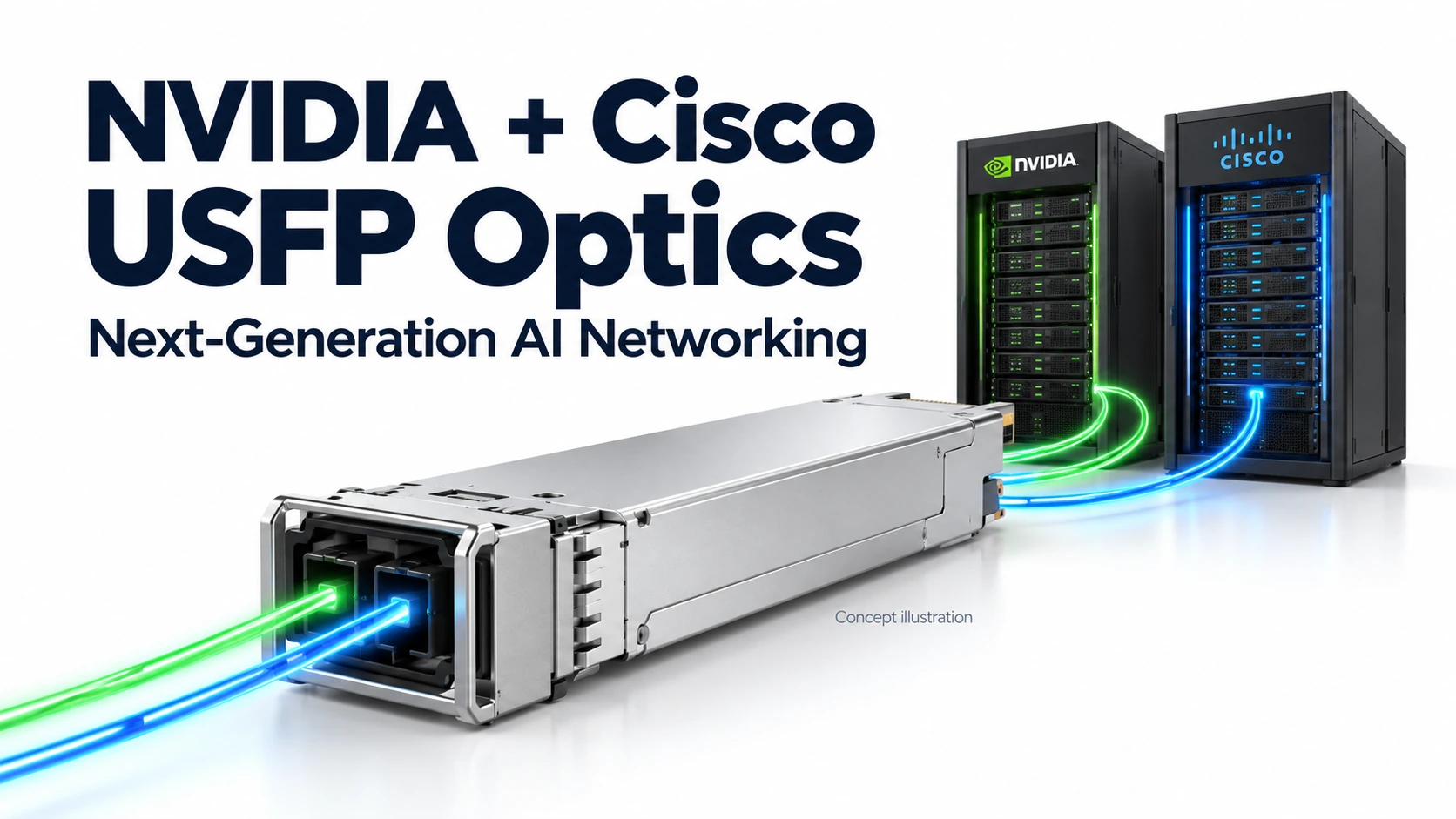
NVIDIA and Cisco have announced plans for USFP optics, a new pluggable optical module designed to help the next generation of AI factories move far more data. The companies revealed the Ultra-Dense Small Form Factor Pluggable (USFP) design on October 12, 2026, alongside the OCP Global Summit 2026.
What Are USFP Optics?
USFP optics are high-density transceivers built for 400Gb/s-per-lane electrical signaling, and a single module can reach up to 12.8Tb/s of capacity. The first planned modules will use 16 full-duplex lanes in an OSFP-sized footprint and will support both switches and SuperNICs. The design can later grow to 32 lanes and beyond.
Key Benefits of USFP Optics
Compared with today’s 200Gb/s-per-lane modules, the companies say the new format offers:
- 4x the front-panel bandwidth density
- About 1.3x better energy efficiency per bit
- The ability to scale Ethernet AI fabrics without adding extra network tiers
- Field-replaceable modules that keep the familiar pluggable model
Why AI Factories Need Denser Optics
As AI models grow, data centers must connect more computing systems while managing power, cost and complexity. Once a switch runs out of ports, builders usually add another switch layer, which increases latency, power use and expense. By packing more bandwidth into each port, USFP optics aim to avoid that extra layer.
Unlike co-packaged optics, which place optical engines close to the switching chip, this approach keeps a removable module. Reports describe it as a complement to co-packaged and near-package optics rather than a replacement.
Partners Behind the USFP Ecosystem
NVIDIA and Cisco are working with TE Connectivity and Amphenol to build a multi-source hardware ecosystem around the form factor. One report says both connector makers have committed to producing the cages and connectors the format needs. The module uses a two-dimensional array connector with a two-step insertion design meant to reduce contact wear and improve signal integrity. Cisco has described the effort as a joint initiative to develop an open specification, which gives suppliers a common foundation for building USFP optics.
What Happens Next
For now, USFP optics are an announced plan rather than a shipping product, so buyers should watch for product timelines from NVIDIA, Cisco and their partners. The performance and efficiency figures also come from the companies themselves and will need independent testing. Still, with AI networks demanding more bandwidth every year, this pluggable design is a development worth following.
FAQ : NVIDIA and Cisco USFP Optics
What are USFP optics?
USFP stands for Ultra-Dense Small Form Factor Pluggable. It is a new optical module designed for 400Gb/s-per-lane electrical signaling, with up to 12.8Tb/s of capacity in a single module. It is built for AI factory networks.
Who announced USFP optics, and when?
NVIDIA and Cisco announced plans for USFP optics on October 12, 2026, alongside the OCP Global Summit 2026.
How do USFP optics compare with current modules?
Compared with today’s 200Gb/s-per-lane optics, the companies say USFP offers 4x the front-panel bandwidth density and about 1.3x better energy efficiency per bit. These figures come from the companies themselves.
How many lanes will USFP modules have?
The first planned modules will have 16 full-duplex lanes in an OSFP-sized footprint. The design can later expand to 32 lanes and beyond.
Which companies are involved besides NVIDIA and Cisco?
NVIDIA and Cisco are working with TE Connectivity and Amphenol to build a multi-source hardware ecosystem around the form factor.
Why do AI factories need USFP optics?
When a switch runs out of ports, builders usually add another switch layer, which increases latency, power use and cost. Denser optics aim to avoid that extra layer by carrying more bandwidth through each port.
Do USFP optics replace co-packaged optics?
No. Reports describe USFP as a complement to co-packaged optics. It keeps a removable, field-replaceable module instead of placing the optical engine next to the switch chip.
Are USFP optics available to buy now?
Not yet. NVIDIA and Cisco have announced plans for the form factor, and the first transceivers are still to come. Watch for product timelines from the companies and their partners.
Here are the official announcements: