What if you could brief an AI before bed and return to a completed video the next morning?
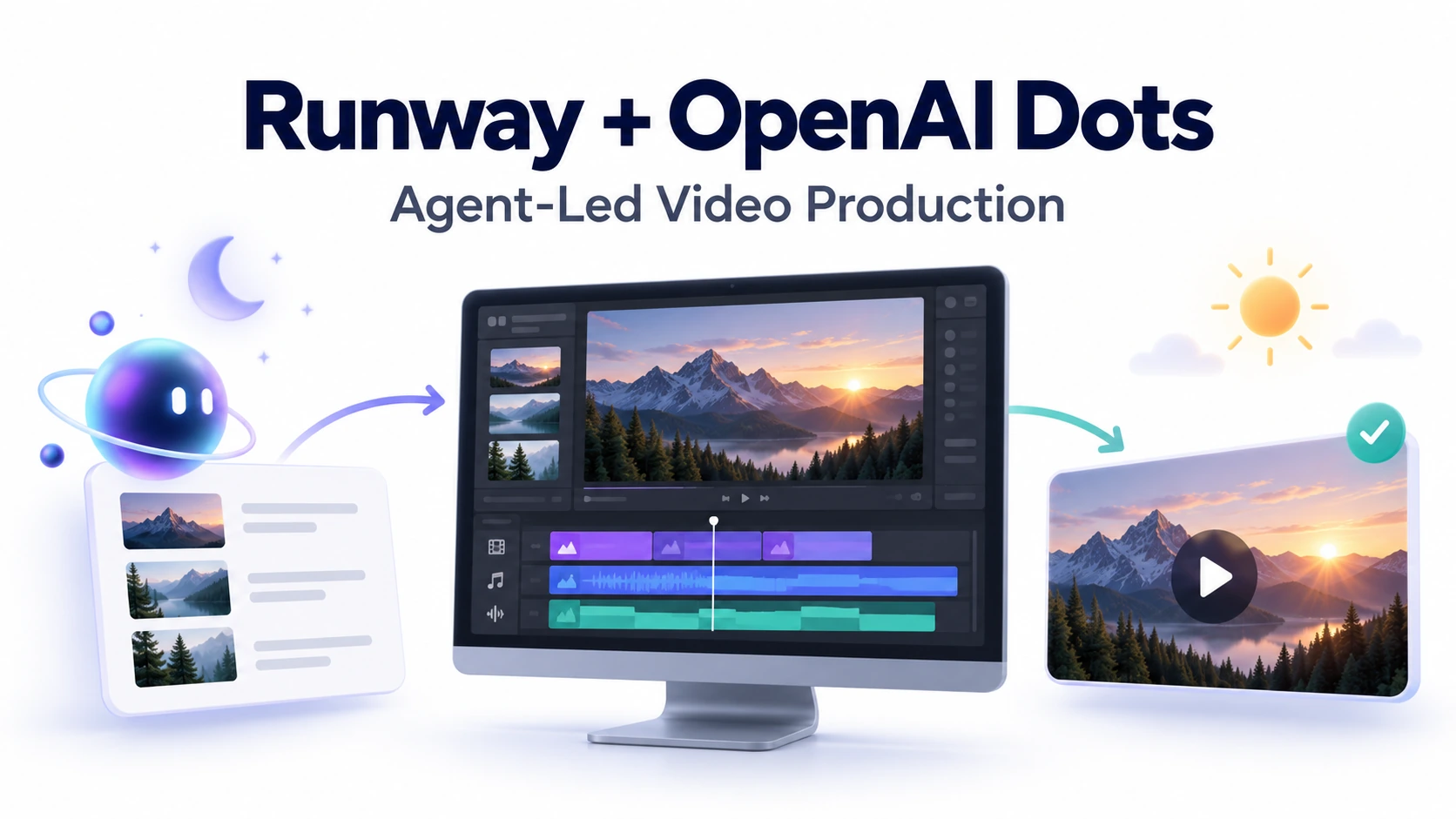
That is the workflow Runway is promoting with its new connection to OpenAI Dots. Rather than manually directing every generation, creators can delegate a video concept to an agent that plans shots and uses Runway to produce footage.
The Runway OpenAI Dots integration appeared in Runway’s official changelog on October 1, 2026. Its description explicitly presents an overnight production scenario, with a dot planning the shots and a finished video spot waiting by morning.
For creators and marketers, this is an interesting step toward delegated video production. However, it should not be mistaken for a guarantee that every project will finish overnight or require no human involvement.
What Is the Runway OpenAI Dots Integration?
The Runway OpenAI Dots integration makes Runway available to OpenAI’s agent system. Runway’s changelog links the announcement to its Runway for ChatGPT page.
The advertised workflow divides responsibilities: the dot plans the shots, while Runway generates the footage. Runway then describes the result as a finished video spot.
This differs from a conventional prompt-by-prompt workflow. Instead of deciding and submitting every shot individually, a creator can delegate a broader objective.
However, the short release note does not specify every production step. It does not establish that all projects automatically include narration, subtitles, licensed music, brand approval or publishing. Those details should be defined in the brief and confirmed in the available workflow.
What Are OpenAI Dots?
OpenAI announced Dots on September 29, 2026, describing always-on agents that can work toward user goals using their own cloud computers and connected applications.
Dots are designed to maintain context across ongoing work and accept projects without requiring users to direct every step. OpenAI also describes tools for monitoring progress, setting boundaries and reviewing actions.
For video creators, this provides the agent layer around a generation tool. Runway supplies media capabilities, while a dot can coordinate the delegated work.
The Runway OpenAI Dots integration therefore concerns a production workflow, rather than the launch of a new Runway video model.
Can a Dot Really Produce a Video Overnight?
Runway directly promotes that possibility. Its October release note describes briefing a dot before bed and finding a finished spot in the morning.
That is an advertised use case—not a guaranteed delivery time.
A simple visual concept and a complex advertisement have different requirements. A project involving several characters, exact product details and multiple revisions may need more direction than a short atmospheric sequence.
Creators should also distinguish a completed generated video from a publication-ready asset. Reviewing whether it matches the brief remains part of deciding whether to use it.
Does the Workflow Run Without Human Intervention?
The phrase “entirely without human intervention” goes beyond what the sources establish.
OpenAI says dots operate within connected-app permissions, user instructions and approval rules. Actions can be checked through automatic review, and certain steps may require the user’s approval. OpenAI also states that consequential work should be reviewed because dots can make mistakes.
The more accurate description is agent-led video production with configurable oversight.
The Runway OpenAI Dots integration may reduce repeated manual prompting. It does not remove the need to establish what the agent can do or decide whether the result is suitable.
Who Can Access the Integration?
Runway labels its October 1 announcement “All Plans.” That label concerns Runway’s listing and should not be interpreted as universal access to OpenAI Dots.
OpenAI’s launch announcement describes rollout to Pro and Business Premium users in eligible markets. Enterprise users, including Edu and Healthcare, can try the beta when their workspace administrator enables it.
Before planning a workflow around the Runway OpenAI Dots integration, confirm:
- Dots access on your account and in your market
- Availability of the Runway connection
- Permissions required for the intended workflow
- Applicable generation credits and usage limits
An integration announcement should not be treated as a promise of free or unlimited video production.
Why This Matters for Creators and Marketers
The potential benefit is coordination.
A creator making a short promotional video usually needs to translate an idea into individual shots, generate material and assemble a sequence. Agent-led production could reduce some of the repeated instructions involved.
For a YouTube creator, a possible application is preparing an illustrative sequence around a defined topic. For a marketer, it could be developing a draft promotional concept for review.
These are practical possibilities suggested by the workflow, rather than independently verified outcomes for every user.
The Runway OpenAI Dots integration is especially worth testing on a small project first. A short, clearly defined task makes it easier to assess output quality, costs and the amount of correction required.
How to Prepare a Better Video Brief
A useful brief should explain the deliverable, not simply request “a cinematic video.”
Include the intended audience, approximate duration, aspect ratio, visual style and required message. Identify any reference materials the agent should use and any details it must preserve.
For example:
Create a draft vertical promotional video for an AI tools website. Use a clean, modern visual style and three short scenes. Present the result for review before publishing. Confirm any generation spending that exceeds my stated budget.
This is an illustrative brief, not a verified command or setup procedure for the integration.
Clear expectations make the result easier to evaluate. They also help separate creative freedom from decisions that need your input.
What Creators Should Know
The announcement is genuine: Runway has confirmed availability in OpenAI Dots and promotes an overnight video-production scenario.
The Runway OpenAI Dots integration points toward a workflow where creators delegate more of the production process. Its usefulness will depend on account access, permissions, project complexity, generation costs and the quality of the finished result.
The strongest takeaway is that agent-led production is becoming an available workflow to explore. Claims of guaranteed overnight delivery or completely intervention-free filmmaking would overstate the announcement.
Frequently Asked Questions
Is the Runway OpenAI Dots integration official?
Yes. Runway listed “OpenAI Dots x Runway” in its changelog on October 1, 2026.
What does Runway say the integration can do?
Runway describes a dot planning shots and using Runway to generate them, with a finished video spot available the following morning.
Is overnight completion guaranteed?
No. The release note promotes an overnight example but does not establish a guaranteed turnaround for every project.
Can every ChatGPT user access Dots?
No. OpenAI’s announcement specifies eligible plans and markets, with administrator enablement for enterprise beta access.
Does the integration automatically publish videos?
The release note does not establish automatic publishing. Publishing permissions and approval requirements should be confirmed separately.
Are video generations free?
The announcement does not establish free or unlimited generation. Check the applicable Runway credits and OpenAI usage limits before starting.