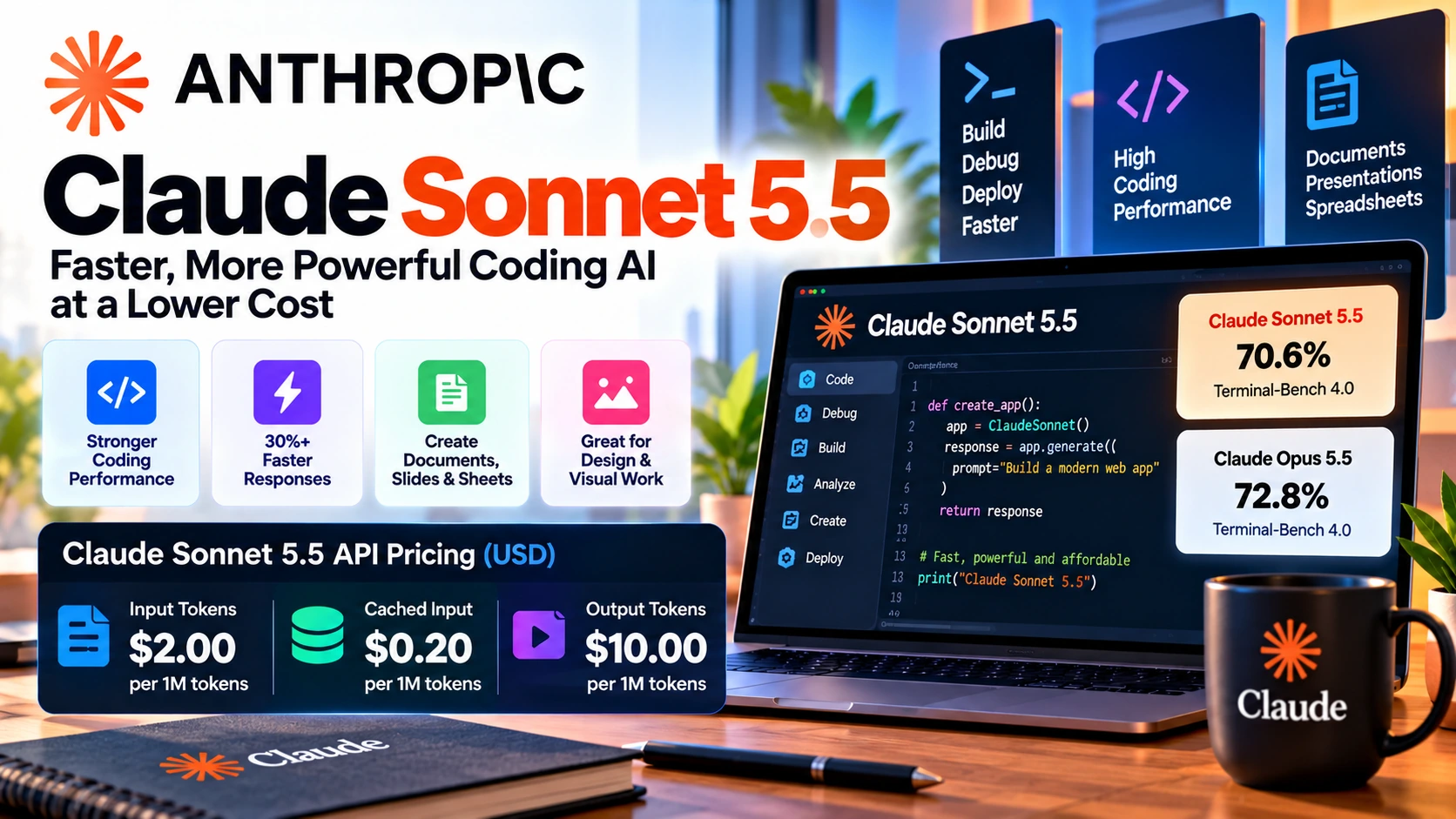
Anthropic has launched Claude Sonnet 5.5, its latest Sonnet-class AI model designed to combine strong intelligence, coding ability and speed with significantly lower costs than the company’s flagship Opus model.
Released on September 28, 2026, Sonnet 5.5 is positioned as a faster and lower-cost complement to Claude Opus 5.5. Anthropic says the model generates outputs more than 30% faster than Sonnet 5 and can cost up to 30% less per task in typical workloads because it often needs fewer tokens to accomplish the same work.
For developers, the headline Claude Sonnet 5.5 pricing is particularly attractive: $2 per million input tokens and $10 per million output tokens through the API.
That is half the standard input and output token price of Claude Opus 5.5.
For creators, programmers and businesses building AI-powered workflows, the combination of speed, coding performance and lower API costs could make Sonnet 5.5 one of Anthropic’s most practical models for everyday production.
What Is Claude Sonnet 5.5?
Claude Sonnet 5.5 is the second member of Anthropic’s Claude 5.5 family, following Claude Opus 5.5.
Anthropic describes it as particularly strong for well-scoped everyday work, debugging, and producing polished documents, presentations and spreadsheets. It also highlights the model’s visual and design abilities.
This positioning is important.
Claude Opus 5.5 remains Anthropic’s higher-end option for complicated tasks requiring deeper judgment and long-running agentic work. Sonnet 5.5 instead aims to provide much of the capability developers and creators need while delivering results faster and at a lower price.
In practical terms, that could make Sonnet 5.5 suitable for coding assistants, content workflows, document creation, AI agents, website development and high-volume business applications.
Claude Sonnet 5.5 Shows Major Coding Improvements
Coding is one of the biggest stories behind this release.
On Terminal-Bench 4.0, an agentic coding benchmark, Anthropic reports that Claude Sonnet 5.5 scored 70.6%. That’s a dramatic improvement from Sonnet 5’s reported 10.3% on the same evaluation.
However, the claim that Sonnet 5.5 beats Opus 5.5 on this benchmark should be corrected. Anthropic’s published comparison shows Opus 5.5 at 72.8%, slightly above Sonnet 5.5.
The more interesting story is therefore not that Sonnet has overtaken Opus across the board.
It’s how close a cheaper and faster Sonnet model can get to the flagship model on demanding tasks.
Anthropic also reports that Sonnet 5.5 finishes only two percentage points behind Opus 5.5 on GDPval-AA, an evaluation covering real-world professional tasks across different occupations.
That price-to-performance relationship could matter much more to developers than claiming a benchmark victory.
Claude Sonnet 5.5 Pricing for the API
The official Claude Sonnet 5.5 pricing currently looks like this:
| API usage | Sonnet 5.5 | Opus 5.5 |
|---|---|---|
| Input | $2 / 1M tokens | $4 / 1M |
| Output | $10 / 1M tokens | $20 / 1M |
| Cache reads | $0.20 / 1M tokens | $0.20 / 1M |
| 5-minute cache writes | $2.50 / 1M tokens | $5 / 1M |
| 1-hour cache writes | $4 / 1M tokens | $8 / 1M |
These are Anthropic’s current standard API rates.
This means Sonnet 5.5 costs 50% less than Opus 5.5 for standard input and output tokens.
Prompt caching can reduce costs further. Anthropic says Sonnet 5.5 can achieve up to 90% savings with prompt caching, while batch processing can provide 50% savings compared with standard processing.
This makes Claude Sonnet 5.5 pricing especially attractive for applications repeatedly using large system prompts, project instructions, codebases or reference documents.
Sonnet 5.5 Is More Than 30% Faster
Price isn’t the only efficiency improvement.
Anthropic says Sonnet 5.5 generates output 30%+ faster than Sonnet 5, making it the company’s fastest Sonnet model at launch.
That can make a noticeable difference when Claude is being used interactively.
A developer waiting for an agent to modify code benefits from faster iteration. A creator generating several versions of an article or presentation can evaluate alternatives more quickly. Businesses running large numbers of AI requests can also benefit from reduced processing time.
Sonnet 5.5 additionally supports adjustable effort levels.
Lower effort settings prioritize speed and token efficiency for routine work, while higher settings let Claude spend more time reasoning and checking its output. Anthropic says Medium is the default effort in Claude Code and its apps, while the Claude Platform defaults to High.
That gives users another way to balance intelligence, speed and cost.
Claude Subscription Plans in USD
API usage and Claude subscriptions are separate, so creators should understand the difference.
Anthropic currently offers the following individual plans:
| Claude plan | USD price | Suitable for |
|---|---|---|
| Free | $0 | Casual users and testing |
| Pro | $20/month or about $17/month with $200 annual billing | Regular creators and professionals |
| Max 5x | $100/month | Heavy users |
| Max 20x | $200/month | Very high-volume individual users |
The Free tier includes Sonnet access, while Pro adds more usage, Claude Code, projects and access to more Claude models. Max offers either five or twenty times Pro’s usage allowance, higher output limits, priority access during high traffic and earlier access to advanced features.
For organizations, Claude Team currently starts at $20 per user per month when billed annually, or $25 monthly, for a Standard seat. Premium Team seats cost $100 per user/month annually or $125 billed monthly. Team supports organizations of two to 150 people.
Enterprise is designed for larger organizations and currently combines a seat price with usage-based costs.
Prices exclude applicable taxes and can vary by region.
Important: Claude Subscription Does Not Include API Usage
This is worth emphasizing in your MiviCAI article.
Buying Claude Pro or Max does not automatically provide standard Claude API usage through the developer Console.
Anthropic treats consumer subscriptions and the Claude Console/API as separate products. API developers generally need to establish Console billing separately and pay according to token consumption.
So the $2 per million input tokens figure is an API rate, not the monthly cost of subscribing to Claude Sonnet 5.5.
How Claude Sonnet 5.5 Helps Developers
Sonnet 5.5’s combination of coding performance, speed and Claude Sonnet 5.5 pricing makes it particularly interesting for software development.
Developers can use it for writing and debugging code, understanding existing projects, refactoring applications, creating tests, explaining unfamiliar code and assisting with longer development workflows.
Anthropic specifically positions the model as strong at fixing bugs and well-scoped everyday tasks.
It is also available through the Claude Platform and through major cloud platforms including AWS, Google Cloud and Microsoft Foundry. Developers can access it directly through the API using the model identifier claude-sonnet-5-5.
For a company processing millions of requests, paying $2 rather than $4 per million standard input tokens can become meaningful at scale.
How Claude Sonnet 5.5 Helps Content Creators
Sonnet 5.5 isn’t only a coding model.
Anthropic specifically highlights its ability to produce polished documents, slides and spreadsheets, along with improved design capabilities.
For creators, this could translate into several useful workflows: researching and organizing content, developing video scripts, creating article outlines, analyzing documents, brainstorming campaigns, producing presentations and helping build websites or creator tools.
A YouTube creator could use a workflow such as:
Topic → Research → Outline → Script → Fact checking → Video structure → Titles → Description
A blogger could use:
Research → SEO structure → Draft → Tables → Meta description → Social posts → WordPress preparation
A creator who also builds small applications or websites gets additional value from the model’s coding capabilities.
This is where Claude Sonnet 5.5 pricing becomes relevant. High-volume creator workflows don’t necessarily require the most expensive flagship model for every step.
Sonnet 5.5 vs Opus 5.5: Which Workload Fits Each?
Anthropic’s own positioning helps clarify the distinction.
Sonnet 5.5 is intended as the faster, lower-cost option for well-scoped tasks, debugging, iteration and document creation. Opus 5.5 is positioned for complex work requiring careful judgment and long-running, highly capable agents.
For many creators, using Sonnet for routine production work and reserving Opus for particularly difficult tasks could be more economical than using Opus for everything.
This is especially relevant because standard Sonnet 5.5 input and output rates are half those of Opus 5.5.
Why Prompt Caching Matters
Prompt caching can make Claude Sonnet 5.5 pricing even more attractive for long-running workflows.
Imagine a coding assistant repeatedly referencing the same repository instructions or a content agent repeatedly using the same brand guidelines.
Instead of paying the full input price every time identical reusable context is processed, cached context can be read at the much lower $0.20 per million token rate.
For agentic applications involving many repeated calls, this can significantly reduce costs.
The same principle can apply to creators who automate production around stable brand instructions, reference documents or reusable project context.
Final Thoughts
Claude Sonnet 5.5 may be more interesting for its price-to-performance balance than for any single benchmark headline.
Anthropic reports a 70.6% Terminal-Bench 4.0 score, more than 30% faster output than Sonnet 5 and up to 30% lower typical task costs despite retaining Sonnet 5’s headline API rates.
At $2 per million input tokens, $10 per million output tokens and $0.20 per million cached reads, Claude Sonnet 5.5 pricing is substantially below Opus 5.5 for standard input and output while offering strong coding and professional-work capabilities.
For developers, that creates a compelling option for coding assistants, agents and high-volume applications. For creators, it provides a faster model for writing, research, document creation, coding and content-production workflows without automatically requiring flagship-model pricing.
The key correction to the original headline is important: Sonnet 5.5 does not beat Opus 5.5 on Terminal-Bench 4.0. The more defensible story is that it comes surprisingly close to Opus-class coding performance in some evaluations while offering substantially lower standard token costs.
Official resources: Claude Sonnet 5.5 announcement · Claude Sonnet product page · Claude API pricing · Claude subscription pricing