Artificial intelligence is becoming increasingly capable of writing software, building applications, and automating complex development tasks. But as AI-generated code becomes more common, one important question remains: How can developers ensure their applications are secure?
OpenAI has introduced GPT-6 Cyber, a specialized artificial intelligence model designed to help authorized security researchers discover vulnerabilities, validate security weaknesses, and develop potential fixes.
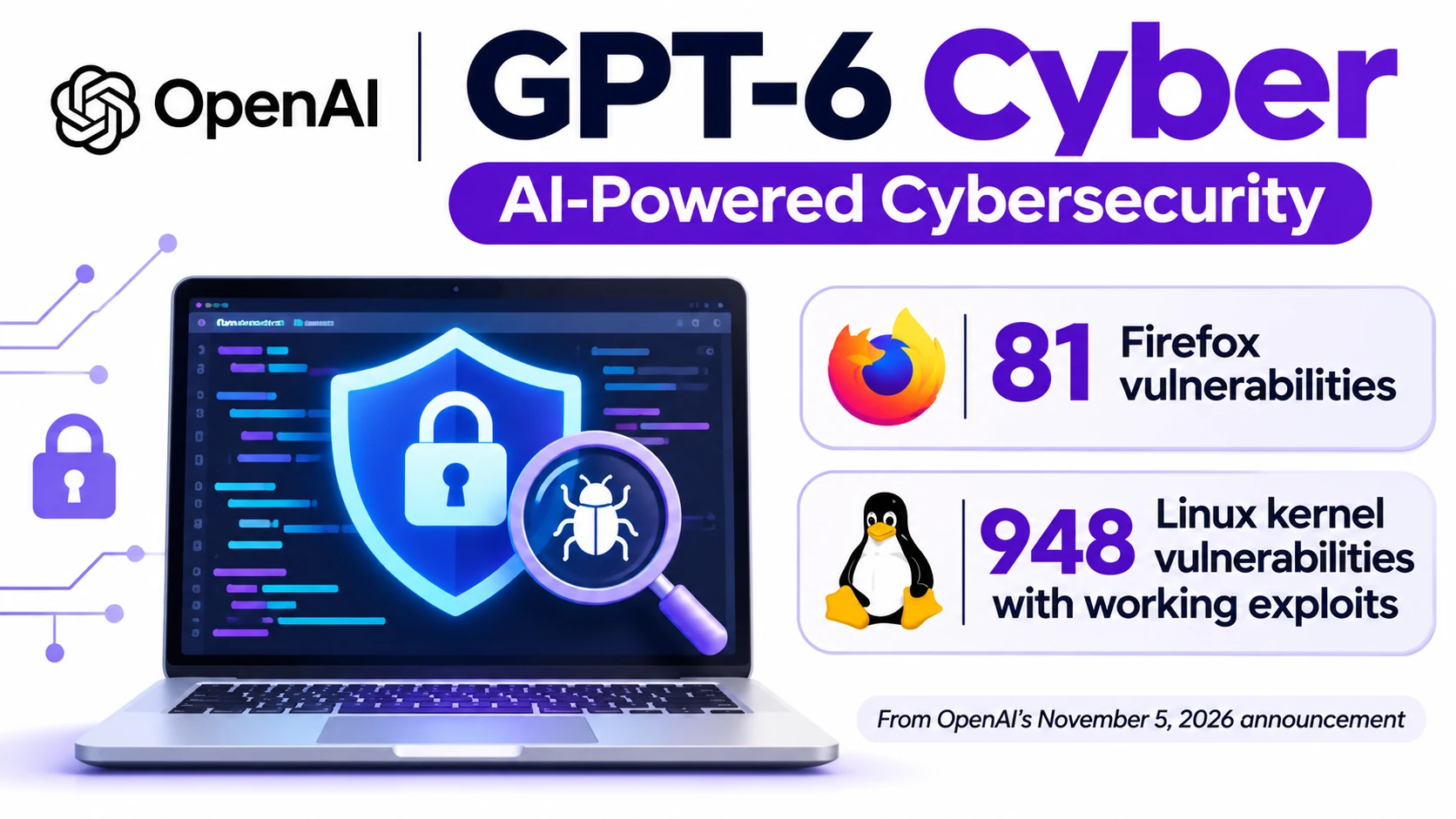
Announced on November 5, 2026, GPT-6 Cyber represents a significant advancement in AI-assisted cybersecurity. According to OpenAI, the model has already supported research identifying 81 previously unknown high-severity Firefox vulnerabilities and developing working exploits for 948 Linux kernel vulnerabilities.
For software developers, AI creators, and businesses building autonomous applications, GPT-6 Cyber highlights how AI could play a larger role in protecting modern software systems. OpenAI
What Is GPT-6 Cyber?
It is OpenAI’s specialized cybersecurity model, developed for advanced vulnerability research and authorized security testing.
Unlike general-purpose AI models that handle writing, coding, and everyday questions, GPT-6 Cyber focuses on understanding complex software systems and identifying potential security weaknesses.
Its capabilities include analyzing software vulnerabilities, validating whether weaknesses are exploitable, and helping researchers prepare candidate patches.
The model is also trained to operate within the boundaries established by authorized researchers.
This distinction is important because cybersecurity research often involves powerful techniques that must be used responsibly.
GPT-6 Cyber is not simply another AI coding assistant. It is a specialized research tool intended to strengthen software defenses through controlled security testing.
Key Features of GPT-6 Cyber
1. Advanced Vulnerability Detection
One of the most important GPT-6 Cyber capabilities is identifying security vulnerabilities in complicated software projects.
Modern applications can contain millions of lines of code, making manual security reviews time-consuming.
It can help researchers investigate potential weaknesses and prioritize findings requiring attention.
This could be particularly valuable for organizations maintaining large applications, cloud services, and open-source software.
2. Vulnerability Validation
Finding suspicious code does not necessarily mean a genuine security vulnerability exists.
Security researchers must determine whether a weakness can actually be exploited.
GPT-6 Cyber supports this validation process by helping researchers reproduce vulnerabilities and evaluate their potential impact in authorized environments.
This can help teams distinguish serious security problems from less significant findings.
3. AI-Assisted Patch Development
Identifying vulnerabilities is only part of the security process.
Developers must also correct the underlying problems without introducing new bugs.
OpenAI reports that GPT-6 Cyber helped generate candidate patches during its security research.
However, these patches still require appropriate testing and human review before deployment.
4. Improved Security Boundaries
OpenAI has emphasized the importance of keeping GPT-6 Cyber within authorized testing limits.
In one alignment evaluation, the model avoided exploiting out-of-scope services in 99.93% of tests without deployment safety instructions and 100% with those instructions.
These results demonstrate improved performance in that evaluation, although they do not guarantee perfect behavior in every real-world situation. OpenAI
GPT-6 Cyber Benchmark Results: How Powerful Is It?
OpenAI published several performance results comparing GPT-6 Cyber with its earlier cybersecurity model.
On ExploitGym, a benchmark evaluating whether models can exploit specified vulnerabilities, GPT-6 Cyber achieved a score of 48.5%.
Its predecessor, GPT-5.6 Cyber, scored 32.1%.
That represents a 51% relative improvement.
| Cybersecurity benchmark | GPT-5.6 Cyber | GPT-6 Cyber |
|---|---|---|
| ExploitGym | 32.1% | 48.5% |
| Avoiding out-of-scope services without deployment safety prompts | 94.49% | 99.93% |
These results suggest meaningful progress in both technical cybersecurity capabilities and compliance with testing boundaries.
Nevertheless, benchmark performance should not be interpreted as a guarantee that GPT-6 Cyber can detect every vulnerability or secure every application. OpenAI
GPT-6 Cyber Finds 81 Firefox Vulnerabilities
One of the most notable achievements involves Mozilla Firefox.
According to OpenAI, its researchers used the model to identify 81 previously unknown vulnerabilities classified by Mozilla as high severity.
The research also produced reproducible evidence and proposed patches to help engineers investigate and correct the problems.
Mozilla subsequently began releasing fixes for many of the reported vulnerabilities.
This achievement is significant because Firefox is a widely used browser with an established security review process.
Finding previously unknown weaknesses in such a mature software project demonstrates the potential value of AI-assisted vulnerability research.
Importantly, these findings came from a coordinated security research effort, not an unrestricted public vulnerability-scanning service. OpenAI
GPT-6 Cyber and the Linux Kernel: 948 Exploits
GPT-6 Cyber also supported a large-scale Linux kernel security investigation.
In a controlled research environment, OpenAI’s automated pipeline identified 2,308 candidate findings and reproduced 1,724 vulnerabilities.
The research produced working local privilege-escalation exploits for 948 distinct vulnerabilities.
A local privilege-escalation vulnerability can potentially allow a user with limited permissions to obtain higher-level access.
OpenAI also developed candidate patches and began reporting important findings to maintainers.
The project demonstrates how AI could assist security teams with vulnerability discovery, validation, and remediation at a scale that would otherwise demand substantial manual effort.
However, the research was resource-intensive, with OpenAI reporting approximately $1.2 million in API costs for the overall run. OpenAI
How GPT-6 Cyber Could Help Developers and AI Creators
For MiviCAI readers building websites, applications, and AI automation systems, GPT-6 Cyber highlights several important opportunities.
Safer AI-generated applications: Advanced security analysis could help developers identify weaknesses in AI-assisted coding projects before deployment.
Better protection for AI agents: Developers building autonomous workflows must carefully manage permissions, credentials, and access to sensitive information.
Improved security reviews: AI-assisted analysis could help security teams investigate complex codebases and prioritize vulnerabilities.
Stronger open-source software: Research like the Firefox and Linux investigations could support maintainers responsible for widely used software.
These are potential benefits of the technology, not a promise that GPT-6 Cyber is available to every individual developer.
GPT-6 Cyber Availability: Can You Use It?
It is not currently a generally available ChatGPT feature.
OpenAI is initially providing access through its API and Codex to selected, approved customers participating in its Daybreak Red security program.
The company intends to expand access to trusted defenders, including security organizations, independent researchers, and open-source maintainers.
Access remains subject to eligibility, authorization, and safety requirements.
Therefore, freelancers and developers should not assume that a standard ChatGPT subscription automatically includes GPT-6 Cyber. OpenAI
Is GPT-6 Cyber Safe?
Advanced cybersecurity models have both defensive benefits and potential misuse risks.
OpenAI says GPT-6 Cyber includes safeguards intended to support authorized research while restricting high-risk activity.
These measures include monitoring for misuse, access controls, and recommendations for sandboxing and human oversight.
For developers, the practical lesson remains unchanged: AI-generated security findings should be independently validated, and proposed fixes should be tested before deployment.
Final Thoughts
GPT-6 Cyber represents an important step toward AI-powered cybersecurity.
Its reported results, including 81 previously unknown Firefox vulnerabilities, 948 Linux kernel vulnerabilities with working exploits, and improved benchmark performance, demonstrate the growing capabilities of specialized security models.
For developers and creators, the announcement offers a glimpse of how future AI tools could help protect applications and automated workflows.
However, GPT-6 Cyber remains a restricted-access research tool rather than a universal security solution.
As AI-generated software becomes more common, combining advanced security technology with careful development practices and human oversight will become increasingly important.
Follow MiviCAI for more AI news, practical tutorials, and updates on emerging AI tools.