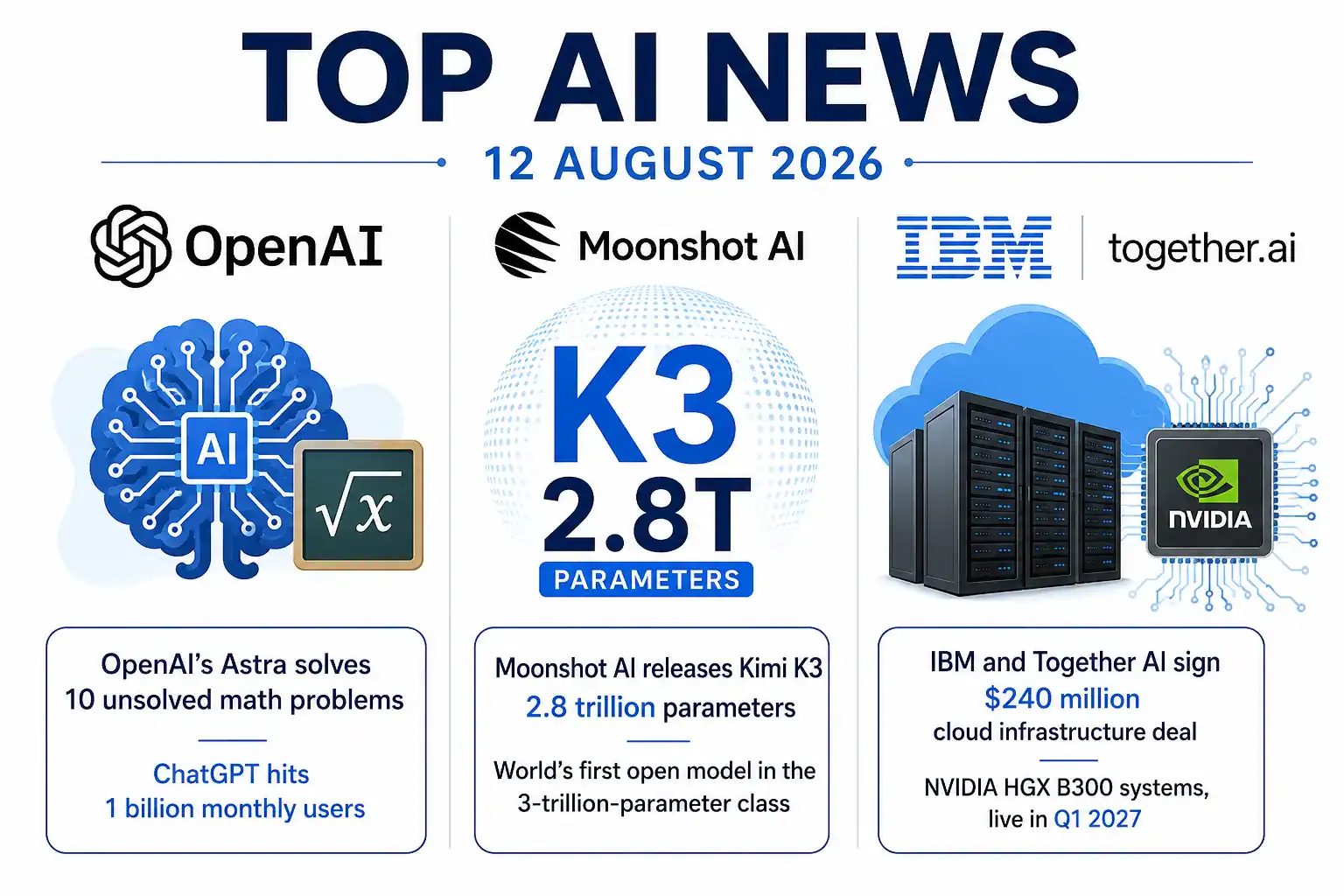
The latest AI developments highlight a major shift in artificial intelligence—from solving difficult research problems to building massive infrastructure for open AI models.
Artificial intelligence is continuing to evolve at an extraordinary pace. This week, developments from OpenAI Astra, China’s Moonshot AI, IBM and Together AI have highlighted three important trends shaping the industry: AI systems are becoming capable of contributing to advanced scientific research, open AI models are reaching unprecedented scales, and demand for computing infrastructure is growing rapidly.
Here are three of the most significant AI developments to know right now.
1. OpenAI Astra Makes Progress on 10 Long-Standing Math Problems
One of the most striking recent developments comes from OpenAI, which has reported new results from an internal version of its unreleased Astra model.
According to OpenAI, the system produced new results on 10 long-standing problems in mathematics and theoretical computer science. The company says the work includes machine-checkable proofs and advances in areas such as geometry, combinatorics, group theory and theoretical computer science.
What makes the development particularly interesting is not simply the number of problems addressed, but the possibility that AI systems could increasingly contribute to genuine mathematical research rather than merely solving textbook-style problems.
OpenAI reported that the successful runs involved approximately $2,000 in API-token costs. That figure should be viewed as the computational cost associated with the reported AI runs rather than as a direct measure of the total human or research effort required to formulate, verify and understand the results.
The results also point toward a broader change in how AI could be used in science. Instead of acting solely as an assistant that summarizes existing knowledge, increasingly capable models may help researchers explore new hypotheses, construct mathematical arguments and discover potentially useful approaches to difficult problems.
OpenAI has made details of the mathematical work available for further examination, making this an especially interesting development for researchers and AI enthusiasts.
Read the original research: OpenAI: Ten advances in mathematics and theoretical computer science
ChatGPT also crosses the 1-billion monthly-user milestone
OpenAI’s consumer AI platform has also reached an extraordinary scale.
Data from market-intelligence company Sensor Tower indicates that ChatGPT surpassed 1 billion monthly active users on mobile in May 2026, making it the fastest app to reach that milestone, according to reports citing the data.
The milestone demonstrates how quickly generative AI has moved from an emerging technology into a mainstream consumer product. ChatGPT is now being used for activities ranging from education and coding to research, writing, productivity and everyday information requests.
It also illustrates the enormous scale of the market that AI companies are now competing for.
2. China’s AI Push Continues With Moonshot AI’s Kimi K3
China’s artificial intelligence ecosystem is producing increasingly large and capable models, and Moonshot AI’s Kimi K3 is one of the latest examples.
Kimi K3 is reported to have 2.8 trillion total parameters, putting it in the three-trillion-parameter class and making it one of the largest openly available AI models by parameter count.
However, the headline parameter figure requires some explanation.
Kimi K3 uses a Mixture-of-Experts (MoE) architecture. In an MoE model, not every parameter needs to be activated for every token processed. This allows a model to have an extremely large overall parameter count while using a smaller portion of its capacity for an individual operation.
Reports about Kimi K3 indicate that approximately 104 billion parameters are activated during inference, despite the model having 2.8 trillion total parameters.
That distinction is important when comparing Kimi K3 with other AI systems. A larger total parameter count does not automatically mean that a model will be faster, cheaper or more capable than another model.
Why Kimi K3 matters
The significance of Kimi K3 goes beyond its size.
The rapid development of models from Chinese AI companies demonstrates that the global AI race is no longer dominated by a small number of American technology companies. Companies in China are investing heavily in model architecture, AI infrastructure, coding capabilities, reasoning and open-weight releases.
For developers and businesses, the growth of open AI models could also increase the number of alternatives available for deploying AI applications.
Instead of relying exclusively on proprietary APIs, organizations may increasingly have the option of deploying or customizing open models depending on their technical requirements, security policies and infrastructure budgets.
That could make the AI market more competitive while giving developers greater flexibility.
Read more about Kimi K3: Kimi K3 model overview on Hugging Face
3. IBM and Together AI Sign $240 Million AI Infrastructure Agreement
The third major development focuses on something that is becoming increasingly important as AI models grow more capable: computing infrastructure.
IBM and AI infrastructure company Together AI have signed a multi-year agreement valued at approximately $240 million to develop a large-scale AI inference cluster on IBM Cloud. The system will use NVIDIA HGX B300 infrastructure and is expected to become available in the first quarter of 2027.
The project is designed to support large-scale inference workloads involving open AI models.
Inference refers to the process of using a trained AI model to generate an output—for example, answering a question, writing code, analyzing information or producing another type of AI-generated response.
As AI adoption increases, inference is becoming a major infrastructure challenge. Training a frontier model can require enormous computing resources, but running that model for millions of users can also create substantial demand for GPUs and networking infrastructure.
Why the IBM-Together AI deal matters
Together AI focuses on infrastructure and services for running open AI models, while IBM provides cloud infrastructure aimed at enterprise customers.
The partnership therefore reflects an important direction in the AI industry: businesses increasingly want access to powerful AI models without necessarily relying exclusively on proprietary, closed AI platforms.
The planned cluster will use NVIDIA’s HGX B300 systems and is intended to provide the computing capacity required for production-scale AI inference.
For enterprises, this could provide another route for deploying AI applications at scale while maintaining greater control over the models and infrastructure they use.
The deal also highlights the growing importance of AI infrastructure companies. As models become larger and AI applications become more widely adopted, access to GPUs, networking and cloud computing capacity is becoming a strategic part of the AI industry.
Read the official announcement: IBM Newsroom: IBM and Together AI Sign Multi-Year Agreement
Read the Reuters report: Reuters: IBM and Together AI ink $240 million AI infrastructure deal
What These Three AI Developments Tell Us
Although the three stories involve very different companies and technologies, they reveal a common direction for the AI industry.
AI is moving beyond simple chatbots
OpenAI’s reported mathematical results suggest that advanced AI systems could increasingly participate in scientific and technical discovery.
The importance of this development is not that AI has suddenly replaced mathematicians. Rather, it demonstrates the possibility of AI becoming a more useful research tool for exploring difficult problems and generating ideas that humans can subsequently verify and develop.
Open models are becoming increasingly important
Kimi K3 demonstrates how quickly open AI models are increasing in scale and sophistication.
The growing availability of powerful open-weight models could give developers and enterprises more choices. It may also put additional pressure on companies offering proprietary AI systems to compete on performance, price and flexibility.
AI infrastructure is becoming a strategic industry
The IBM-Together AI agreement illustrates another major trend: powerful AI requires enormous computing infrastructure.
As AI applications move into mainstream business use, companies will need infrastructure capable of handling large numbers of inference requests efficiently. This is likely to drive continued investment in GPUs, networking, cloud platforms and specialized AI data centers.
The Bigger Picture
The AI industry is entering a phase where progress is no longer measured only by how well a chatbot answers questions.
Three different forms of progress are happening simultaneously.
First, AI models are becoming capable of tackling increasingly difficult research and reasoning problems.
Second, open AI models are becoming larger and more competitive, giving developers alternatives to proprietary systems.
Third, the infrastructure required to operate these models at scale is becoming a major business opportunity in its own right.
Together, these developments suggest that the next stage of the AI race will involve much more than competing chatbot products. Model architecture, scientific reasoning, open-weight ecosystems, computing infrastructure and enterprise deployment will all play important roles.
For consumers, developers and businesses, that means the AI landscape is likely to become more competitive—and considerably more interesting—over the coming years.
Final Takeaway
OpenAI‘s Astra research, Moonshot AI’s Kimi K3 and the IBM-Together AI infrastructure agreement represent three different sides of the rapidly evolving AI industry.
Astra points toward AI-assisted scientific discovery. Kimi K3 demonstrates the growing scale of open AI models. And IBM’s agreement with Together AI shows how much infrastructure will be required to put these models into production.
The biggest story may therefore not be any single AI model. It is the speed at which the entire ecosystem—from research and model development to infrastructure and enterprise deployment—is expanding.
This article was independently written for editorial and informational purposes. Facts and developments are attributed to the respective companies, researchers and reporting organizations. The article does not reproduce substantial portions of the source material.