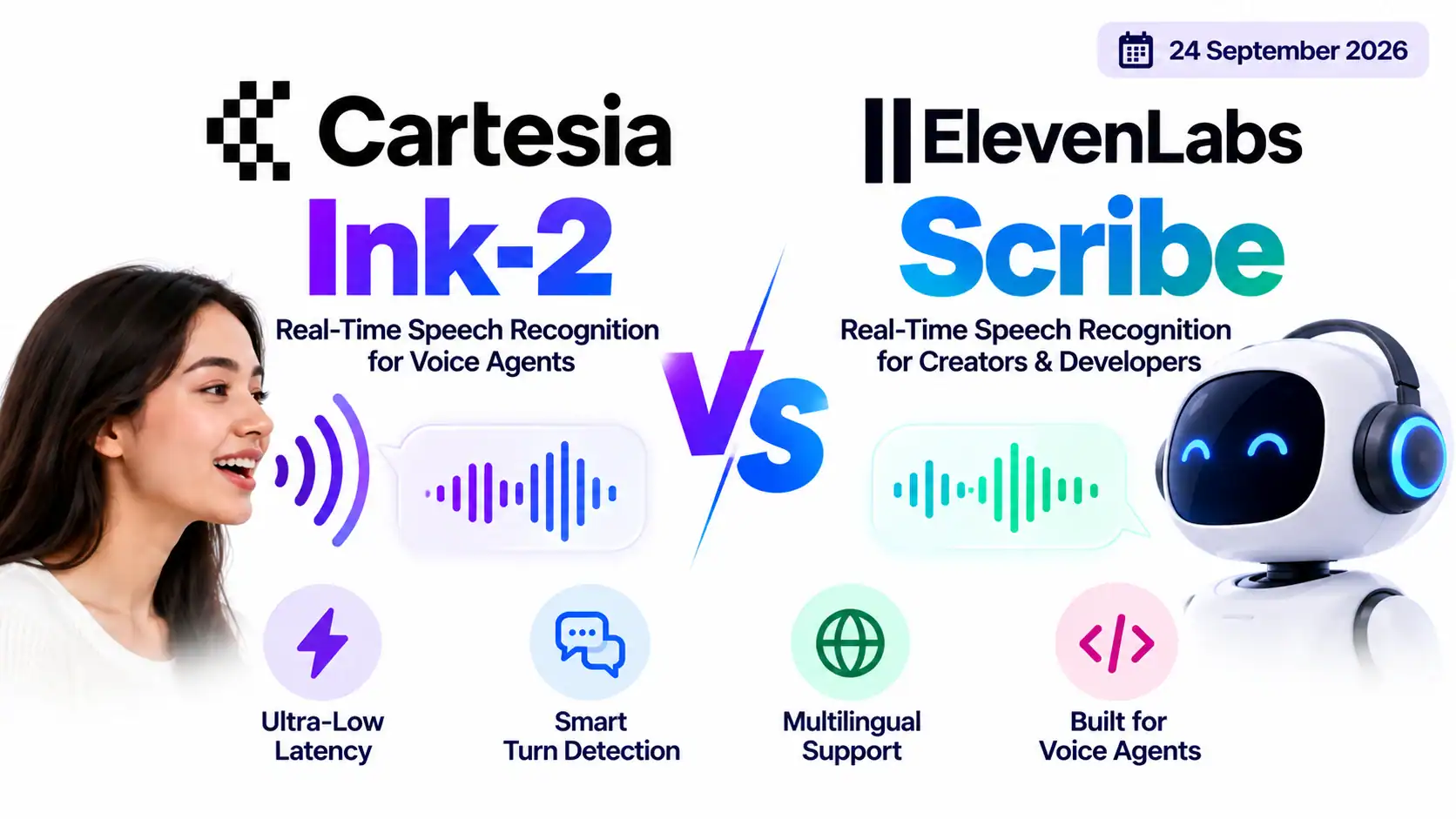
Real-time voice AI is becoming an important part of modern applications, from AI customer-service agents and virtual receptionists to educational assistants, interactive characters and creator tools. But building a natural voice conversation requires more than simply converting speech into text.
An AI system must understand when a person has finished speaking. If it responds too early, it can interrupt the user. If it waits too long, the conversation can feel slow and unnatural.
This is where Cartesia Ink-2 enters the picture.
Cartesia introduced Ink-2, a streaming speech-to-text model specifically designed for real-time voice agents. Its key feature is built-in turn detection, allowing the system to determine whether a user has completed a conversational thought rather than relying only on silence. Cartesia subsequently added configurable turn detection and keyterm prompting to Ink-2.
At the same time, ElevenLabs Scribe v2 Realtime provides another developer-focused option for live speech recognition. ElevenLabs says Scribe v2 Realtime is designed for agents and real-time applications and can process live speech in under 150 milliseconds.
So how do Cartesia Ink-2 and ElevenLabs Scribe compare?
Rather than treating one as universally better, this comparison looks at their documented capabilities, pricing structures and potential applications.
What Is Cartesia Ink-2?
Cartesia Ink-2 is a streaming speech-to-text model built for conversational voice applications.
Traditional speech-to-text systems primarily focus on accurately transcribing spoken words. A real-time voice agent has a more complicated requirement: it must understand the timing of a conversation.
For example:
“Can you schedule a meeting for tomorrow at…”
A user may pause before saying:
“…3 PM.”
A system that relies heavily on silence detection might assume the speaker has finished. Cartesia Ink-2 is designed to use conversational information to determine whether the speaker has actually completed the turn.
Cartesia describes Ink-2 as an STT model built specifically for voice agents and highlights its built-in turn detection.
What Is ElevenLabs Scribe?
ElevenLabs has expanded beyond its well-known text-to-speech and voice-generation products with its Scribe speech-to-text technology.
Scribe v2 Realtime is the company’s streaming speech recognition model for live applications. ElevenLabs says it supports 90+ languages and is designed for agents, meetings and other applications requiring immediate speech recognition.
The platform can also be used through APIs and SDKs, allowing developers to integrate speech recognition into their own applications.
This gives developers an alternative architecture for applications where live transcription is a central component.
Cartesia Ink-2 vs ElevenLabs Scribe: Key Differences
Here is a factual comparison based on the companies’ currently published information.
| Feature | Cartesia Ink-2 | ElevenLabs Scribe v2 Realtime |
|---|---|---|
| Primary purpose | Real-time speech recognition for voice agents | Real-time speech recognition and transcription |
| Streaming | Yes | Yes |
| Turn detection | Built into the model | Designed for real-time transcription; broader agent integration available |
| Semantic endpointing | Key feature | ElevenLabs focuses on streaming transcription and low latency |
| Languages | Multilingual capabilities | 90+ languages |
| API access | Yes | Yes |
| SDK/developer integration | Yes | Yes |
| Keyterm prompting | Yes | — |
| Voice-agent ecosystem | Cartesia Voice Agents / Managed Agents | ElevenLabs Agents |
| Current free option | Yes | Yes |
| Entry-level paid plan | Pro | Starter |
| Published pricing | From $5/month for Pro | From $6/month for Starter |
| Speech-to-text usage | Credits/hours | Credits/minutes |
| Best suited to | Developers prioritizing conversational turn handling | Developers needing broad speech-to-text and ElevenLabs ecosystem integration |
The table describes documented product characteristics; it does not establish an overall winner.
Why Turn Detection Matters
One of the biggest technical challenges in voice AI is endpointing.
Imagine asking an AI assistant:
“What is the weather going to be like tomorrow in…”
Then you pause for a moment.
If the AI assumes that you have finished, it might respond before you say:
“…New York?”
That creates a frustrating experience.
Cartesia Ink-2 approaches this problem by integrating turn detection directly into the speech-recognition model. Cartesia also introduced configurable turn detection controls, allowing developers to tune endpointing for speed or accuracy.
This can reduce the need for developers to construct a separate endpointing layer around the speech-recognition model.
For applications involving natural conversations, this can be particularly relevant.
Cartesia Ink-2 for Creators
Although Cartesia Ink-2 is primarily a developer tool, content creators can benefit from applications built using the technology.
AI Video Assistants
A creator could develop an AI assistant that listens to spoken instructions and launches content-production workflows.
For example:
Creator:
“Create a short video about today’s AI news.”
The voice agent could transcribe the request, send it to an LLM and initiate the appropriate workflow.
Interactive Educational Content
Creators producing online courses could develop voice-enabled tutors that allow students to ask questions naturally.
AI Receptionists
A website owner could create an AI receptionist capable of answering questions, collecting information and routing requests.
Interactive Characters
Game developers and video creators could combine speech recognition with an LLM and text-to-speech engine to create characters that respond to spoken dialogue.
ElevenLabs Scribe for Creators
ElevenLabs Scribe has a broader content-creation angle because ElevenLabs already provides a large ecosystem around speech, voice generation and audio production.
According to ElevenLabs, Scribe can be used for:
- Video transcription
- Captions and subtitles
- Podcasts
- Meetings
- Interviews
- Accessibility
- Voice applications
- AI agents
Scribe v2 Realtime extends that capability into live applications. ElevenLabs says its realtime model provides live transcription in under 150 milliseconds and supports more than 90 languages.
For creators already using ElevenLabs for voice generation, adding Scribe can therefore create a workflow in which speech recognition and speech synthesis are handled within the same broader ecosystem.
Cartesia Ink-2 Pricing and Plans
Cartesia’s current pricing page lists Ink-2 under its Speech to Text offering.
The published plans include:
| Plan | Price | Approx. Ink-2 Usage |
|---|---|---|
| Free | $0/month | ~1 hour 51 minutes |
| Pro | $5/month | ~9 hours 16 minutes |
| Startup | $49/month | ~115 hours 44 minutes |
| Scale | $299/month | ~740 hours 44 minutes |
| Enterprise | Custom | Custom |
Cartesia also lists concurrent-request limits of 8, 12, 20 and 60 for the Free, Pro, Startup and Scale plans respectively.
The same platform includes Cartesia’s Sonic text-to-speech technology and voice-agent products, depending on the subscription level.
Creators and developers should check the current pricing before subscribing because usage limits and prices can change.
ElevenLabs Scribe Pricing and Plans
ElevenLabs currently provides Scribe access through its broader subscription structure.
Its published pricing page lists:
| Plan | Monthly Price | Included Credits |
|---|---|---|
| Free | $0/month | 10,000 credits |
| Starter | $6/month | 30,000 credits |
| Creator | $22/month* | 121,000 credits |
| Pro | $99/month | 600,000 credits |
*ElevenLabs currently displays a promotional first-month price of $11 for Creator on its pricing page.
For Scribe, ElevenLabs currently lists an API price of $0.22 for an additional hour of transcription. The company also lists up to 99 languages, realtime transcription, speaker labels and word-level timestamps among its speech-to-text capabilities.
Because ElevenLabs plans include many other voice and audio capabilities, the total value of a subscription depends on how much of the broader platform a creator uses.
Cartesia Ink-2 vs ElevenLabs Scribe: Which Workflow Fits?
The practical choice depends heavily on the application architecture.
For conversational voice agents
Cartesia Ink-2 is particularly relevant when conversational endpointing is a central requirement. Its built-in turn detection is explicitly designed around the problem of determining when a user has completed a conversational turn.
For multilingual transcription
ElevenLabs Scribe v2 Realtime currently advertises support for more than 90 languages, making it relevant for developers creating multilingual applications.
For Cartesia’s voice stack
Developers interested in combining speech recognition with Cartesia’s Sonic text-to-speech and voice-agent products can build within Cartesia’s broader platform. Cartesia describes its platform as providing APIs for speech generation, transcription and production voice agents.
For the ElevenLabs ecosystem
Creators already using ElevenLabs for voice generation, voice cloning, audio production or Agents may find Scribe particularly relevant because speech recognition is integrated into the company’s broader developer ecosystem.
How to Build a Voice Agent With Cartesia Ink-2
The basic workflow can be implemented in several steps.
Step 1: Create a Cartesia Account
Start with the Free plan and create an API key.
Step 2: Connect Your Microphone or Audio Stream
Your application sends live audio to the Cartesia speech-to-text service.
Step 3: Use Ink-2 for Transcription
Configure the application to process the incoming audio using Ink-2.
Step 4: Configure Turn Detection
Tune the turn-detection behavior according to whether your application prioritizes faster responses or greater tolerance for pauses. Cartesia provides configurable turn detection for this purpose.
Step 5: Send the Transcript to an LLM
Once the conversational turn is complete, send the recognized text to an LLM.
Step 6: Generate the AI Response
The LLM processes the request and generates the response.
Step 7: Convert Text to Speech
Use a TTS system such as Cartesia Sonic to generate the spoken response.
Step 8: Stream the Audio
Return the generated audio to the user and continue listening for the next conversational turn.
The overall architecture becomes:
🎙️ User → Ink-2 → LLM → TTS → 🔊 AI Response
How ElevenLabs Scribe Can Be Used in a Similar Workflow
The process with ElevenLabs follows a similar architecture:
🎙️ User → Scribe v2 Realtime → LLM → ElevenLabs Voice → 🔊 Response
Developers can integrate Scribe v2 Realtime through the ElevenLabs API or SDKs. ElevenLabs specifically positions Scribe v2 Realtime for agents and real-time applications.
For creators, this could be used for:
- Voice-controlled applications
- AI customer-service agents
- Live transcription
- Interactive educational tools
- Video captioning
- Podcast transcription
- Voice-based content workflows
Cartesia Ink-2 vs ElevenLabs Scribe: What Creators Should Know
Both technologies address the growing demand for real-time speech recognition, but they emphasize somewhat different aspects of the voice-AI workflow.
Cartesia Ink-2 places particular emphasis on conversational turn detection and real-time voice-agent infrastructure. Cartesia also offers a broader stack covering speech recognition, text-to-speech and managed voice agents.
ElevenLabs Scribe v2 Realtime emphasizes fast live transcription, broad language support and integration with ElevenLabs’ wider speech and agent ecosystem.
Neither approach automatically makes one product suitable for every application. Developers should test the models using their own audio, languages, accents, background noise, response patterns and latency requirements.
Final Verdict: Cartesia Ink-2 vs ElevenLabs Scribe
The Cartesia Ink-2 vs ElevenLabs Scribe comparison shows how quickly real-time voice AI is evolving.
Cartesia Ink-2 focuses heavily on the conversational side of speech recognition, particularly native turn detection and configurable endpointing. Cartesia’s current platform also combines Ink-2 with Sonic and its voice-agent infrastructure.
ElevenLabs Scribe v2 Realtime provides fast streaming transcription, support for 90+ languages and API/SDK access, while fitting into ElevenLabs’ broader ecosystem of voice and AI-agent tools.
For developers, the important question is therefore not simply which model has the biggest feature list. Instead, evaluate turn detection, latency, transcription accuracy, language requirements, pricing, concurrency and integration requirements against your particular application.
For creators building the next generation of AI-powered voice experiences, both Cartesia Ink-2 and ElevenLabs Scribe demonstrate the same broader shift: speech recognition is becoming an active component of conversational AI rather than merely a tool for converting recordings into text.
Official resources: Cartesia Ink-2 · Cartesia Pricing · ElevenLabs Scribe
Frequently Asked Questions
Cartesia Ink-2 is a streaming speech-to-text model built specifically for real-time voice agents. Its standout feature is built-in turn detection, which helps the system work out whether a person has finished their thought instead of relying only on silence.
Scribe v2 Realtime is the streaming version of ElevenLabs’ speech-to-text technology. ElevenLabs says it can process live speech in under 150 milliseconds, supports 90+ languages, and is designed for agents, meetings and other real-time apps.
Turn detection is how a voice AI decides that you have finished speaking. If it guesses too early, it interrupts you. If it waits too long, the conversation feels slow. Ink-2 builds this into the speech model itself, and developers can tune it for faster replies or for more patience with pauses.
Neither is a universal winner. Cartesia Ink-2 is a strong fit when natural conversation flow and smart endpointing matter most. ElevenLabs Scribe v2 Realtime is a strong fit when you want fast live transcription, wide language support, or you already use ElevenLabs. Test both with your own audio before you decide.
ElevenLabs advertises support for 90+ languages for Scribe v2 Realtime. Cartesia describes Ink-2 as multilingual. If you need a specific language, check each company’s current documentation first.
Yes, both do. Cartesia’s Free plan includes roughly 1 hour 51 minutes of Ink-2 usage. ElevenLabs’ Free plan includes 10,000 credits per month.
Cartesia’s Pro plan starts at $5 per month, with roughly 9 hours 16 minutes of Ink-2 usage. ElevenLabs’ Starter plan starts at $6 per month with 30,000 credits. ElevenLabs also lists an API price of $0.22 per additional hour of Scribe transcription. Prices and limits change, so check both pricing pages before subscribing.
Both are accessed through APIs and SDKs, so they are mainly developer tools. Creators can still benefit from what gets built with them, such as AI video assistants, voice-enabled tutors, AI receptionists and interactive characters. ElevenLabs also has a broader creator angle, including captions, subtitles, podcasts and video transcription.
Yes. A voice agent needs speech-to-text to hear the user, an LLM to write the answer, and text-to-speech to speak it. Cartesia offers Sonic for text-to-speech, and ElevenLabs offers its own voice tools, so you can keep everything in one ecosystem if you prefer.
Start on each free plan and try your own recordings, including your accents, languages and background noise. Compare turn handling, speed, accuracy, pricing, concurrency limits and how easily each tool fits into your setup.