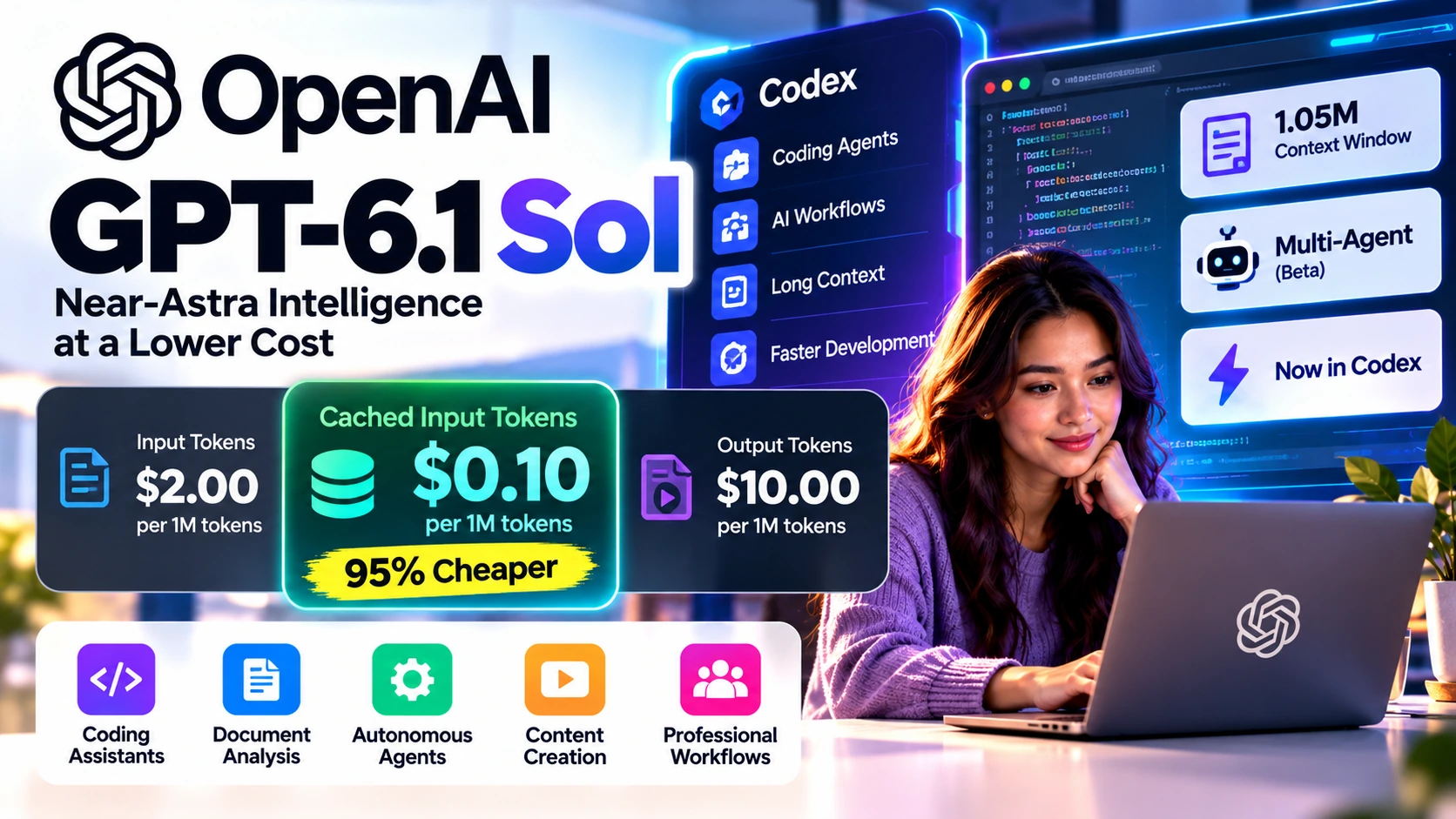
OpenAI has introduced GPT-6.1 Sol, a major upgrade to GPT-6 Sol aimed at developers, professional users and teams building complex AI workflows. The headline attraction is not only improved intelligence—it is the aggressive GPT-6.1 Sol pricing, particularly for applications that repeatedly reuse large amounts of context.
The new model costs $2 per million standard input tokens, $0.10 per million cached input tokens, and $10 per million output tokens under standard API pricing for prompts up to 272,000 input tokens. OpenAI says this gives GPT-6.1 Sol near-Astra intelligence at one-fifth of Astra’s standard input and output prices. OpenAI
For developers building coding agents, research systems and long-running AI applications, the most interesting number may be $0.10 per million cached tokens.
That’s where the economics of repeated, context-heavy AI workflows start becoming particularly interesting.
What Is GPT-6.1 Sol?
GPT-6.1 Sol is OpenAI’s newer Sol-class reasoning model for complex professional work. OpenAI positions it between the highly economical GPT-6 Luna and its most capable GPT-6 Astra model.
According to OpenAI, GPT-6.1 Sol improves over GPT-6 Sol in areas including agentic coding, computer use and professional work. OpenAI describes its overall positioning as “near-Astra” performance at substantially lower cost. OpenAI
The model has a huge 1.05-million-token context window and supports up to 128,000 output tokens. Its knowledge cutoff is April 30, 2026. It also supports image input, structured outputs, streaming and function calling. OpenAI Developers
For developers, the API model name is:
gpt-6.1-sol
OpenAI recommends the Responses API when tool calling is required. Reasoning effort can be configured across low, medium, high, xhigh and max levels. OpenAI Developers
GPT-6.1 Sol Pricing in USD
The biggest story surrounding the release is GPT-6.1 Sol pricing.
For standard API usage, OpenAI currently lists:
| Token type | GPT-6.1 Sol | GPT-6 Sol | GPT-6 Astra |
|---|---|---|---|
| Input / 1M tokens | $2.00 | $2.00 | $10.00 |
| Cached input / 1M | $0.10 | $0.20 | $1.00 |
| Cache write / 1M | $2.50 | $2.50 | $12.50 |
| Output / 1M | $10.00 | $10.00 | $50.00 |
These figures are OpenAI’s standard rates shown on the current GPT-6.1 Sol model page. OpenAI Developers
So, compared with GPT-6 Astra, GPT-6.1 Sol costs 80% less for standard input and output tokens and 90% less for cached input.
Compared with GPT-6 Sol, regular input and output pricing remains the same, but cached input drops from $0.20 to $0.10 per million tokens—a 50% reduction. OpenAI Developers
The often-mentioned 95% saving means something slightly different: cached GPT-6.1 Sol input costs 95% less than GPT-6.1 Sol’s own $2 standard input rate. OpenAI explicitly describes cached tokens as being priced at 5% of the model’s uncached input rate. OpenAI Developers
That distinction is worth making clear in an article.
Why $0.10 Cached Input Matters
Prompt caching can substantially reduce costs when an AI application repeatedly sends the same information.
Imagine an AI coding agent working on a large software project. Every new request might otherwise require resending documentation, coding conventions, repository context, instructions and other information.
With caching, eligible reusable prompt prefixes can be stored and reused by later requests.
OpenAI’s prompt-caching documentation explains that the system looks for matching cached prompt prefixes and charges subsequent reads at a reduced rate. For GPT-6.1 Sol, cached reads cost only 5% of the standard uncached input rate. OpenAI Developers
This makes GPT-6.1 Sol pricing particularly attractive for workloads where the same large context is reused many times.
Potential examples include coding agents, document-analysis systems, enterprise knowledge assistants, autonomous research workflows and other persistent agents.
GPT-6.1 Sol vs GPT-6 Astra
The more interesting comparison may be with GPT-6 Astra.
Astra remains OpenAI’s higher-end model for the most demanding work, but it carries significantly higher API costs.
Astra’s standard pricing is $10 input, $1 cached input and $50 output per million tokens. GPT-6.1 Sol costs $2, $0.10 and $10, respectively. OpenAI Developers
OpenAI describes GPT-6.1 Sol as providing near-Astra intelligence for complex work while costing one-fifth as much for standard input and output tokens. OpenAI
That does not mean Sol will equal Astra on every task. Developers should still benchmark both models against their actual workloads.
But for applications executing thousands or millions of requests, even relatively small differences in token prices can translate into substantial infrastructure savings.
GPT-6.1 Sol Comes to Codex
The model is also important for developers using OpenAI’s coding environment.
OpenAI released GPT-6.1 Sol for Codex, ChatGPT Work and the API on September 29. Its release notes specifically recommend considering the model for repeated, long-running work involving code, applications and documents. OpenAI
GPT-6.1 Sol also supports Multi-agent in beta through the Responses API, allowing the model to delegate work to subagents. OpenAI Developers
That combination is potentially important.
A sophisticated coding task might require one agent to investigate the repository, another to research documentation, another to implement changes and another to test the result.
Long-running multi-agent workflows can consume substantial context. Cheaper cached input can therefore become more valuable as agent systems grow more complex.
GPT-6.1 Sol Subscription Availability
API pricing and ChatGPT subscriptions should not be confused.
OpenAI says GPT-6.1 Sol is available to Plus, Pro, Business, Enterprise and Edu users through ChatGPT Work and Codex. At launch, OpenAI specifically stated that GPT-6.1 Sol was not yet available in regular Chat. Developers can separately access the model through the API. OpenAI
So there are effectively two ways creators and developers may encounter GPT-6.1 Sol: through eligible ChatGPT plans in Work/Codex, or through metered API usage.
The API itself is not an unlimited monthly subscription. Developers pay according to token usage and applicable processing options.
For anyone building a commercial application, the GPT-6.1 Sol pricing figures above are therefore more relevant than simply asking which ChatGPT subscription includes the model.
Long Context Can Cost More
There is another pricing detail developers should understand.
The headline GPT-6.1 Sol pricing applies to prompts with up to 272,000 input tokens.
For prompts exceeding 272K input tokens, OpenAI says the entire request is charged at 2× the input and cache rates and 1.5× the output rate. OpenAI Developers
That’s important because the model supports a context window exceeding one million tokens.
A huge context window doesn’t mean every million-token request will cost the headline $2-per-million input rate.
Developers building extremely large-context applications should calculate costs using the long-context rates rather than assuming the short-context headline price applies universally.
How GPT-6.1 Sol Can Help Creators
Although much of the launch focuses on developers, creators can also benefit.
A content creator increasingly works with more than a simple chatbot. AI may help research a topic, analyze source material, generate scripts, modify code, organize assets, automate a website and create publishing workflows.
For creators building such systems, GPT-6.1 Sol pricing makes more sophisticated automation potentially cheaper.
A YouTube creator, for example, could build a workflow resembling:
Topic → Research → Sources → Script → Fact checking → Scene planning → Metadata → Publishing preparation
A website publisher could use an agent to analyze existing articles, maintain style instructions, prepare drafts, generate structured metadata and work with a content-management pipeline.
Software creators could use GPT-6.1 Sol for repository analysis, debugging, code generation and longer-running coding tasks.
The key benefit isn’t simply cheaper chatbot conversations. It’s making persistent, context-heavy AI workflows more economical.
Step-by-Step: How Developers Can Use GPT-6.1 Sol
Getting started through the API is straightforward.
First, create or sign into your OpenAI developer account and configure API billing.
Next, select:
gpt-6.1-sol
For agentic applications requiring tools, OpenAI recommends using the Responses API. OpenAI Developers
Then structure prompts so reusable information remains stable. This is important because prompt caching works by finding matching reusable prefixes.
For example, you might place persistent system instructions, coding conventions, product documentation and stable project context earlier in the prompt, while putting frequently changing user requests later.
Once eligible context has been cached, subsequent matching requests can benefit from the much lower $0.10-per-million cached input rate.
Developers should then monitor actual token consumption, cache hits and output usage rather than optimizing solely around the advertised input price.
Finally, benchmark GPT-6.1 Sol against Astra and less expensive models such as Luna. The best model can differ according to workload.
Why GPT-6.1 Sol Pricing Could Matter for AI Agents
AI applications are increasingly shifting from single question-and-answer interactions toward longer-running agents.
Those agents may read documents, operate software, call tools, write code and delegate work to other agents.
Each step can require context.
That makes context reuse a significant part of AI economics.
At $0.10 per million cached input tokens, GPT-6.1 Sol makes repeatedly reused context much less expensive than standard input. OpenAI Developers
This could be particularly useful for autonomous coding systems, enterprise knowledge bases and AI workflows that keep large instructions or project context active across many requests.
Final Thoughts
GPT-6.1 Sol is notable because OpenAI is trying to combine high-end reasoning capability with substantially lower economics than its flagship Astra model.
The model offers a 1.05-million-token context window, 128K maximum output, configurable reasoning, tool use through the Responses API and beta multi-agent capabilities. Most importantly for repeated workloads, GPT-6.1 Sol pricing drops cached input to only $0.10 per million tokens. OpenAI Developers
For creators, developers and businesses, that could make sophisticated agentic workflows more practical—especially when the application repeatedly reuses the same project context.
The important takeaway is that the 95% reduction refers to cached input versus GPT-6.1 Sol’s standard input price. Compared with the previous GPT-6 Sol cached rate, the reduction is 50%.
That makes the story less sensational than simply saying OpenAI cut all token prices by 95%—but potentially more meaningful for developers whose applications are specifically designed to take advantage of prompt caching.
Frequently Asked Questions About GPT-6.1 Sol
GPT-6.1 Sol is OpenAI’s newer Sol-class reasoning model for complex professional work. It sits between the low-cost GPT-6 Luna and the most capable model, GPT-6 Astra. OpenAI says it improves on GPT-6 Sol in agentic coding, computer use and professional work.
For prompts up to 272,000 input tokens, standard API pricing is:
- Input: $2.00 per million tokens
- Cached input: $0.10 per million tokens
- Cache write: $2.50 per million tokens
- Output: $10.00 per million tokens
GPT-6.1 Sol costs 80% less than Astra for standard input and output tokens, and 90% less for cached input. OpenAI describes it as offering “near-Astra” intelligence at one-fifth of the price. It may not match Astra on every task, so it’s worth benchmarking both on your own workload.
Regular input and output prices are the same. The difference is cached input, which drops from $0.20 to $0.10 per million tokens, a 50% reduction.
It refers to cached input compared with GPT-6.1 Sol’s own standard input price. Cached tokens cost 5% of the $2 uncached rate, which is a 95% saving. It does not mean OpenAI cut all token prices by 95%. Against the previous GPT-6 Sol cached rate, the reduction is 50%.
Prompt caching lets the system reuse matching prompt prefixes, such as instructions, documentation or repository context, and charge a much lower rate for them on later requests. It’s most valuable for coding agents, document-analysis systems, enterprise knowledge assistants and other applications that keep resending the same large context.
Keep reusable information stable and put it at the start of your prompt, such as system instructions, coding conventions and product documentation. Put frequently changing content, like the user’s latest request, at the end. Then monitor your actual token use, cache hits and output costs rather than relying only on the advertised input price.
The context window is 1.05 million tokens, and the model can produce up to 128,000 output tokens. It also supports image input, structured outputs, streaming and function calling. Its knowledge cutoff is April 30, 2026.
No. The headline rates apply only to prompts up to 272,000 input tokens. Above that, the whole request is charged at 2× the input and cache rates and 1.5× the output rate. If you build very large-context applications, calculate costs with the long-context rates.
The model name is gpt-6.1-sol. OpenAI recommends the Responses API when your application needs tool calling. Reasoning effort can be set to low, medium, high, xhigh or max.
It’s available to Plus, Pro, Business, Enterprise and Edu users through ChatGPT Work and Codex. At launch it was not available in regular Chat. Developers can also use it through the API, which is billed by token usage rather than a flat monthly fee.
Yes. Multi-agent is in beta through the Responses API, so the model can delegate work to subagents. For example, one agent can investigate a repository while others research documentation, implement changes and test the result. Long-running multi-agent workflows use a lot of context, so cheaper cached input matters more as they grow.
Yes, though the launch focuses on developers. Creators building automated workflows, such as research, scripting, fact-checking, scene planning, metadata and publishing preparation for video, or article drafting and style maintenance for a website, may find these workflows more affordable to run.
It suits developers and teams running complex, context-heavy workflows, especially those that repeatedly reuse the same large context, such as coding agents, research systems and knowledge assistants. For simple, low-volume tasks, the cheaper GPT-6 Luna may be enough. For the most demanding work, Astra may still be worth testing.
Official resources: OpenAI GPT-6.1 Sol announcement · GPT-6.1 Sol model documentation · OpenAI prompt-caching guide · OpenAI API changelog