OpenAI’s Sora was once among the most talked-about artificial intelligence video-generation platforms. Its ability to transform written prompts into cinematic video clips attracted filmmakers, YouTube creators, digital marketers, and developers interested in automated video production.
However, the story has taken an unexpected turn.
The OpenAI Sora API shutdown marks the end of an important chapter in OpenAI’s generative video journey. According to OpenAI’s official discontinuation guidance, the Sora web and mobile experiences ended on April 26, 2026, while the Sora API was scheduled to shut down on September 24, 2026.
This development is particularly important for developers who previously integrated Sora into custom applications or planned to use it for automated content creation.
Although some recent reports have suggested that OpenAI opened the Sora API to additional developer tiers, the company’s published discontinuation guidance does not support a new public launch in October 2026.
Instead, the OpenAI Sora API shutdown raises a broader question: What happens when a major AI provider discontinues a service that creators and developers may have built their workflows around?
The answer highlights both the opportunities and the risks of AI-powered video production.
What Was the OpenAI Sora API?
The OpenAI Sora API was a developer interface designed to bring generative video capabilities into software applications.
Rather than requiring creators to generate each video through a website, developers could submit video-generation requests programmatically.
This made it possible to incorporate AI video generation into content dashboards, marketing platforms, creative applications, and automated production pipelines.
The API supported several important capabilities, including text-to-video generation, image-guided generation, asynchronous processing, and video remixing.
For example, a developer could build an application where users entered a video topic, received AI-generated scene descriptions, and then submitted those descriptions for video generation.
The generated clips could subsequently be downloaded and assembled into a longer production.
This made the technology attractive to creators seeking to reduce repetitive work.
However, the OpenAI Sora API shutdown means developers should no longer treat it as an available option for building new production applications.
Why Did OpenAI Discontinue Sora?
OpenAI has confirmed the discontinuation, but it is important to distinguish official statements from speculation.
The company’s published guidance provides shutdown dates and information about accessing existing content. It does not establish a single detailed technical or commercial explanation that should be presented as the definitive cause.
Therefore, claims that Sora was discontinued specifically because of operating costs, competition, infrastructure limitations, or weak demand should not be treated as confirmed facts without supporting evidence.
What can be said is that the OpenAI Sora API shutdown illustrates how quickly AI products and developer services can change.
Even a widely recognized platform may undergo major changes as companies revise their technology strategies.
For creators and developers, this makes long-term platform reliability an important consideration alongside model quality.
OpenAI Sora API Features: What Made It Interesting?
Before its discontinuation, Sora offered several capabilities relevant to automated video production.
1. Text-to-video generation
Creators could describe a scene using natural language.
For example:
A cinematic aerial shot of a futuristic city at sunset, featuring illuminated skyscrapers, flying vehicles, and smooth camera movement.
The model would use the description to generate a video clip.
This could help creators illustrate concepts that would otherwise require expensive filming or visual effects.
2. Image-to-video workflows
Reference images could help guide the appearance of generated videos.
For product marketers, this opened possibilities for animated promotional content.
For storytellers, reference images could provide visual direction for characters, environments, and scenes.
However, using reference images did not guarantee perfect character consistency across independently generated clips.
3. Video editing and remixing
Sora’s documented capabilities included video remixing, with later updates introducing additional editing and extension functionality.
These tools allowed creators to experiment with alternative versions and modify existing generations.
4. Programmatic automation
One of the most significant advantages was API integration.
Developers could connect Sora to other systems, allowing video generation to become one step in a larger automated workflow.
For businesses producing repeated advertisements or creators managing several channels, this approach offered the potential to reduce manual operations.
What Does the Shutdown Mean for Developers?
For software developers, the biggest issue is service dependency.
Imagine building a video-generation application that relies entirely on one provider.
If that provider discontinues its API, the application may lose a critical function.
Developers might then need to rewrite integration code, adjust generation parameters, redesign billing calculations, and test a replacement model.
The OpenAI Sora API shutdown demonstrates why flexible application architecture matters.
Instead of tightly connecting every component to a single AI service, developers can design independent modules for script generation, image creation, video generation, narration, and editing.
That makes it easier to replace one service without rebuilding the entire application.
How to Build an AI Video Workflow Without Sora
Creators who want to automate video production can still build a system using currently supported AI services.
A practical workflow might include the following stages.
Step 1 — Generate the script
Use an AI language model to create the narration, scene structure, and visual descriptions.
Step 2 — Prepare visual assets
Generate AI images, search licensed stock footage, or use a supported AI video-generation service.
Step 3 — Generate narration
Use a text-to-speech service or recorded voice narration.
Step 4 — Assemble the video
Combine visuals, narration, transitions, subtitles, and background music using editing software or FFmpeg.
Step 5 — Review and export
Check visual relevance, timing, factual accuracy, audio quality, and platform requirements before publishing.
This modular approach can work for both short-form social media videos and longer YouTube documentaries.
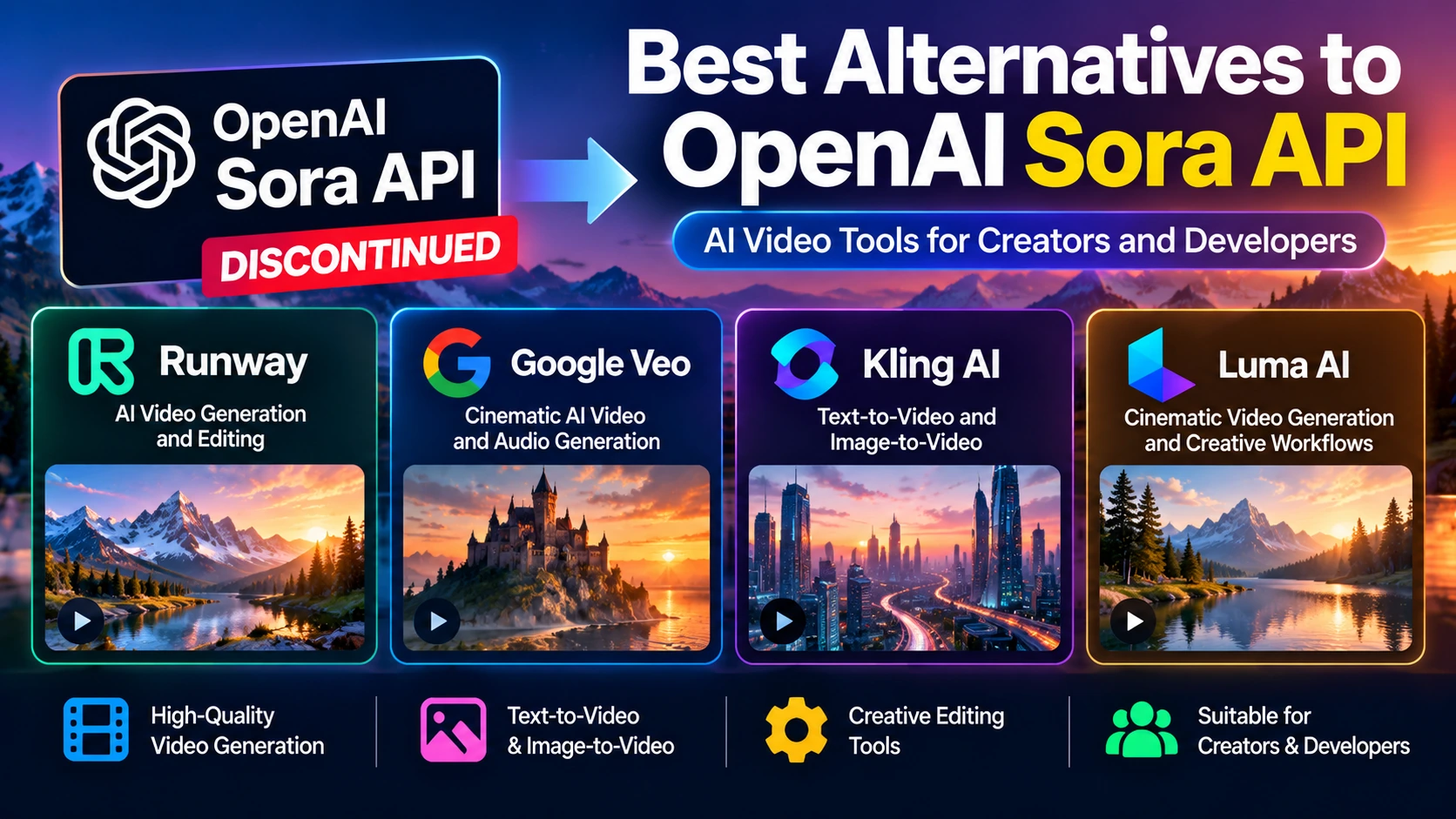
Alternatives to the OpenAI Sora API
The OpenAI Sora API shutdown may encourage developers to evaluate other AI video-generation platforms.
Some relevant services to investigate include:
| AI video platform | Potential use |
|---|---|
| Runway | AI video generation, editing, and creative workflows |
| Google Veo | Cinematic AI video and audio generation |
| Kling AI | Text-to-video and image-to-video generation |
| Luma AI | Cinematic video generation and AI-assisted creative workflows |
These are potential alternatives, not verified drop-in replacements. API availability, supported models, pricing, regional access, and commercial-use permissions should be checked before integration.
For creators producing long-form content on a limited budget, a hybrid approach may be more economical than generating every second of footage with AI video models.
Combining stock footage, AI-generated still images, motion effects, and selected AI-generated video clips can reduce costs while maintaining visual variety.
What Can AI Creators Learn From the Sora Shutdown?
The most important lesson is that powerful AI technology does not automatically guarantee long-term product availability.
Creators should evaluate several factors before committing to a platform: output quality, commercial-use rights, API stability, pricing transparency, integration options, and the ability to export completed work.
Keeping local copies of generated assets and maintaining independent project files can also help protect a production workflow.
The OpenAI Sora API shutdown serves as a reminder that successful AI content creation depends on more than choosing the most impressive model.
It also requires building a reliable production system.
Final Thoughts
The OpenAI Sora API shutdown is a significant development in the evolution of generative AI video.
Sora demonstrated how developers could integrate video generation into automated creative applications. Its text-to-video, image-guided generation, and editing capabilities offered valuable possibilities for filmmakers, marketers, and content creators.
However, OpenAI’s published discontinuation schedule means Sora should no longer be recommended as an active API for new video applications.
For creators, the future of AI video production remains broader than any single platform.
By combining supported AI models, stock footage, automated narration, and video-editing tools, developers can build flexible workflows that are less vulnerable to the discontinuation of an individual service.
The central takeaway is simple: Choose AI video tools not only for their capabilities today, but also for how easily your workflow can adapt tomorrow.
Official references
- OpenAI Sora Discontinuation FAQ
- OpenAI Sora 2 Announcement
- OpenAI Video API Documentation
- OpenAI Developer Documentation
Frequently Asked Questions About the OpenAI Sora API Shutdown
Yes. According to OpenAI’s official discontinuation guidance, the Sora web and mobile experiences ended on April 26, 2026, and the Sora API was scheduled to shut down on September 24, 2026.
No. Some reports suggested OpenAI opened the Sora API to more developer tiers, but OpenAI’s published discontinuation guidance does not support a new public launch in October 2026.
OpenAI has confirmed the discontinuation and published the shutdown dates, but it has not given a single detailed technical or commercial reason. Claims that Sora ended because of operating costs, competition, infrastructure limits or weak demand are not confirmed facts without supporting evidence.
The API supported several capabilities:
- Text-to-video: generate a clip from a written scene description
- Image-guided generation: use reference images to steer the look of a video
- Remixing and editing: create alternative versions of existing generations, with later updates adding editing and extension tools
- Programmatic automation: make video generation one step in a larger automated workflow
Developers should no longer treat the Sora API as an option for new production applications. If your app depended on it, you may need to rewrite integration code, adjust generation parameters, redesign billing calculations and test a replacement model.
A practical workflow has five steps:
- Script: use an AI language model for narration, scene structure and visual descriptions
- Visuals: generate AI images, use licensed stock footage, or use a supported AI video service
- Narration: use text-to-speech or recorded voice
- Assembly: combine visuals, narration, transitions, subtitles and music in editing software or FFmpeg
- Review and export: check relevance, timing, accuracy, audio quality and platform requirements
Services worth evaluating include Runway, Google Veo, Kling AI and Luma AI. These are potential alternatives, not verified drop-in replacements. Check API availability, supported models, pricing, regional access and commercial-use permissions before you integrate.