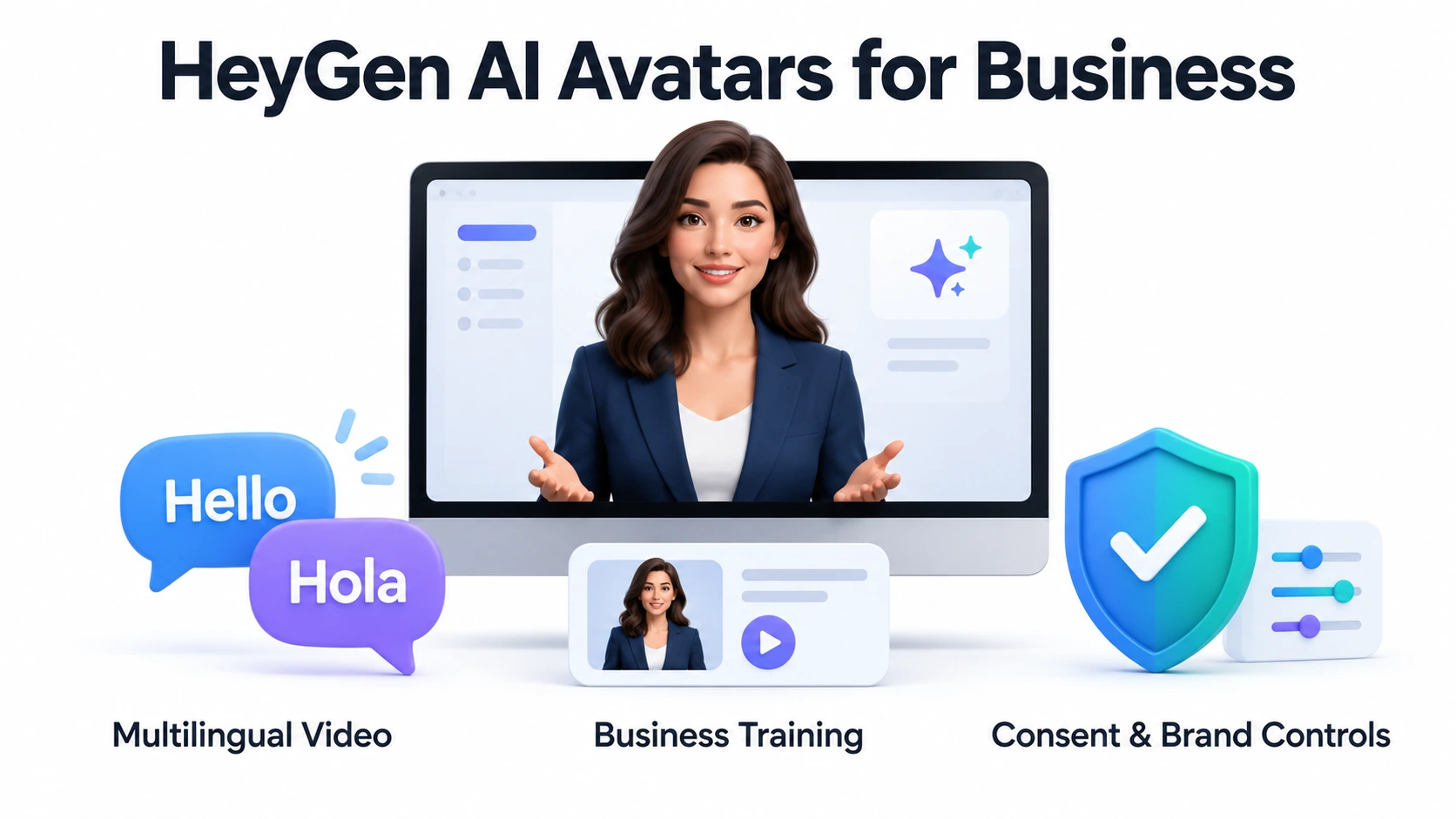
AI avatar video is finding practical uses in business communication. HeyGen’s published customer stories describe companies using its technology for multilingual training, marketing localization and educational content.
These examples show how HeyGen AI avatars and video translation can become part of repeatable production workflows. However, they do not establish a sudden industry transformation in October 2026. The evidence supports a story about documented business adoption, rather than a new product announcement or an independently confirmed market shift.
How Businesses Are Using HeyGen AI Avatars
HeyGen’s enterprise customer stories cover several applications, including employee learning, internal communication and localized marketing.
The company describes Komatsu using its technology to scale training videos and support international collaboration. Miro’s story focuses on producing localized learning content, while Workday’s example highlights multilingual video production.
HeyGen also lists HubSpot among customers using its tools for faster video creation and localization. Together, these examples illustrate how AI video can support ongoing business needs across departments. They are vendor-published customer accounts, so performance claims should be attributed to HeyGen rather than presented as independent findings.
Multilingual Video Is a Practical Business Application
Producing a video for several markets traditionally involves translation, recording and post-production for each language. AI video translation offers another way to adapt existing material.
HeyGen’s customer stories describe uses across training, marketing and education. For example, Workday’s account concerns localization across multiple languages, while Coursera’s story describes multilingual instructor-led content.
It is important to distinguish video translation from avatar generation. A company can translate footage featuring a real person without creating a new avatar-led video. An article about HeyGen AI avatars should therefore avoid describing every localization project as an avatar deployment.
Consent Matters When Creating Digital Twins
When an avatar represents a real employee, instructor or executive, permission is an essential part of the workflow.
HeyGen’s help documentation states that users creating a video-based Digital Twin must record a consent video. Its trust and safety guidance also requires users to have the rights and explicit consent needed to use another person’s likeness.
For businesses considering HeyGen AI avatars, this means avatar creation should begin with the person’s informed permission. Access to a photograph or recording should not be treated as permission to create a digital representation.
Enterprise Controls Help Protect Brand Identity
Creating an avatar is only one part of managing business video. Organizations also need to decide who can create digital twins, use approved avatars and change brand assets.
HeyGen documents enterprise controls that allow administrators to restrict custom avatar creation, manage avatar visibility and control Brand Kit editing. These features can help teams establish boundaries around employee likenesses and consistent visual presentation.
For companies using HeyGen AI avatars repeatedly, these controls are relevant to managing access and responsibility. They provide evidence that governance is part of the product’s enterprise offering.
Has Governance Become More Important Than Avatar Realism?
The available evidence does not establish that governance has replaced realism as the industry’s primary challenge.
Consent and brand controls clearly matter. However, that does not prove they outweigh every other consideration for every business. A company producing training videos may have different priorities from a creator making advertisements or an executive recording a public message.
The more accurate conclusion is that business adoption introduces governance needs alongside production-quality requirements. Claims about which challenge ranks first would require a named study, survey or analyst report.
What This Means for Creators and Agencies
For creators and agencies, the documented applications suggest opportunities in multilingual learning content, localized marketing and recurring business communication.
An agency working with HeyGen AI avatars could help clients organize scripts, adapt content for different audiences and manage approved digital presenters. This is a practical inference from the published use cases, rather than a guarantee of demand or commercial success.
The strongest service proposition would connect video production to a specific client need: updating training materials, adapting a product explanation or preparing consistent communication across languages.
What Readers Should Know
HeyGen’s official materials support the claim that businesses are using AI video for training, localization and communication. They also document consent requirements and enterprise brand controls.
However, the sources reviewed do not substantiate an unnamed analyst claim about a major shift “this month.” Nor do they prove that avatar realism is no longer a significant concern.
Official Sources
- HeyGen enterprise customer stories
- HeyGen avatar consent and brand controls
- HeyGen Digital Twin consent instructions
- HeyGen trust and safety guidance
Frequently Asked Questions
What are HeyGen AI avatars used for in business?
Published customer stories describe applications in training, education, marketing and internal communication. HeyGen also offers video translation, which is a separate capability from avatar generation.
Does every HeyGen localization project use an AI avatar?
No. Video translation can adapt existing footage. It should not automatically be described as creating or using a digital avatar.
Is consent required to create an avatar of a real person?
Yes. HeyGen requires appropriate rights and explicit consent. Creating a video-based Digital Twin also requires a consent recording.
Can businesses restrict who creates custom avatars?
HeyGen documents enterprise administrator controls over custom avatar creation, avatar visibility and Brand Kit editing.
Is this a new HeyGen announcement from October 2026?
The sources reviewed support existing business applications and governance features. They do not establish a single new October 2026 announcement.