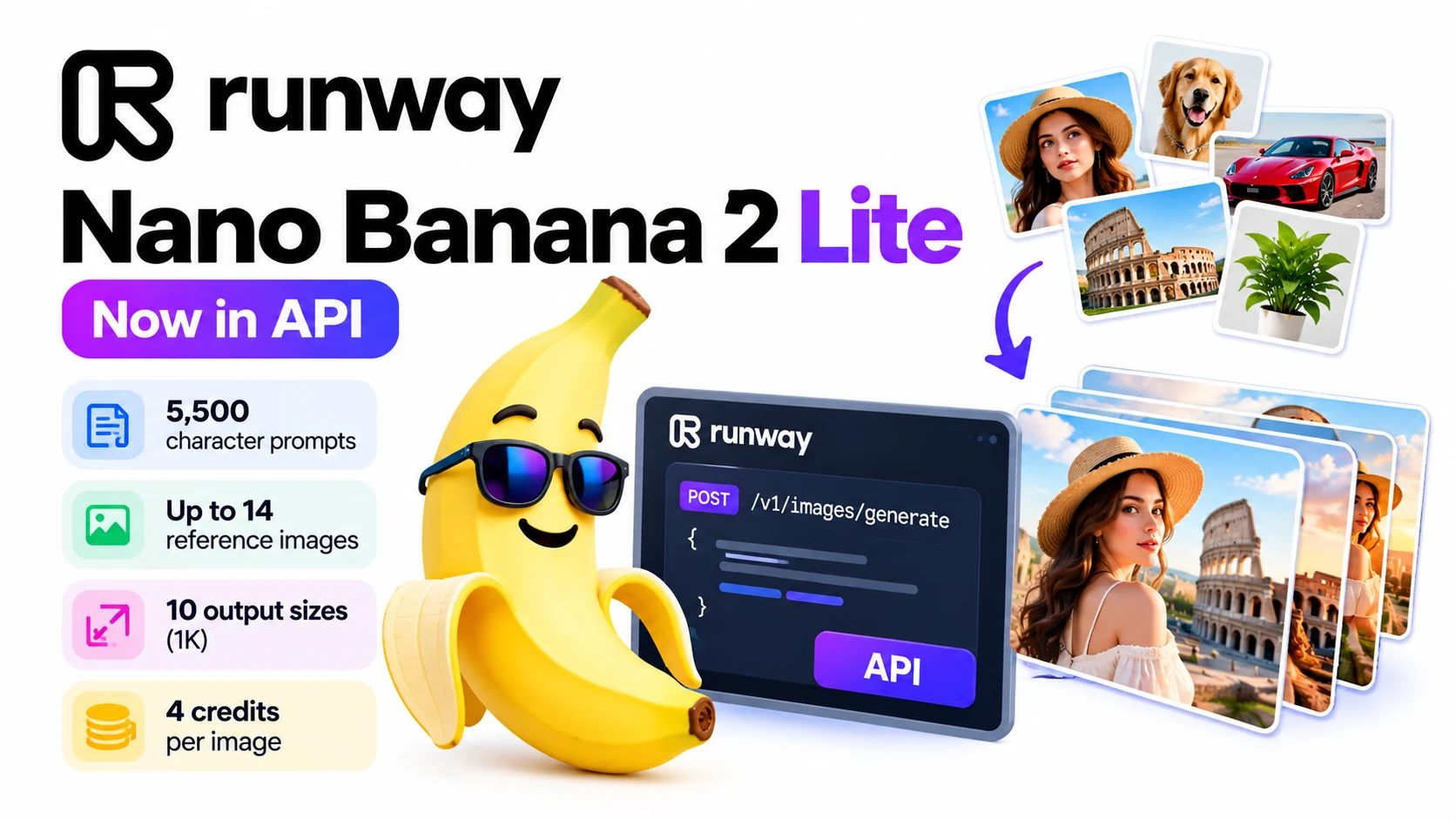
Runway has expanded its developer platform with Nano Banana 2 Lite, a lower-cost AI image-generation model designed for creators, developers, and automated content-production workflows.
According to the October 21, 2026 update to the Runway Dev API changelog, Nano Banana 2 Lite supports detailed text prompts, multiple reference images, and several output dimensions.
The headline feature is its support for up to 14 reference images, including five people and nine objects. This could make the model particularly interesting for creators who need consistent characters, products, or visual elements across multiple generated images.
Runway lists the generation cost at four credits per image.
For YouTubers building faceless channels, automated documentary videos, or AI-generated storyboards, Nano Banana 2 Lite presents an interesting alternative to models such as FLUX.1 Schnell.
But is Nano Banana 2 Lite actually cheaper and better than FLUX Schnell for producing 20, 50, or even 100 images per video?
The answer depends on more than the advertised generation price. Image consistency, processing speed, resolution, and API reliability all matter.
Key Features of Nano Banana 2 Lite
1. Support for up to 14 reference images
The standout feature of Nano Banana 2 Lite is its reference-image allowance.
Developers can provide up to 14 reference images, including a maximum of five human references and nine object references.
This could be useful when generating a series of images featuring the same fictional character, branded product, or recurring visual theme.
For example, a faceless YouTube channel covering ancient history might need a recurring historical character across 20 scenes. Reference images could help the model maintain visual consistency while changing locations, lighting, and camera angles.
However, supporting multiple references does not guarantee perfect character consistency. That needs to be tested.
2. Detailed prompts up to 5,500 characters
Nano Banana 2 Lite supports prompts containing up to 5,500 characters.
This provides room to specify lighting, camera angles, environments, clothing, object placement, and visual style.
For automated video generators, detailed prompts can be useful because each image must match a particular scene in the narration.
3. Ten output sizes at 1K resolution
Nano Banana 2 Lite supports ten 1K output sizes.
That provides flexibility for different content formats, although the model’s output options are more limited than those of some higher-resolution alternatives.
For a 1080p YouTube video, creators may need to upscale images or combine them with other visual assets.
4. Multiple outputs per request
Runway’s documentation specifies an outputCount of either 1 or 4.
This allows developers to request four generated images in one operation and choose the most suitable result.
Importantly, each image is billed separately, so requesting four images costs 16 credits rather than four.
These specifications are confirmed in the official Runway Dev changelog.
Nano Banana 2 Lite vs FLUX Schnell: Feature Comparison
FLUX.1 Schnell, developed by Black Forest Labs, is widely used for fast, inexpensive AI image generation. It is available through services including fal.ai.
Here is how the two options compare.
| Feature | Nano Banana 2 Lite | FLUX.1 Schnell via fal.ai |
|---|---|---|
| API provider | Runway Dev | fal.ai |
| Primary strength | Reference-guided generation and editing | Fast, inexpensive image generation |
| Prompt length | Up to 5,500 characters | Endpoint-specific limits |
| Reference images | Up to 14 | Standard text-to-image endpoint does not offer equivalent multi-reference input |
| Output sizes | Ten 1K sizes | Multiple presets and custom dimensions |
| Generation cost | 4 Runway credits/image | $0.003 per billed megapixel |
| Batch options | 1 or 4 outputs | Configurable image count |
| Best potential use | Recurring characters and products | High-volume visual generation |
FLUX Schnell uses a distilled architecture designed to generate images in one to four inference steps. Its low processing requirements make it attractive for automated content creation.
Nano Banana 2 Lite Pricing: How Much Does It Cost?
Runway charges four credits for each image generated with Nano Banana 2 Lite.
For a project requiring 20 images:
20 X 4 = 80 credits
A larger project requiring 100 images would consume 400 credits.
FLUX Schnell uses a different pricing structure. On fal.ai, the listed rate is $0.003 per megapixel, with image dimensions rounded up to the next whole megapixel for billing.
Which Model Is Better for Faceless YouTube Videos?
For faceless YouTube channels, the most important requirements are visual relevance, consistency, speed, and cost.
FLUX Schnell may be suitable for documentaries featuring landscapes, buildings, historical environments, scientific illustrations, and other scenes that do not require recurring characters.
Nano Banana 2 Lite could be more useful when a video repeatedly features the same person, product, or object.
Consider a 10-minute documentary containing 60 AI-generated visuals.
If the video focuses on historical locations, FLUX Schnell’s low cost and fast generation could make it the more economical starting point.
If the documentary follows a recurring character through multiple scenes, Nano Banana 2 Lite’s reference-image support may justify testing the additional cost.
A hybrid workflow could potentially offer the best balance: use FLUX Schnell for general scenes and Nano Banana 2 Lite for visuals requiring strong reference guidance.
That is a proposed workflow, not a tested performance result.
How We Would Test Nano Banana 2 Lite Against FLUX Schnell
A meaningful comparison should use the same 20-image project for both models.
The test should include:
- Character consistency: Generate five scenes featuring the same fictional character.
- Product fidelity: Generate five images featuring the same product from different angles.
- Scene accuracy: Generate five documentary-style scenes from detailed prompts.
- Visual quality: Generate five images intended for YouTube thumbnails or storyboards.
Each model should be evaluated for prompt accuracy, consistency, processing time, usable output percentage, and total generation cost.
Reference-image workflows must also be compared fairly. Standard FLUX Schnell text-to-image generation does not offer the same multi-reference functionality, so any additional editing model should be identified and priced separately.
This approach would reveal which model offers better value for actual video production rather than simply comparing advertised specifications.
Final Verdict: Should Creators Switch to Nano Banana 2 Lite?
Nano Banana 2 Lite is a noteworthy addition to Runway’s developer platform, particularly for creators who want reference-guided image generation inside automated workflows.
Its support for up to 14 reference images is attractive for recurring characters, product imagery, and consistent visual storytelling.
However, FLUX Schnell remains a compelling choice for inexpensive, high-volume image generation.
For automated YouTube production, there is currently insufficient independent testing to declare either model the overall winner.
Our initial recommendation: Keep FLUX Schnell as a cost-efficient option for general-purpose visuals, while evaluating Nano Banana 2 Lite for scenes where reference consistency is important.
Official resources: Runway Dev API changelog · Runway developer documentation · FLUX.1 Schnell on fal.ai