This news report contains affiliate links. We may earn a commission on purchases made through these links at no extra cost to you. Our coverage is based on official ElevenLabs information.
An AI receptionist can have a convincing voice and still deliver a frustrating conversation. Long pauses interrupt the flow, while a misunderstood request can send the caller back to the beginning.
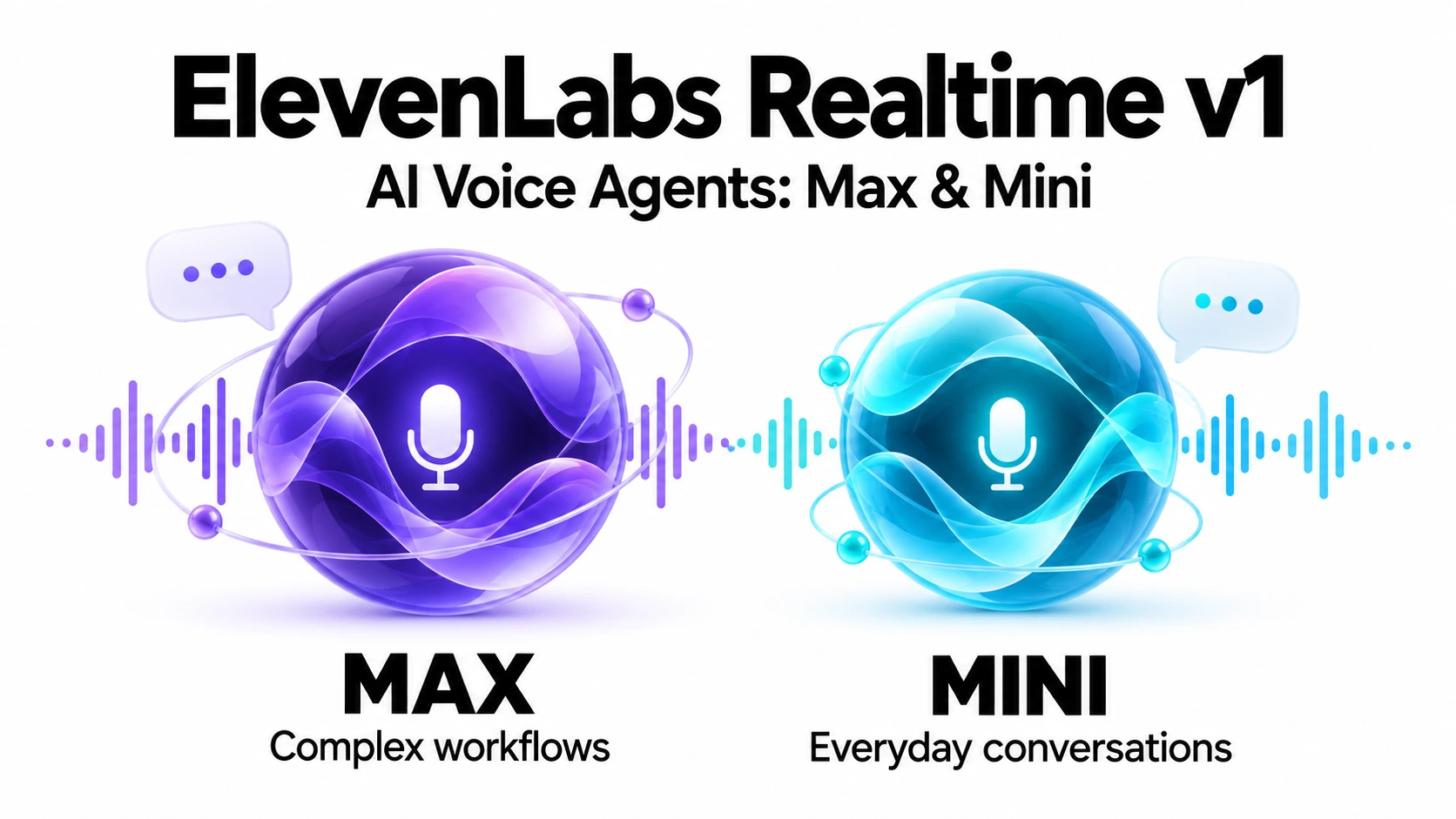
ElevenLabs Realtime v1 aims to simplify that experience with two models: Mini for everyday conversations and Max for more demanding tasks.
Announced on 20 October 2026, with the launch post updated on 29 October, Eleven Realtime combines the components needed for a voice conversation into a managed system. Both versions support more than 90 languages and access to the company’s library of over 17,000 voices.
For freelancers and small businesses, the practical question is which version can complete the job reliably at an acceptable cost.
What Is ElevenLabs Realtime v1?
A voice agent needs to understand speech, decide when someone has finished talking, prepare an answer, and speak it aloud. Configuring those parts separately can require substantial testing.
ElevenLabs describes Realtime as a complete voice-agent model built on a cascaded architecture. In plain language, separate processing stages are tuned to work together, with text available between stages to help diagnose mistakes.
That distinction matters when troubleshooting. If an agent records the wrong customer name, you want to know whether it misheard the caller or misunderstood the instruction.
Source: ElevenLabs launch announcement.
ElevenLabs Realtime v1 Max vs. Mini: Benchmark Results
The published results show different strengths rather than one model winning every category.
| Benchmark | Realtime v1 Max | Realtime v1 Mini |
|---|---|---|
| Spoken reasoning accuracy | 98.8% | 75.9% |
| Average time to first audio | 0.57 seconds | 0.62 seconds |
| Conversational dynamics | 94.1% | 95.8% |
| Tool-use task success | 87.1% | 60.3% |
The exact reasoning figures appear in ElevenLabs’ announcement. Artificial Analysis’s own comparison independently lists the models, with rounded reasoning scores and matching latency, conversational-dynamics, and tool-use results.
These are benchmark outcomes, not guaranteed performance for your business. They also show why Mini should not automatically be called faster: Max begins speaking slightly sooner in this particular test.
Sources: ElevenLabs benchmarks and Artificial Analysis.
For an appointment agent, a quick greeting is only the beginning. Correctly checking availability, recording details, and confirming a booking may matter much more than a small response-time difference.
When Does Mini Make Sense?
Consider ElevenLabs Realtime v1 Mini for a narrowly defined assistant answering common questions from an approved information source.
A creator could test it as a voice guide for course enquiries. A freelancer might build a simple assistant that explains service packages or collects an initial project brief.
Keep the first version focused. An assistant handling five clear enquiry types is easier to evaluate than one expected to answer anything about the business.
During testing, include interruptions, incomplete sentences, and corrections. A customer who says “Tuesday—sorry, Thursday” provides a more useful trial than someone reading a perfect script.
When Is Max Worth Testing?
ElevenLabs Realtime v1 Max deserves closer evaluation when the conversation requires several connected actions.
Imagine an appointment assistant that must check a schedule, offer alternatives, collect contact details, and save the confirmed selection. Each step depends on the previous one.
The tool-use benchmark gap makes this a sensible comparison case. However, a stronger model cannot repair an incorrectly configured calendar connection or an ambiguous booking rule.
Write down what successful completion means before testing. The final record should contain the correct details, and the spoken confirmation should match the action actually performed.
How Does ElevenLabs Realtime v1 Pricing Work?
For Realtime agents in ElevenAgents, billing combines the standard per-minute charge with input, cached-input, and output token charges. Max costs more per token than Mini.
The documentation recommends starting with Mini and considering Max when complex instructions or multi-step tool use require it.
Compare cost per successfully completed task. A cheaper conversation that needs a staff callback may provide less value than a slightly more expensive interaction that finishes correctly.
Avoid estimating a monthly bill from the model name alone. Use actual trial conversations and the rates shown for your deployment route.
How to Try ElevenLabs Realtime v1
In ElevenAgents, open the Agent tab, set Voice mode to Realtime, and select your model. Mini is the default. Publish after testing.
Access is rolling out gradually. The current documentation also says Max is unavailable in the India and Singapore data-residency environments. That concerns hosting environments rather than a blanket restriction based on where a user lives.
Text-only and Speech Engine agents have restrictions on using this ElevenAgents mode.
Source: Realtime models documentation.
Separately, developers can use a standalone WebSocket Realtime API. ElevenLabs explains that this route runs apart from ElevenAgents, so platform features should not be assumed to carry over automatically.
Source: Realtime API introduction