Artificial intelligence is moving beyond chatbots that simply answer questions. Anthropic’s latest developments point toward AI systems that can manage tasks, organize workflows, and help professionals get more done with less manual effort.
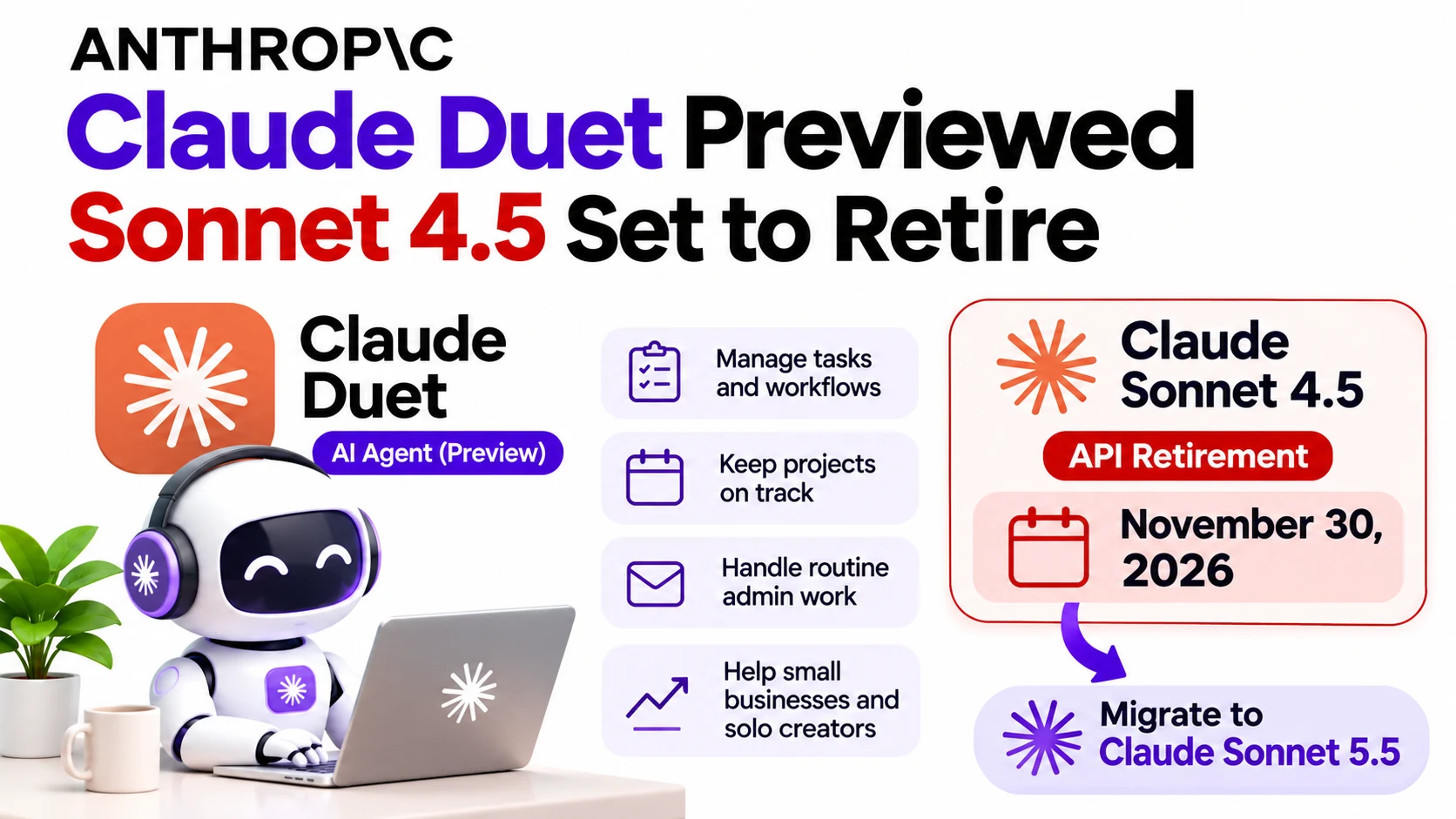
The company has introduced a research preview of the Claude Duet AI Agent, a proactive assistant designed to support everyday work. At the same time, developers face another important change: Claude Sonnet 4.5 is scheduled for retirement from the Anthropic API on November 30, 2026.
For freelancers, content creators, small business owners, and developers, these announcements highlight two important trends: more autonomous AI assistants and faster changes in the models powering AI applications.
Let’s explore what Claude Duet offers, who can access it, and how developers can prepare for the upcoming model retirement.
What Is the Claude Duet AI Agent?
The Claude Duet AI Agent is Anthropic’s preview of a proactive personal AI assistant. Unlike a conventional chatbot, which generally waits for a user to submit a question, Duet is intended to help manage ongoing tasks and workflows.
For example, a professional might use a proactive assistant to monitor project updates, prepare daily summaries, or identify work requiring attention.
The goal is to reduce time spent on repetitive administrative activities.
Anthropic is positioning Claude Duet as a tool for professionals who want assistance managing their digital work rather than simply generating text.
Importantly, Claude Duet is currently a research preview, so its capabilities and availability may evolve before a wider release.
Key Features of Claude Duet
The Claude Duet AI Agent introduces several capabilities that could make AI assistants more useful in everyday business operations.
1. Proactive Task Management
Traditional AI assistants generally respond after receiving instructions.
Claude Duet is designed to take a more proactive approach by monitoring relevant information and helping users stay informed about pending work.
This could be valuable for freelancers managing multiple clients, deadlines, and deliverables.
2. Connected App Workflows
Modern businesses rely on several applications for email, documents, communication, and project management.
Claude Duet aims to help users coordinate information across connected tools, reducing the need to switch constantly between applications.
The exact actions available depend on supported integrations, permissions, and the preview’s capabilities.
3. Automated Briefings and Summaries
A proactive AI assistant could prepare useful updates about ongoing projects, messages, and tasks.
For example, a blogger managing several articles might benefit from a summary of upcoming deadlines and outstanding approvals.
Instead of reviewing every application individually, the creator could start with a consolidated briefing.
4. User Control Over Sensitive Actions
Autonomous AI agents also raise important questions about security and control.
Claude Duet is designed to request approval for sensitive activities, such as sending messages or making payments.
This human-approval approach is particularly important for businesses handling customer information, financial transactions, or confidential documents.
How Claude Duet Could Help Content Creators
For creators, the biggest attraction of the Claude Duet AI Agent is its potential to reduce administrative workload.
Consider someone operating a small AI news website.
Their daily responsibilities may include researching topics, preparing articles, managing emails, reviewing publishing schedules, and coordinating social media posts.
A proactive AI assistant could potentially help organize these activities.
For example, a creator might use Claude Duet to:
- Identify important project updates and pending tasks.
- Prepare summaries of information from connected applications.
- Organize content-production priorities.
- Highlight deadlines requiring attention.
- Assist with repetitive administrative workflows.
These are potential use cases, not guarantees that every workflow is currently supported.
For a website such as MiviCAI, this kind of assistant could eventually complement existing AI writing, research, and publishing tools.
However, creators should continue reviewing AI-generated information and approving important actions before publication.
Claude Duet Availability: Can Everyone Use It?
Although the Claude Duet AI Agent is promising, it is not yet broadly available.
The initial research preview has limited access, with a waitlist for eligible Claude Pro and Max subscribers in the United States.
Users outside the supported preview group should not assume immediate access.
Anthropic may expand availability over time, but broader release dates and pricing should be confirmed through official announcements.
This distinction matters for freelancers who may otherwise expect to start using Claude Duet immediately.
Claude Sonnet 4.5 Retirement: What Developers Need to Know
Alongside the Claude Duet preview, Anthropic’s model lifecycle introduces another significant development.
Claude Sonnet 4.5 is scheduled to retire from the Anthropic API on November 30, 2026.
The affected API model identifier is:
claude-sonnet-4-5-20250929
Anthropic recommends moving to claude-sonnet-5-5.
This change is especially relevant for developers who have integrated Sonnet 4.5 into websites, automation systems, customer-support tools, or custom AI applications.
Once the retirement takes effect, applications that continue requesting the retired model may encounter API errors.
Developers should therefore complete migration testing before the deadline.
It is also important to understand that this announcement concerns the specified API model. It does not mean every Claude service or subscription is being discontinued.
How to Migrate From Claude Sonnet 4.5
Developers should approach the migration systematically rather than simply replacing a model name and assuming everything will work.
First, identify applications and scripts using the retiring model identifier.
Next, update the relevant API configuration to the recommended replacement.
Then test the workflows that matter most, including prompt handling, structured outputs, tool calling, response quality, and error management.
Finally, review pricing, latency, and token usage under realistic workloads.
Although newer models may provide improvements, developers should not assume that every application will automatically become faster or cheaper.
Actual results depend on the complexity of requests, model configuration, and application design.
Claude Duet vs Traditional AI Assistants
The Claude Duet AI Agent represents a shift in how people may interact with AI.
| Feature | Traditional AI Chatbot | Claude Duet AI Agent |
|---|---|---|
| Interaction | Primarily prompt-driven | Designed for proactive assistance |
| Task management | Usually user-initiated | Can help monitor ongoing work |
| Connected workflows | Depends on tools and integrations | Emphasis on coordinating work |
| Briefings | Generated on request | Proactive updates are a key use case |
| Availability | Varies by product | Limited research preview |
The difference is not simply better writing or more accurate answers.
It is the possibility of AI assisting with ongoing work between individual conversations.
Is Claude Duet Worth Watching in 2026?
For freelancers and small businesses, the Claude Duet AI Agent is an interesting development.
Its greatest potential lies in helping users coordinate tasks, monitor information, and spend less time on routine administration.
However, its real-world value will depend on reliability, supported integrations, pricing, privacy protections, and the level of control users retain.
Meanwhile, Claude Sonnet 4.5’s upcoming retirement is a more immediate concern for developers.
Anyone maintaining an application that uses the affected API model should review their configuration and begin migration testing.
Final Thoughts
Anthropic’s latest developments illustrate how quickly the AI industry is evolving.
The Claude Duet AI Agent points toward a future where AI assistants help manage ongoing projects rather than waiting for individual prompts.
At the same time, the November 30 retirement of Claude Sonnet 4.5 reminds developers that maintaining AI-powered applications requires regular model updates.
For creators, Claude Duet is worth following. For developers using Sonnet 4.5, preparing for migration should already be a priority.
Stay connected with MiviCAI for practical AI news, creator-focused tutorials, and updates on emerging AI tools.