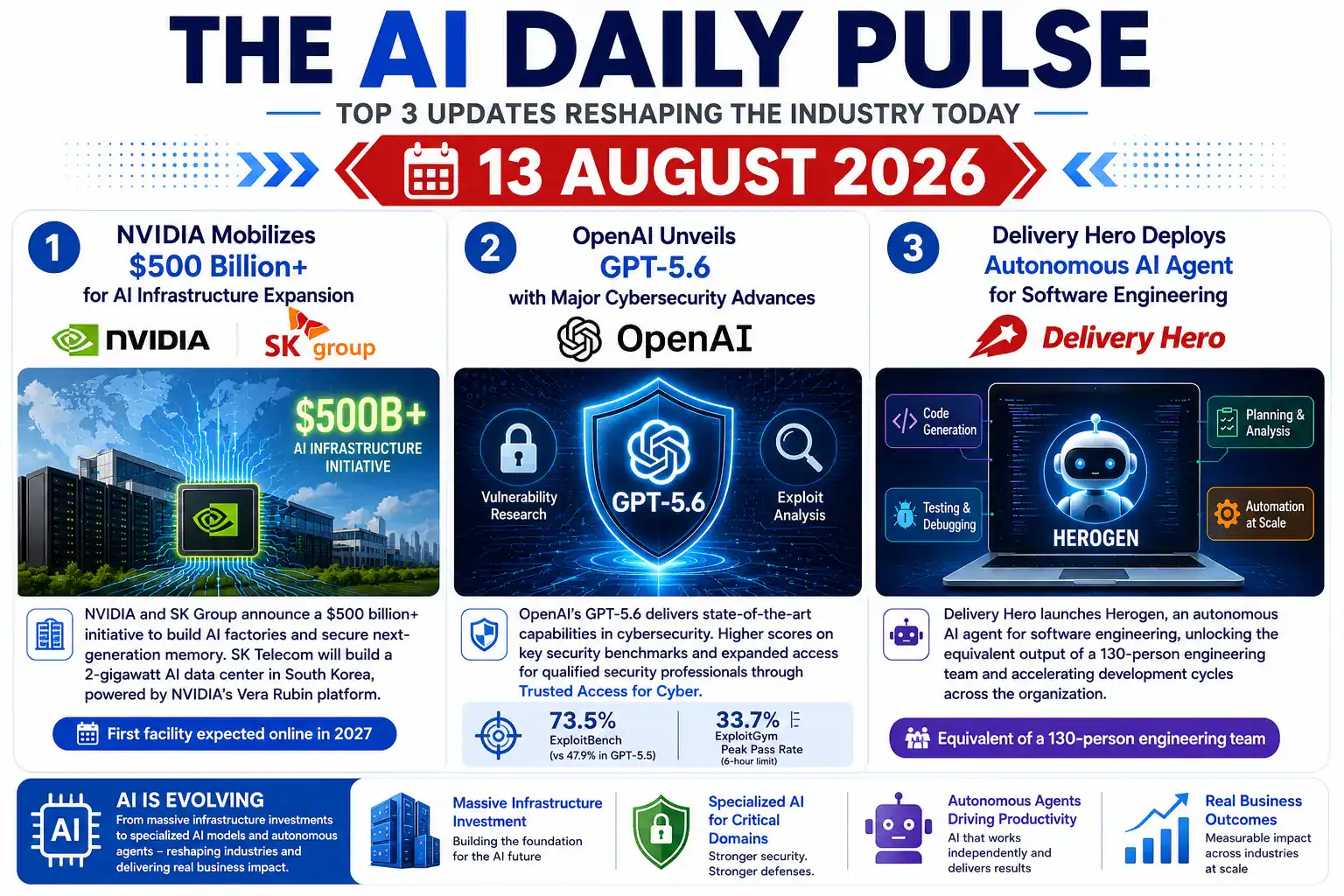
From a $500 billion-plus AI infrastructure initiative to major advances in cybersecurity and autonomous software development, the artificial intelligence industry is rapidly moving into a new phase of scale and deployment.
Artificial intelligence is no longer advancing only through bigger models and better benchmarks. The latest developments show that the industry is increasingly focused on the infrastructure needed to run AI at scale, specialized models capable of handling complex cybersecurity tasks, and autonomous AI agents that can perform substantial amounts of work with limited human intervention.
Here are three important AI developments shaping the industry.
1. NVIDIA and SK Group Announce $500 Billion-Plus AI Infrastructure Initiative
NVIDIA and South Korea’s SK Group have announced plans for a $500 billion-plus initiative focused on expanding AI infrastructure and securing next-generation memory supplies.
The partnership covers two major areas: the development of large-scale AI factories and a long-term collaboration involving advanced memory technologies. NVIDIA said the initiative is designed to address the rapidly increasing global demand for computing capacity required by AI applications.
One of the most significant elements of the plan involves SK Telecom, which intends to build a 2-gigawatt AI data center in South Korea using NVIDIA’s Vera Rubin platform and SK hynix’s HBM4 high-bandwidth memory. The first facility is expected to come online in 2027.
The announcement also includes a long-term partnership between NVIDIA and SK hynix to secure and develop next-generation high-bandwidth memory for AI workloads.
Why the NVIDIA-SK partnership matters
The announcement highlights a fundamental reality of the AI boom: increasingly powerful AI models require enormous amounts of computing infrastructure.
Training and operating advanced AI systems depends on GPUs, high-speed networking, memory, data centers and reliable power. As demand for AI continues to grow, companies are increasingly treating infrastructure as a strategic part of the AI ecosystem rather than simply a supporting technology.
The planned 2-gigawatt facility also illustrates how large future AI data centers could become. Gigawatt-scale infrastructure represents a major expansion in the amount of computing capacity being planned for AI workloads.
The partnership could therefore have implications well beyond South Korea, particularly as countries and companies compete to secure enough computing resources for AI development.
Read the official announcement: NVIDIA Newsroom – SK Group and NVIDIA Expand Strategic Partnership Across AI Factories and Next-Generation Memory
2. OpenAI’s GPT-5.6 Brings Major Advances in Cybersecurity
OpenAI has introduced its GPT-5.6 family of models, with the company’s flagship GPT-5.6 Sol delivering substantial improvements in cybersecurity alongside advances in coding, knowledge work and science.
OpenAI describes GPT-5.6 as its strongest cybersecurity model so far. The company reports significant gains on several cybersecurity evaluations, including tests involving vulnerability research, exploit development and complex software security tasks.
For example, OpenAI reports that GPT-5.6 Sol achieved a 73.5% score on ExploitBench, compared with 47.9% for GPT-5.5 at a comparable output-token budget. On ExploitGym, another evaluation focused on turning vulnerabilities into working exploits, GPT-5.6 Sol reached a peak pass rate of 33.7% under a six-hour testing limit.
These capabilities have obvious dual-use implications. The same technology that can help security professionals discover weaknesses and develop patches could potentially be misused by attackers.
OpenAI says GPT-5.6 therefore uses multiple layers of safeguards, including model-level protections, real-time monitoring, account-level signals and differentiated access for sensitive cybersecurity capabilities.
A growing role for AI in defensive security
One of the most significant aspects of GPT-5.6 is its potential use by cybersecurity defenders.
OpenAI says qualified individuals and organizations participating in its Trusted Access for Cyber program can access additional defensive capabilities for authorized security work. These include vulnerability triage and validation, malware analysis, detection engineering, secure code review and patch validation.
This represents a broader shift in how AI is being used in cybersecurity. Rather than simply generating code or answering technical questions, advanced AI systems are increasingly being tested on long-running security workflows that require analysis, reasoning and interaction with complex codebases.
At the same time, the development highlights why security controls will remain an important part of advanced AI deployment.
Read the official announcement: OpenAI – GPT-5.6: Frontier intelligence that scales with your ambition
3. Delivery Hero Pushes Autonomous AI Into Software Engineering
Delivery Hero is also exploring how autonomous AI agents can transform the way large technology organizations build and maintain software.
In April 2026, the company announced Herogen, an autonomous AI agent designed to take on software-engineering work. Delivery Hero described the system as capable of unlocking the equivalent of output from a 130-person engineering team.
The development is notable because it moves the discussion around AI agents beyond simple chatbots and productivity assistants.
Traditional AI assistants generally require a person to provide instructions, review outputs and decide what happens next. Autonomous agents are designed to handle longer sequences of tasks, potentially including planning, execution, testing and iteration.
For a large technology company operating across dozens of countries and managing complex digital platforms, automating parts of software development could potentially improve engineering efficiency and allow teams to spend more time on higher-level problems.
Delivery Hero operates across approximately 65 countries and serves millions of customers through its delivery ecosystem. The company has also described its broader platform as increasingly AI-powered.
Why autonomous AI agents matter
The rise of systems such as Herogen points to a potentially important change in enterprise AI adoption.
The first generation of generative AI focused heavily on creating content, answering questions and assisting individual employees. The next stage is increasingly about AI agents that can complete multi-step tasks.
This could affect areas such as software development, customer service, data analysis, marketing, operations and business administration.
However, autonomous systems also introduce new challenges. Companies need mechanisms for controlling permissions, monitoring decisions, reviewing outputs and ensuring that agents do not make costly mistakes.
As a result, the success of enterprise AI agents will likely depend not only on model intelligence but also on the quality of the surrounding systems, safeguards and human oversight.
Read more: Delivery Hero Newsroom
What These Three Developments Tell Us About AI
Although these announcements involve very different companies and technologies, they point toward the same broader trend: AI is moving from experimentation toward large-scale deployment.
1. Infrastructure is becoming as important as models
The NVIDIA-SK initiative demonstrates the enormous infrastructure requirements associated with the next generation of AI.
The competition is no longer simply about which company has the most capable model. Access to GPUs, advanced memory, networking, electricity and data-center capacity is becoming strategically important.
2. AI is becoming a serious cybersecurity tool
GPT-5.6’s cybersecurity capabilities show how advanced models can increasingly participate in complex security workflows.
For defenders, AI could help identify vulnerabilities faster, analyze large codebases and accelerate patching. But the same capabilities make robust safeguards increasingly important.
3. AI agents are moving toward autonomous work
Delivery Hero’s Herogen illustrates another major transition: AI systems are beginning to take on longer and more complex workflows instead of simply generating individual responses.
If these systems continue improving, AI agents could become an important component of enterprise software and digital operations.
The Bigger Picture
The AI industry is entering a phase in which scale, infrastructure and autonomy are becoming just as important as model intelligence.
The NVIDIA-SK partnership demonstrates the enormous investment required to build the physical infrastructure behind AI. OpenAI’s GPT-5.6 shows how advanced models are becoming increasingly capable in specialized fields such as cybersecurity. Delivery Hero’s Herogen demonstrates how companies are experimenting with autonomous agents to perform complex engineering work.
Together, these developments suggest that the next chapter of artificial intelligence will not be defined solely by the release of another chatbot or language model.
Instead, the competition will increasingly involve who can build the most capable infrastructure, deploy AI safely in high-value industries and create agents that can reliably perform useful work.
For businesses and consumers, that could make the coming years one of the most consequential periods in the development of artificial intelligence.
Final Takeaway
The AI industry is rapidly evolving from a model-centric technology race into a much broader ecosystem involving data centers, advanced chips, cybersecurity, autonomous agents and enterprise deployment.
As investment increases and AI systems become more capable, the key question is shifting from “What can AI generate?” to “What useful work can AI reliably perform at scale?”
The companies that successfully answer that question could play a major role in defining the next stage of the AI industry.
This article has been independently written and fact-checked against publicly available company announcements. It does not reproduce or substantially copy the wording of the cited sources. Facts and company claims are attributed to their respective organizations.