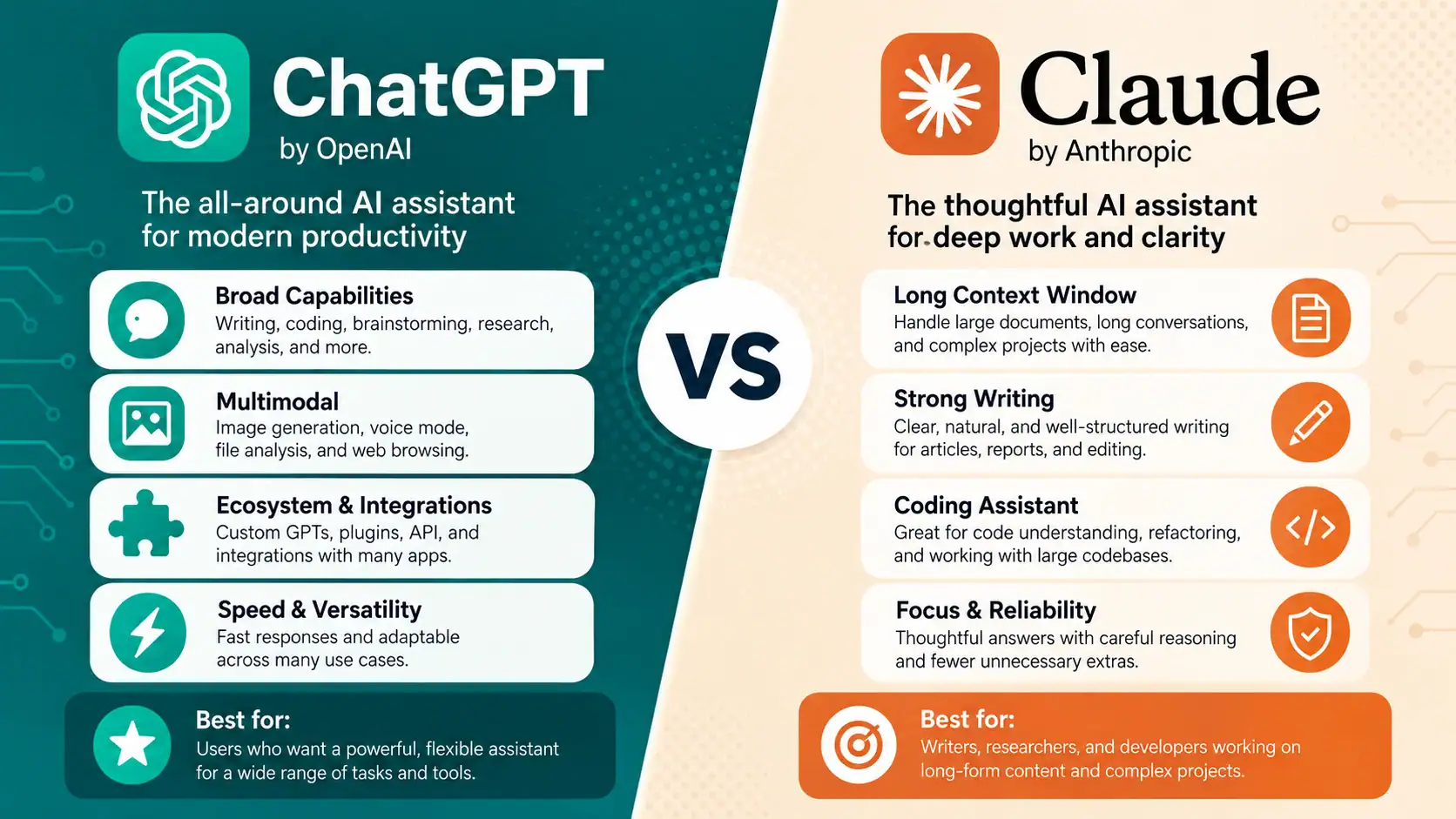
ChatGPT vs Claude: If you’re looking for an AI assistant in 2026, these are two of the biggest names you’ll encounter.
Both are powerful enough to write articles, analyze documents, help with coding, research topics, brainstorm ideas, summarize information and handle increasingly complex workflows. But they are not identical.
The better choice depends less on which AI is “smarter” and more on what you actually want to do with it.
ChatGPT has developed into a broad AI platform combining text, reasoning, web search, file analysis, image generation, voice, coding and other tools. Claude, meanwhile, has built a strong reputation around writing, document-heavy workflows, coding and long-form reasoning.
ChatGPT vs Claude: So which one should you choose?
The answer depends on your workflow.
Quick Answer
Choose ChatGPT if you want an all-round AI assistant with a broad range of capabilities, including image generation, voice, web search, file analysis, custom GPTs, projects and coding tools.
Choose Claude if your priorities are long-form writing, document analysis, coding workflows and working with large amounts of information.
Choose both if AI is an important part of your daily work. Many users can benefit from using one as their primary assistant and the other as a second opinion or specialist tool.
ChatGPT vs Claude at a Glance
| Feature | ChatGPT | Claude |
|---|---|---|
| Developer | OpenAI | Anthropic |
| Free plan | Yes | Yes |
| Entry paid plan | Go / Plus | Pro |
| Popular paid tier | Plus — $20/month | Pro — $20/month |
| Higher usage tiers | Pro options available | Max 5x / Max 20x |
| Image generation | Yes | No native image generation |
| Voice | Yes | Yes |
| Web search | Yes | Yes |
| File analysis | Yes | Yes |
| Coding | Strong | Strong |
| Long-document workflows | Strong | Strong |
| Custom assistants | Custom GPTs | Projects, skills and related features |
| Best known for | Broad AI ecosystem and multimodal workflows | Writing, coding and document-heavy work |
Important: AI plans, pricing, models and usage limits change frequently. Prices can also vary by country, taxes and billing method. Always check the official pricing pages before subscribing.
Pricing: ChatGPT vs Claude
Pricing is no longer as simple as saying that both companies have one $20 plan.
ChatGPT currently has multiple consumer options, including Free, Go, Plus and Pro. OpenAI introduced ChatGPT Go as a lower-cost subscription and subsequently made it available globally. ChatGPT Plus is positioned for users who want greater access to advanced models and tools, while Pro is aimed at heavy AI users.
Claude offers Free, Pro and Max plans for individual users. Claude Pro costs $20 per month when billed monthly, while Max is available in $100 and $200 monthly tiers, with the higher tiers providing substantially more usage capacity.
Which is cheaper?
For users comparing the most familiar $20 subscriptions, the answer is essentially a tie:
- ChatGPT Plus: $20/month
- Claude Pro: $20/month
However, the comparison changes if you’re a heavy user or want a lower-cost plan.
ChatGPT has its Go tier, while Claude’s higher-usage offering starts with Max 5x at $100/month.
Therefore, don’t choose between the two based purely on the headline subscription price. Your actual usage limits and the features you need are more important.
Writing Quality: Which AI Is Better for Writers?
This is one of the hardest categories to declare a winner.
Claude
Claude has developed a particularly strong reputation among writers because its responses often feel natural and consistent over longer pieces.
It can be particularly useful for:
- Long-form articles
- Editing and rewriting
- Reports
- Research summaries
- Newsletters
- Scripts
- Maintaining a consistent tone across a long document
For a 2,000- or 3,000-word article, Claude can be an excellent choice when you want the writing to remain consistent from beginning to end.
ChatGPT
ChatGPT is also extremely capable at writing and editing. Its major advantage is versatility.
You can use it to:
- Generate article outlines
- Rewrite paragraphs
- Create SEO titles
- Write meta descriptions
- Produce social-media captions
- Generate image prompts
- Research topics
- Analyze uploaded documents
- Create different versions of the same content
It is particularly useful when writing is only one part of a larger content-production workflow.
Winner?
There isn’t a universal winner.
Claude may have an edge for some long-form editing and prose-heavy workflows, while ChatGPT may be more convenient when writing is combined with research, images, data analysis and other tools.
For serious content creators, testing the same article prompt in both is a better way to decide than relying on generic rankings.
Coding and Technical Work: ChatGPT vs Claude
Both ChatGPT and Claude are now serious coding assistants.
Claude is particularly attractive for developers working with large projects and multi-file codebases. Its ecosystem includes Claude Code, which is designed for terminal-based coding workflows. Claude’s paid plans include Claude Code access.
ChatGPT also has a strong coding ecosystem, including Codex and other tools designed for software development and agent-style workflows.
The practical choice depends on the task.
Choose Claude when:
- You regularly work with large codebases
- You want an AI coding partner
- You need help understanding multiple files
- Your workflow is heavily centered around coding
Choose ChatGPT when:
- You want coding combined with other AI tools
- You need help with scripts or automation
- You want to analyze data and code together
- You want coding integrated into a broader AI workflow
For a WordPress user, for example, both can be extremely useful for HTML, CSS, JavaScript, PHP and troubleshooting.
Context Window: ChatGPT vs Claude
The context window determines how much information an AI can process within a conversation or task.
This becomes important when you’re working with:
- Long reports
- Books
- Research papers
- Large codebases
- Multiple documents
- Long conversations
- Extensive project instructions
Claude currently lists a 200K context window for its individual Free, Pro and Max plans, while certain enterprise configurations can offer larger context.
ChatGPT’s context capacity varies by model and subscription. OpenAI’s current documentation lists different context limits for GPT-5.5 Instant and Thinking, with larger limits available on higher tiers.
Therefore, simply saying “Claude has a much larger context window than ChatGPT” is now too broad.
The more accurate conclusion is:
Both platforms support substantial long-context workflows, but their limits depend on the specific model and plan you’re using.
If you routinely work with extremely large documents, check the current model-specific limits before choosing a subscription.
Accuracy and Reliability: ChatGPT vs Claude
Neither ChatGPT nor Claude should be treated as automatically correct.
Both can:
- Make factual mistakes
- Misinterpret instructions
- Produce outdated information
- Invent citations or details
- Misunderstand ambiguous questions
This matters particularly for bloggers.
If you’re publishing an article about technology, finance, medicine, law or current events, AI-generated information should be verified against reliable sources before publication.
A good workflow is:
AI draft → source verification → human editing → publication
rather than:
AI draft → publish
The difference can have a major impact on the credibility of your website.
Images, Voice and Multimodal Features
This is an area where ChatGPT has a significant practical advantage for many creators.
ChatGPT combines several capabilities in one platform, including:
- Text generation
- Web search
- File analysis
- Data analysis
- Image generation
- Image understanding
- Voice interaction
- Coding
- Custom GPTs
- Projects and other productivity features
OpenAI’s current documentation lists image generation, voice, file analysis, web search and other tools across its ChatGPT ecosystem, with availability depending on the plan and model.
Claude also offers voice mode, web search, file creation, code execution, projects, research and other tools.
However, Claude does not currently provide native image generation in the same way ChatGPT does.
For bloggers, YouTubers and social-media creators who frequently need both text and visuals, this can make ChatGPT the more convenient all-in-one platform.
ChatGPT vs Claude for Bloggers
If you’re running a blog, both can be useful, but their strengths can lead to slightly different workflows.
ChatGPT is particularly useful for:
- Topic research
- SEO brainstorming
- Article outlines
- Blog writing
- Image generation
- Image prompts
- Meta titles and descriptions
- Social-media posts
- Content repurposing
- Data analysis
- Website code
- WordPress troubleshooting
Claude is particularly useful for:
- Long-form articles
- Editing
- Rewriting
- Document analysis
- Research summaries
- Content consistency
- Coding
- Reviewing long pieces of text
For a blogger who wants one AI platform to handle writing, research, images, analysis and technical tasks, ChatGPT is arguably the more complete choice.
For someone primarily focused on writing, editing, documents and coding, Claude can be an excellent alternative.
Which One Is Better for Researchers?
Researchers shouldn’t choose solely on the basis of model reputation.
Both platforms now offer web-search and research-oriented capabilities, but the quality of a research workflow depends heavily on:
- The sources being accessed
- Whether citations are provided
- How carefully claims are verified
- The model used
- The complexity of the question
Claude’s document-oriented workflow can be particularly attractive when you need to analyze large collections of text. Claude also offers Research and web-search capabilities on supported plans.
ChatGPT similarly offers web search, deep research and file-analysis capabilities, depending on the plan.
For serious research, source quality matters more than simply choosing ChatGPT or Claude.
Which One Should You Choose?
Here’s a practical breakdown.
| User type | Better starting point |
| Blogger | ChatGPT / Claude |
| Long-form writer | Claude |
| SEO content creator | ChatGPT |
| Social-media creator | ChatGPT |
| YouTube creator | ChatGPT |
| Developer | ChatGPT / Claude |
| Large-codebase developer | Claude |
| Document-heavy researcher | Claude |
| Image-focused creator | ChatGPT |
| General everyday user | ChatGPT |
| AI power user | Try both |
These aren’t absolute rankings. Your results can change significantly depending on the model, prompt and task.
The Best Strategy: Use Both
The biggest mistake is thinking you have to choose one AI and completely ignore the other.
You don’t.
A practical workflow could look like this:
Claude → create or refine a long-form article
ChatGPT → fact-check ideas, restructure the article, generate images, create SEO elements and produce social-media content
Or reverse the workflow.
You can also ask both models the same question and compare their answers.
This is particularly useful when the topic is important or when you’re unsure whether an AI-generated answer is reliable.
ChatGPT vs Claude: Final Verdict
So, which AI assistant is better in 2026?
There is no universal winner.
ChatGPT is the stronger choice if you want a broad, multimodal AI ecosystem that combines writing, research, images, voice, coding, file analysis and other tools.
Claude is a compelling choice if your work revolves around writing, documents, research and coding, particularly when you value a focused workflow.
For many professionals, the best answer may actually be:
Use ChatGPT as your primary AI assistant and Claude as your second AI tool.
The two platforms increasingly overlap, but they still have different strengths. Instead of asking which AI is “smarter,” ask a more useful question:
Which AI saves me more time on the work I actually do?
That’s the comparison that matters.
Frequently Asked Questions
Is Claude better than ChatGPT for writing?
Claude can be excellent for long-form writing, editing and maintaining consistency across lengthy documents. ChatGPT is also highly capable and can be particularly useful when writing is combined with research, images, data analysis and other tools.
Which is cheaper, ChatGPT vs Claude?
The popular paid tiers are similarly priced at $20 per month: ChatGPT Plus and Claude Pro. However, both companies offer additional tiers, so the overall pricing comparison depends on your usage requirements.
Can I use ChatGPT and Claude together?
Yes. There is no reason you cannot subscribe to both. Many users use one as their primary AI assistant and the other for second opinions, editing, coding or specialized tasks.
Does Claude generate images?
Claude does not currently offer native image generation like ChatGPT. It can work with visual information and create other types of content, but users looking for integrated AI image generation may find ChatGPT more convenient.
Which AI is better for coding?
Both are strong coding assistants. Claude has Claude Code and is particularly attractive for developers working extensively with codebases. ChatGPT offers Codex and a broader collection of tools around coding, research and multimodal workflows.
Should bloggers use: ChatGPT vs Claude?
If you want an all-in-one content workflow that includes writing, research, images, SEO and technical assistance, ChatGPT is a strong choice. If your primary requirement is long-form writing and editing, Claude is worth trying as well.
Editor’s note: Pricing, models, usage limits and features change rapidly in the AI industry. Always verify the latest information on the official OpenAI and Anthropic websites before making a purchasing decision.
ChatGPT pricing: View the latest ChatGPT pricing plans
Claude pricing: View the latest Claude pricing plans