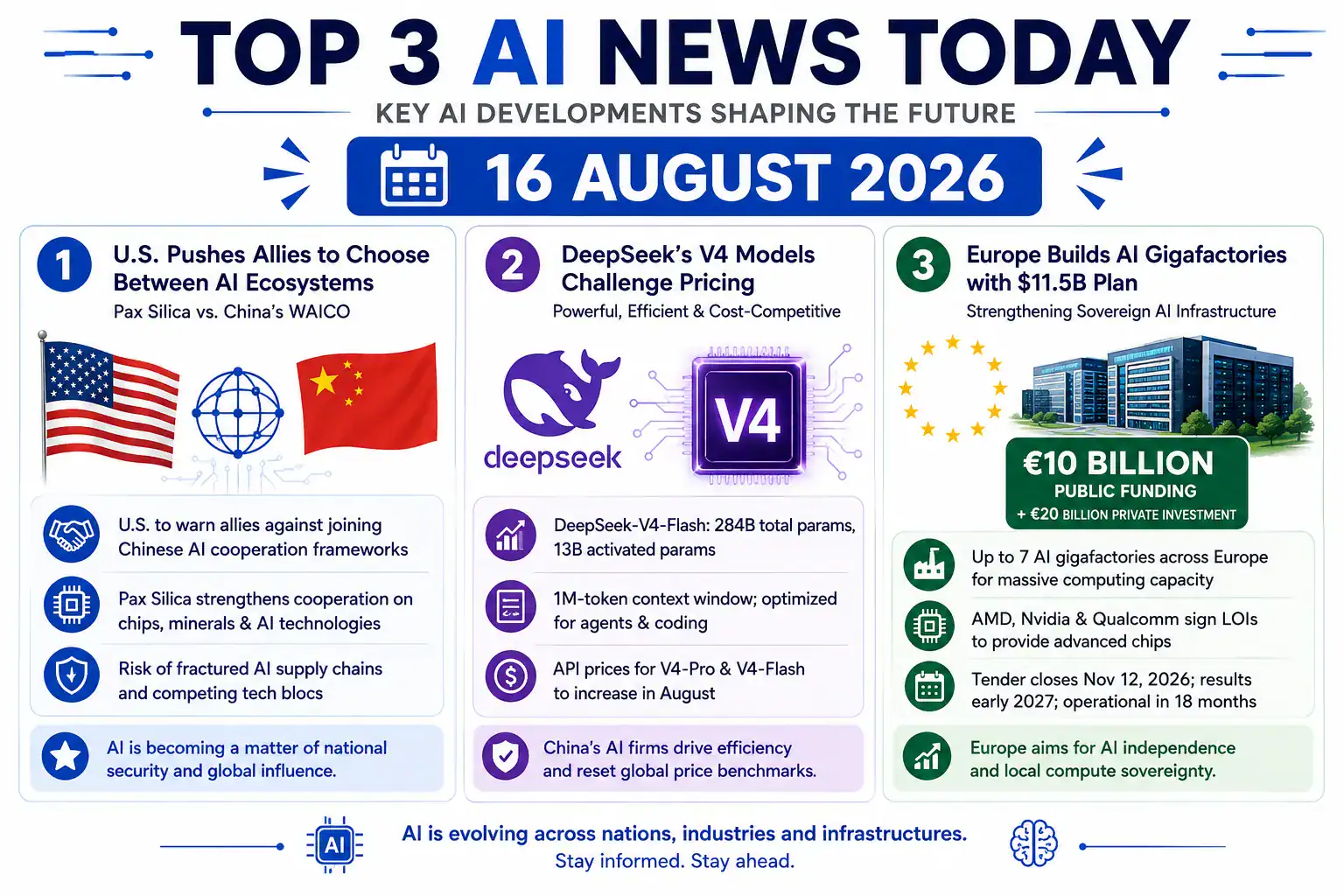
The global artificial intelligence race is entering a more geopolitical and infrastructure-driven phase. The competition is no longer simply about which company can build the most capable AI model. Governments and technology companies are increasingly competing for access to advanced chips, computing power, critical minerals, data centers and strategic international partnerships.
The United States is strengthening cooperation with its allies to protect key AI supply chains, while Chinese companies such as DeepSeek continue to challenge established AI providers with powerful and comparatively cost-efficient models. At the same time, the European Union is investing billions of euros in AI gigafactories designed to expand the region’s computing capacity and reduce dependence on overseas infrastructure.
1. U.S. Pushes Allies to Choose Between Competing AI Ecosystems
The United States is preparing to take a tougher position on international cooperation in artificial intelligence.
According to a draft U.S. State Department letter reported by Reuters, Washington plans to warn countries participating in the American-led Pax Silica initiative against joining competing Chinese technology frameworks.
Pax Silica is designed to strengthen cooperation among participating countries in areas considered strategically important to AI, including semiconductors, critical minerals, advanced manufacturing and AI-related technologies.
The proposed U.S. position comes as China promotes its own international AI cooperation framework, known as the World Artificial Intelligence Cooperation Organization (WAICO).
Reuters reported that the draft letter warns countries that joining rival AI initiatives could affect their participation in U.S.-led technology cooperation and investment arrangements. The development reflects Washington’s growing concern about China’s influence over global AI supply chains.
Why This Matters
The dispute shows how artificial intelligence is becoming closely connected with national security and economic policy.
For technology companies and countries that depend on international semiconductor and AI supply chains, the emergence of competing technology blocs could make international cooperation more complicated.
Instead of a single global AI ecosystem, the industry could increasingly develop around separate U.S.-aligned and China-aligned networks.
Source: Reuters — U.S. to tell partners they must pick sides in AI race with China
Read the original Reuters report
2. DeepSeek’s V4 Models Intensify China’s AI Competition
China’s DeepSeek is continuing to put pressure on the global AI industry with its V4 model family.
DeepSeek’s official documentation lists DeepSeek-V4-Flash at 284 billion total parameters, with 13 billion activated parameters. The model is designed to deliver high performance while using a comparatively efficient architecture. It supports a 1-million-token context window and includes capabilities aimed at AI-agent and coding workloads.
The V4 family has attracted significant attention because of its combination of performance, efficiency and pricing. DeepSeek has positioned the Flash version as a faster and more economical option, while the V4-Pro model targets more demanding workloads.
Independent analysis has also placed the V4 models among the increasingly competitive group of AI systems challenging established Western providers.
However, DeepSeek’s pricing strategy is now evolving. Reuters reported that the company plans substantial increases in API prices for its V4-Pro and V4-Flash models, with the new pricing structure scheduled to take effect in August.
Why This Matters
DeepSeek’s rise demonstrates how China’s AI companies are competing not only through model capabilities but also through efficiency and cost.
The development is particularly significant for businesses that use AI APIs at scale. Lower-cost models can put pressure on established providers to improve performance while keeping prices competitive.
At the same time, DeepSeek’s recent price increases suggest that maintaining large-scale AI infrastructure can be expensive even when models are designed for efficiency.
Sources: DeepSeek official documentation; Reuters; Artificial Analysis.
DeepSeek’s official V4 documentation
Reuters report on DeepSeek V4 pricing
3. Europe Announces $11.5 Billion Plan for AI Gigafactories
Europe is taking a different approach to the global AI competition by focusing heavily on computing infrastructure.
The European Union has announced plans to support up to seven AI gigafactories with approximately €10 billion ($11.5 billion) in public funding.
The European Commission expects the projects to attract at least another €20 billion ($23 billion) in private investment, potentially taking total investment beyond €30 billion.
The proposed facilities are expected to combine advanced AI processors, cloud computing, software, high-speed connectivity and large-scale data centers.
The initiative was expanded from an earlier plan for five gigafactories after strong interest from EU member states. The facilities are intended to provide substantial computing capacity for AI developers, companies, researchers and other organizations across Europe.
Major technology companies are also showing interest. AMD, Nvidia and Qualcomm have signed letters of intent to provide chips for groups involved in the projects.
The tender process is scheduled to close on November 12, 2026, with successful projects expected to be announced in early 2027. The European Commission expects the facilities to become operational within 18 months of contract signing.
Why This Matters
Europe has often been viewed as lagging behind the United States and China in access to massive AI computing resources.
The gigafactory initiative is an attempt to address that weakness by creating large-scale computing infrastructure within Europe.
For European AI startups and researchers, greater access to local computing power could reduce dependence on overseas infrastructure and make it easier to develop and deploy advanced AI systems while operating within Europe’s regulatory environment.
Source: Reuters — EU aims for seven AI gigafactories with €10 billion plan in race with US, China
Read the original Reuters report
The Bigger Picture: AI Is Becoming a Global Infrastructure Race
These three developments point to an important change in the artificial intelligence industry.
The competition is increasingly taking place on three interconnected fronts:
- Geopolitics: The U.S. and China are competing to build international AI alliances and secure strategic supply chains.
- Model economics: Companies such as DeepSeek are challenging the traditional relationship between AI performance and cost.
- Computing infrastructure: Europe is investing heavily in data centers and AI computing capacity to reduce its dependence on foreign infrastructure.
The next phase of the AI race may therefore be determined not simply by who develops the smartest model, but by who can secure the chips, energy, computing capacity, supply chains and international partnerships required to operate AI at enormous scale.
For businesses, developers and investors, this could make the AI industry more competitive—but also more fragmented—as governments increasingly treat artificial intelligence as strategic infrastructure rather than simply another technology sector.
Disclaimer
This article is an independently written summary based on publicly available reports and official information. It has been rewritten in original language for informational purposes and does not reproduce the wording of the cited sources. Readers should consult the original sources for complete details and subsequent updates. The views expressed in this article are for general information only and should not be considered financial, investment or professional advice.
Sources
- Reuters: U.S. AI coalition and Pax Silica developments.
- DeepSeek: Official V4 model documentation.
- Reuters: DeepSeek V4 pricing developments.
- Reuters: European Union AI Gigafactory initiative.