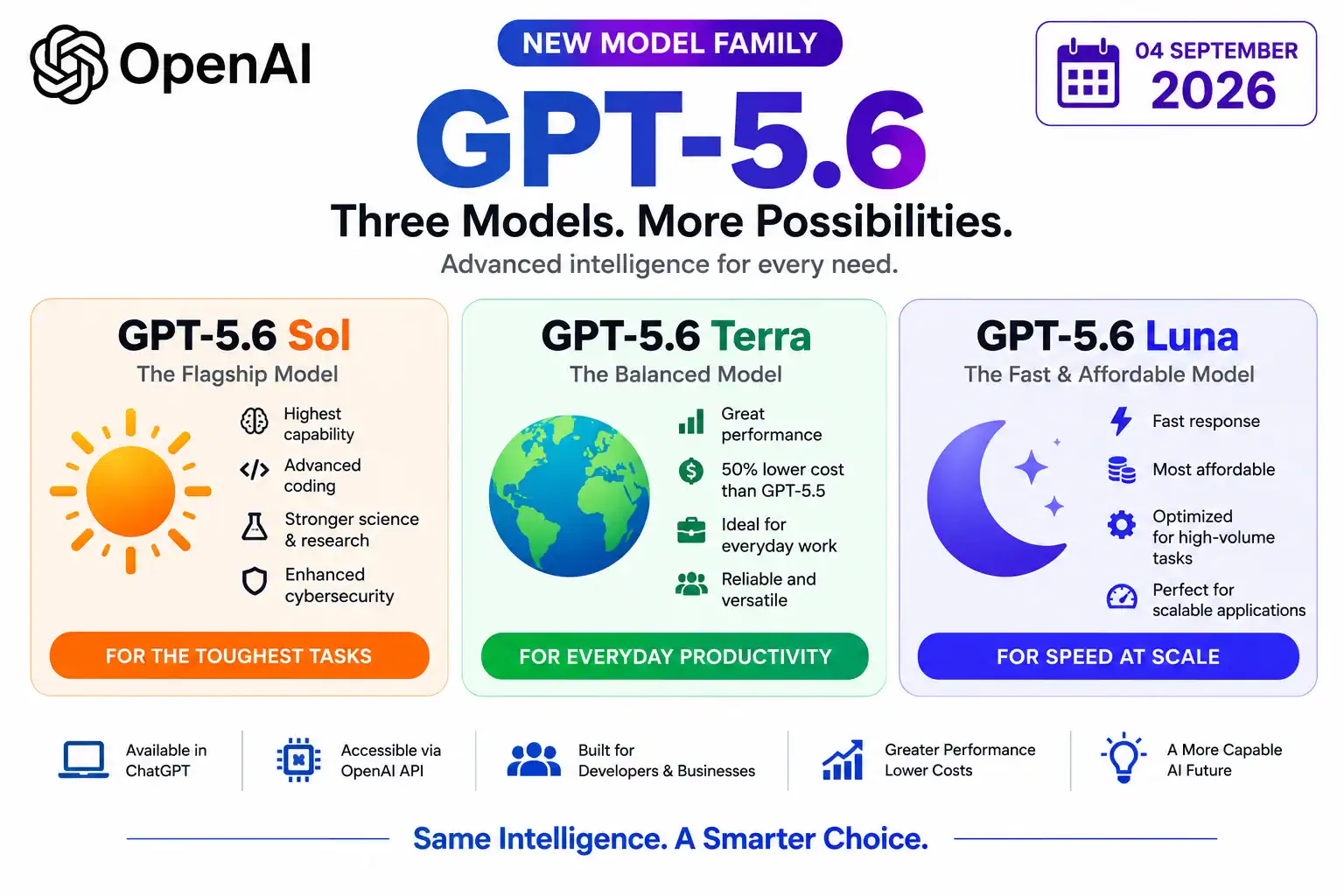
OpenAI’s GPT-5.6 family represents a major step in the company’s strategy to make advanced artificial intelligence more capable, efficient and accessible across different types of workloads.
Rather than offering a single model for every task, GPT-5.6 introduces three distinct model tiers: Sol, Terra and Luna. Sol is positioned as the flagship model for demanding workloads, Terra is designed as a balanced option for everyday professional work, while Luna focuses on speed and affordability.
The GPT-5.6 family was first introduced through a limited preview on June 26, 2026, before OpenAI moved the models into general availability on July 9, 2026. OpenAI says the three-tier approach is intended to give users and developers more flexibility when choosing the right balance between intelligence, speed and cost.
For businesses, developers and everyday AI users, the arrival of GPT-5.6 is significant because the competition among frontier AI companies is increasingly shifting from raw model intelligence toward performance per dollar, reliability, speed and the ability to complete complex real-world tasks.
OpenAI’s latest generation reflects that change.
What Is GPT-5.6?
GPT-5.6 is OpenAI’s model family built around three capability tiers:
- GPT-5.6 Sol — the flagship model for the most demanding tasks
- GPT-5.6 Terra — a balanced model for everyday professional work
- GPT-5.6 Luna — the fastest and most affordable option
OpenAI describes Sol as its strongest model in the family, while Terra is positioned as a lower-cost model with performance competitive with GPT-5.5. Luna is designed for high-volume workloads where speed and cost efficiency are particularly important.
This naming system is also intended to make model selection easier.
Instead of forcing users to choose between a small number of generic models, the GPT-5.6 family provides different levels of capability depending on what the user needs.
For example, an organization could use Sol for complex research or advanced coding while using Luna for routine classification, summarization or background automation.
That flexibility could become increasingly important as businesses deploy AI across thousands or millions of individual tasks.
GPT-5.6 Sol: OpenAI’s Flagship Model
At the top of the GPT-5.6 family is Sol.
OpenAI describes GPT-5.6 Sol as its strongest model, with improvements across coding, professional knowledge work, cybersecurity and scientific tasks.
The model is designed for situations where accuracy and reasoning quality matter more than minimizing the cost of every individual request.
One of the notable additions is a new max reasoning effort.
This allows Sol to spend more computational effort on particularly difficult problems.
OpenAI has also introduced an ultra mode, which goes beyond the capabilities of a single agent by coordinating multiple subagents on complex tasks.
That approach is particularly relevant to the growing field of agentic AI.
Instead of simply generating a response to a question, an AI system can divide a complex problem into multiple pieces, work through those pieces and combine the results.
This could be useful for software engineering, research, analysis and other long-running professional workflows.
GPT-5.6 and Advanced Coding
Software development is one of the areas where GPT-5.6 places considerable emphasis.
OpenAI says GPT-5.6 Sol achieved a state-of-the-art result on Terminal-Bench 2.1, an evaluation designed to test command-line workflows involving planning, iteration and tool coordination.
This is significant because modern AI coding is moving beyond generating isolated pieces of code.
Developers increasingly expect AI systems to:
- Understand an existing codebase
- Modify multiple files
- Run commands
- Diagnose errors
- Test implementations
- Iterate on solutions
- Use development tools
- Complete multi-step programming tasks
The ability to coordinate these activities is becoming an important part of AI-assisted software development.
The GPT-5.6 family is therefore designed around a broader concept of AI assistance rather than simply autocomplete-style coding.
For developers, this could mean using AI as a more active collaborator during software-development workflows.
GPT-5.6 Brings Improvements in Science and Biology
Another important area for GPT-5.6 is scientific reasoning.
OpenAI says GPT-5.6 Sol demonstrated stronger performance on biology workflows, including the GeneBench v1 evaluation.
According to OpenAI, the model achieved stronger results than GPT-5.5 while using fewer tokens.
Token efficiency matters because AI systems are often charged according to the amount of information processed and generated.
If a model can achieve a similar or better result with fewer tokens, the overall cost of completing a task can potentially decline.
This is part of a larger theme surrounding GPT-5.6: OpenAI is not focusing solely on making models more intelligent.
It is also attempting to make them more efficient.
That combination could be particularly important for scientific research, where AI systems may need to process large amounts of technical information and perform lengthy reasoning tasks.
GPT-5.6 Strengthens Cybersecurity Capabilities
Cybersecurity is another major area highlighted by OpenAI.
The company describes GPT-5.6 Sol as its most capable model yet for cybersecurity tasks, particularly long-horizon vulnerability research and exploitation-related work.
OpenAI says GPT-5.6 Sol achieved competitive performance against other advanced systems on its cited cybersecurity evaluations while using significantly fewer output tokens in some comparisons.
The company has simultaneously emphasized safety.
The GPT-5.6 launch included stronger safeguards designed to address higher-risk activities, sensitive cybersecurity requests and repeated misuse. OpenAI says it combined automated testing with human red-teaming before broader release.
This reflects a growing challenge for advanced AI developers.
As models become more capable of performing legitimate cybersecurity research, they can also become more capable of assisting with harmful activities.
Consequently, improving AI capability and improving AI safety increasingly have to happen together.
GPT-5.6 Terra: The Balanced AI Model
For many businesses, GPT-5.6 Terra could be the most interesting model in the family.
Terra is designed for everyday professional workloads while offering a lower price than the flagship Sol model.
OpenAI says Terra provides performance competitive with GPT-5.5 while costing substantially less.
This makes Terra particularly relevant for companies that need large-scale AI deployment.
Consider a company using AI for:
- Document analysis
- Customer support
- Internal knowledge search
- Data processing
- Content classification
- Business automation
- Routine coding
- Research assistance
Not every task requires the maximum available reasoning capability.
Using a flagship model for every request could therefore be unnecessarily expensive.
GPT-5.6 Terra provides another option.
Businesses can reserve Sol for high-value, difficult tasks and use Terra for routine workloads.
This kind of model selection could become an important component of enterprise AI cost management.
GPT-5.6 Luna Focuses on Speed and Affordability
At the other end of the family is GPT-5.6 Luna.
OpenAI positions Luna as its fastest and most affordable model.
Luna is particularly suited to high-volume applications.
For example, an organization might need to process millions of customer messages, classify documents or perform routine background tasks.
In those situations, a small improvement in cost per request can have a significant effect on the overall AI budget.
OpenAI subsequently reduced Luna’s API pricing by 80% on July 30, 2026, while Terra received a 20% price reduction.
OpenAI said these reductions were intended to make high-volume AI workloads more economical.
This makes the economics of GPT-5.6 Luna particularly interesting for developers building applications that may generate enormous numbers of AI requests.
GPT-5.6 Improves AI Performance Per Dollar
One of the central themes of the GPT-5.6 launch is performance per dollar.
AI models can become more capable while simultaneously becoming more expensive to operate.
That creates a problem for businesses.
An extremely intelligent model is not necessarily commercially useful if each task costs too much to run.
OpenAI is therefore emphasizing efficiency alongside capability.
The company says GPT-5.6 Sol can achieve stronger results with fewer tokens and lower estimated costs than previous and competing frontier models in several evaluations.
OpenAI also says that improvements in the efficiency of serving its models helped reduce the cost of running Sol.
The company’s July 30 announcement said internal optimization work reduced the end-to-end cost of serving the model by approximately 20%, while experiments improved token-generation efficiency by more than 15%.
These figures are OpenAI’s own reported results, so they should be treated as company-reported performance claims rather than independent benchmarks.
GPT-5.6 Pricing
The GPT-5.6 family uses different pricing tiers based on model capability.
OpenAI’s current API pricing lists:
| Model | Input per 1M tokens | Output per 1M tokens |
|---|---|---|
| GPT-5.6 Sol | $5 | $30 |
| GPT-5.6 Terra | $2 | $12 |
| GPT-5.6 Luna | $0.20 | $1.20 |
OpenAI announced the lower Terra and Luna pricing on July 30.
This pricing structure makes the differences between the three models particularly clear.
Sol is intended for premium, high-capability workloads.
Terra provides a middle ground.
Luna is designed for large-scale, cost-sensitive applications.
For developers, this creates an opportunity to route different tasks to different models.
GPT-5.6 and the Future of AI Agents
Another major development associated with GPT-5.6 is its focus on agentic workflows.
Modern AI systems are increasingly being designed to use tools, execute multiple steps and coordinate work rather than simply answer questions.
OpenAI says GPT-5.6 supports capabilities such as programmatic tool calling and multi-agent workflows through its API.
This could allow developers to build applications where an AI system:
- Receives a complex objective.
- Breaks the task into smaller problems.
- Uses external tools.
- Processes intermediate results.
- Coordinates multiple subagents.
- Produces a final result.
This is an important evolution from traditional chatbot interactions.
The ultimate goal is to make AI systems useful for completing real-world workflows, not just generating text.
GPT-5.6 in ChatGPT, Codex and the API
The GPT-5.6 family is available across several OpenAI products and services.
OpenAI’s general-availability announcement says GPT-5.6 is available through Ch
atGPT, Codex and the OpenAI API, with access varying according to subscription level and product.
Developers can therefore use Sol, Terra and Luna programmatically through the API.
For users, the availability of different models depends on the specific ChatGPT plan and environment.
The introduction of multiple tiers also gives OpenAI greater flexibility in serving different types of users.
A casual user may prioritize speed.
A software developer may prioritize coding capability.
An enterprise may prioritize cost efficiency.
A researcher may require maximum reasoning performance.
The GPT-5.6 family is designed to accommodate these different requirements.
Why GPT-5.6 Matters for Businesses
The biggest impact of GPT-5.6 may ultimately come from enterprise adoption.
Businesses increasingly want to integrate AI into everyday operations.
But deploying AI at scale requires more than selecting the most intelligent model.
Companies must consider:
- Cost
- Latency
- Reliability
- Security
- Data handling
- Scalability
- Tool integration
- Model performance
- Employee productivity
The three-tier GPT-5.6 strategy gives businesses more control over these trade-offs.
A company can use Luna for high-volume background operations, Terra for regular knowledge work and Sol for complex tasks where maximum capability is justified.
This could create a more economically sustainable approach to enterprise AI.
GPT-5.6 vs GPT-5.5
The most direct comparison is between GPT-5.6 and GPT-5.5.
OpenAI positions GPT-5.6 as a significant improvement in both capability and efficiency.
Terra is specifically described as having performance competitive with GPT-5.5 while costing less. Sol is positioned as the flagship model with improvements across professional work, coding, cybersecurity and science.
The important change, however, is not simply that GPT-5.6 is newer.
The family introduces a new way of thinking about model selection.
Instead of treating one model as suitable for everything, OpenAI is offering different capability tiers designed around different economic and performance requirements.
The Bigger Picture
The arrival of GPT-5.6 highlights a broader change taking place across the AI industry.
The first phase of generative AI focused heavily on model intelligence.
The next phase is increasingly about useful intelligence at scale.
Businesses do not necessarily need the most powerful model for every task.
They need the right model for each task.
That means a fast, inexpensive model can sometimes be more valuable than a significantly more intelligent but expensive alternative.
This is where the three-tier GPT-5.6 strategy becomes particularly interesting.
Sol pushes the frontier.
Terra targets everyday professional work.
Luna targets high-volume affordability.
Together, the models allow developers and businesses to build AI systems around different combinations of intelligence, speed and cost.
Final Takeaway
GPT-5.6 represents an important evolution in OpenAI’s model strategy.
The family consists of three distinct tiers: Sol, Terra and Luna. Sol is designed for demanding frontier workloads, Terra provides a balance between capability and cost, and Luna focuses on fast and affordable AI for high-volume applications.
The biggest change may be the emphasis on efficiency.
OpenAI is not simply trying to build more capable AI. It is also attempting to make advanced intelligence economically practical for a much wider range of applications.
For developers, that could mean choosing between models according to the specific requirements of each task.
For enterprises, it could mean deploying AI across more business processes without sending every request to the most expensive model.
And for the broader AI industry, GPT-5.6 demonstrates that the next competitive frontier may increasingly be measured not only by benchmark scores, but by how much useful work an AI system can accomplish for every dollar spent.
As AI agents become more capable and businesses move from experimentation to large-scale deployment, that balance between intelligence, speed and cost could become one of the most important factors determining which AI systems succeed.
Official OpenAI Sources
- OpenAI – Previewing GPT-5.6 Sol — OpenAI’s original limited-preview announcement for Sol, Terra and Luna.
- OpenAI – GPT-5.6: Frontier intelligence that scales with your ambition — General-availability announcement, capabilities, benchmarks and access details.
- OpenAI – Advancing the price-performance frontier with GPT-5.6 — Details on the July pricing reductions for Terra and Luna and OpenAI’s efficiency improvements.
Disclaimer
Disclaimer: This article has been independently written using publicly available information from OpenAI’s official announcements. It does not reproduce substantial portions of OpenAI’s source material. Benchmark results, performance comparisons, cost estimates and efficiency improvements cited in this article are based on OpenAI’s published information and should not automatically be interpreted as independent third-party benchmarks.
AI model capabilities, pricing, availability and access can change rapidly. Readers should consult the official OpenAI sources for the latest information before making technical, business or purchasing decisions.