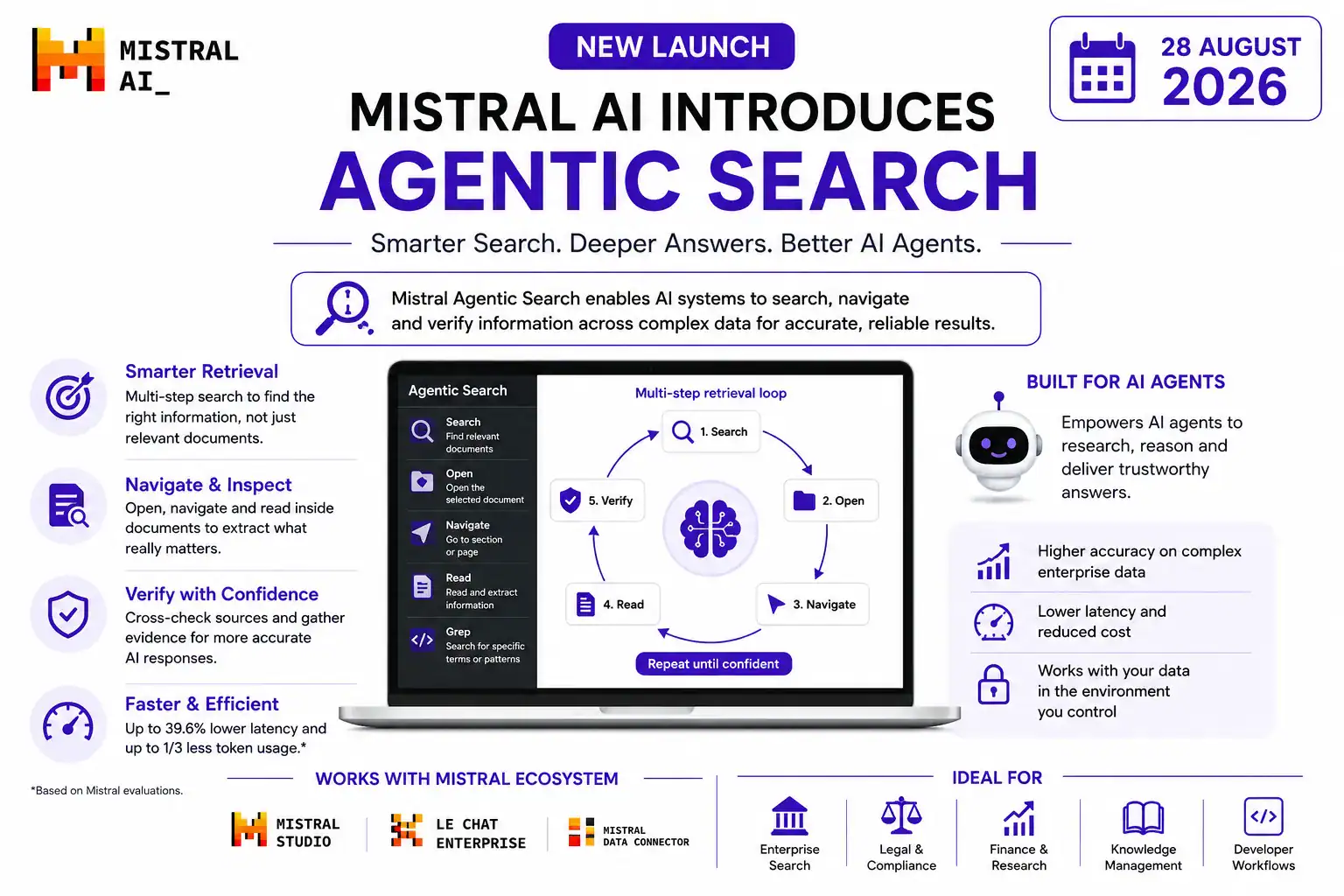
Mistral Agentic Search brings multi-step retrieval, document navigation and source verification to AI systems, helping developers build more accurate and efficient AI agents.
The way developers build AI applications is changing rapidly. Modern AI systems are no longer limited to answering questions from information already contained in a model. Increasingly, developers are connecting AI models to private databases, company documents, websites, research papers and other external sources through retrieval-augmented generation (RAG).
But conventional search and RAG systems have an important limitation: finding a relevant document does not necessarily mean finding the right information inside that document.
Mistral AI is attempting to address that problem with Mistral Agentic Search, a new retrieval layer designed to allow AI systems to search, inspect, navigate and verify information before generating an answer.
Announced on August 20, 2026, Mistral says Agentic Search is designed to deliver more accurate results while reducing unnecessary search turns, token consumption and latency. The technology is available through the Mistral Search Toolkit and Libraries, including integrations with Mistral’s Studio and Vibe environments.
For developers building AI agents, enterprise assistants and complex RAG systems, Mistral Agentic Search could represent an important shift from simple document retrieval toward more autonomous information research.
What Is Mistral Agentic Search?
Mistral Agentic Search is a retrieval system that allows an AI model to do more than simply receive a handful of search results.
Traditional RAG generally works by taking a user’s question, searching an indexed collection of documents and returning the most relevant text chunks to the AI model. The model then uses those chunks to formulate an answer.
This approach works well when the required information appears clearly within one of the retrieved passages.
However, many real-world questions are more complicated.
The answer may be:
- Buried deep inside a lengthy report
- Located in a table
- Spread across several documents
- Hidden in a footnote
- Dependent on information elsewhere in the same document
- Requiring comparison between multiple sources
- Impossible to verify from the first search results
This is where Mistral Agentic Search takes a different approach.
Instead of stopping after the initial retrieval, the AI model can continue investigating the available information. It can search again, open a document, move to a particular section, read additional content and look for specific terms before deciding that it has enough evidence.
Mistral describes this as a multi-step retrieval loop for finding, inspecting and verifying information across complex data sources.
Why Traditional RAG Can Struggle
Retrieval-augmented generation has become one of the most popular techniques for connecting AI models to external information.
A typical RAG workflow looks something like this:
User question → Search → Retrieve relevant chunks → AI model → Answer
The simplicity of this approach is also its weakness.
Suppose an employee asks an enterprise AI assistant:
“What was our company’s effective tax rate in Q3?”
A traditional search system might locate the correct financial report.
But finding the report is only the beginning.
The actual answer could be inside a financial table several pages later. The AI may need to locate the correct section, identify the appropriate quarter and interpret the surrounding figures.
A one-shot RAG system may not have the ability to perform those additional steps.
Mistral Agentic Search allows the model to continue investigating the source rather than simply relying on the first retrieved chunks.
This could make a significant difference for enterprise AI systems that work with long and complicated documents.
How Mistral Agentic Search Works
The system builds on an existing search index and gives the AI model a set of tools that resemble familiar file-system operations.
Mistral currently describes five core retrieval tools:
1. Search
The search tool finds potentially relevant documents or sections using the existing index.
2. Open
The open tool allows the model to open a specific document after identifying it as potentially useful.
3. Navigate
The navigate tool lets the model move through a document to a particular page, section or region.
4. Read
The read tool retrieves the actual information from the selected location.
5. Grep
The grep tool searches for a specific word, phrase or pattern inside an opened document.
Together, these tools allow Mistral Agentic Search to move beyond simple retrieval.
The AI can search, inspect the result, identify where additional evidence might be located, navigate to that area and read the relevant information. It can then perform another search if the evidence is still insufficient.
Mistral Agentic Search vs Traditional RAG
The difference can be summarized simply.
Traditional one-shot RAG
Question → Search → Retrieve chunks → Answer
Mistral Agentic Search
Question → Search → Inspect → Navigate → Read → Verify → Search again if necessary → Answer
The second workflow requires more reasoning, but it can potentially produce better answers when the information is difficult to locate.
Mistral says its approach allows retrieval quality to improve alongside the reasoning and tool-use capabilities of AI models, without requiring model-specific fine-tuning.
That is an important aspect of the system.
As AI models become better at planning and using tools, the retrieval workflow can potentially become more capable without requiring developers to completely rebuild their underlying search infrastructure.
Mistral Reports Major Accuracy Improvements
One of the most interesting aspects of Mistral Agentic Search is the benchmark data published by Mistral.
The company tested its system on two challenging evaluations:
- FinanceBench
- OfficeQA Pro
These benchmarks involve large collections of financial and government documents, including long PDFs, tables and complex information that can be difficult for conventional retrieval systems to process.
According to Mistral, Agentic Search produced substantial improvements over one-shot retrieval.
FinanceBench Results
FinanceBench contains hundreds of SEC filings, including 10-K, 10-Q and 8-K documents.
Mistral says that moving from one-shot RAG to a search-only agentic loop improved accuracy by more than 47 percentage points for Mistral Medium 3.5 and more than 52 percentage points for GLM-5.2.
When navigation tools such as open, navigate, read and grep were added, accuracy improved further.
Mistral reports that the full system reached 86% correctness on the benchmark, compared with 26.7% for the initial one-shot approach in the cited configuration.
These are significant results, although they should be understood as Mistral’s own benchmark results rather than an independent industry-wide evaluation.
Lower Token Usage and Latency
Better accuracy is not the only claimed advantage.
A common concern with agentic AI is that allowing models to perform multiple searches and tool calls could increase costs and response times.
Mistral argues that its navigation tools can actually reduce wasted work.
Instead of repeatedly performing broad searches, the model can enter a relevant document and move directly toward the information it needs.
According to Mistral’s testing, the full navigation workflow reduced token usage compared with the search-only loop. For the tested models, token consumption fell by approximately 24% to 34% in the FinanceBench evaluation.
Mistral also reports that adding navigation reduced p90 latency from approximately 255 seconds to 154 seconds in one FinanceBench configuration.
The company’s headline summary says Agentic Search can reduce p90 latency by up to 39.6% and token consumption by up to one-third.
This is particularly important for enterprise applications.
An AI search system that produces better answers but requires excessive computation may be difficult to operate economically at scale.
Mistral Agentic Search for Enterprise Data
One of the strongest potential applications for Mistral Agentic Search is enterprise AI.
Large organizations often have enormous amounts of internal information stored across:
- Financial documents
- Legal contracts
- Technical manuals
- Internal reports
- Government records
- Research documents
- Policies
- Product documentation
- Operational databases
Much of this information is confidential.
Mistral says its tooling is designed to support sensitive, domain-specific data while allowing organizations to maintain isolation boundaries in cloud or on-premises environments.
This could be particularly important for industries such as:
Financial services
AI systems could search financial filings, reports and regulatory documents.
Healthcare
Organizations could build assistants that retrieve information from large collections of internal documents, subject to applicable privacy and regulatory requirements.
Legal
AI systems could search lengthy contracts and identify relevant clauses.
Manufacturing
Enterprise agents could navigate technical specifications, manuals and operational documentation.
Government
AI assistants could search large collections of regulations, reports and historical records.
The common requirement is the same: the AI needs to find evidence, not merely retrieve a vaguely related paragraph.
Mistral Agentic Search for AI Agents
The technology is also particularly relevant to the growing AI-agent ecosystem.
AI agents are designed to perform multi-step tasks rather than simply answer individual questions.
An agent might need to:
- Search for information.
- Examine the available sources.
- Determine whether the information is sufficient.
- Search for additional evidence.
- Compare multiple documents.
- Verify important details.
- Complete a task based on the evidence.
This makes retrieval a critical part of agent architecture.
Without reliable retrieval, an otherwise capable AI agent can make decisions based on incomplete or incorrect information.
Mistral Agentic Search essentially gives agents more freedom to investigate their information environment before reaching a conclusion.
That could make it useful for research agents, enterprise assistants and RAG-based autonomous workflows.
Mistral Agentic Search Can Work With Existing Indexes
Another important aspect is that developers do not necessarily need to abandon their existing search infrastructure.
Mistral says Mistral Agentic Search builds on an existing search index.
The system can use the index as its starting point and then provide additional tools for navigating and investigating the underlying documents.
This could make adoption easier for organizations that already have search systems in place.
Instead of replacing the entire retrieval architecture, developers can add an agentic layer that allows AI models to interact more intelligently with the available information.
The Mistral documentation describes Agentic Search as an orchestration layer rather than simply another retrieval method. It can work on top of keyword, semantic or hybrid retrieval approaches.
When Should Developers Use Mistral Agentic Search?
Not every AI search problem requires agentic retrieval.
For simple questions, traditional search may still be the better option.
For example, if a user asks:
“What is the company’s headquarters?”
and the answer appears clearly in a short document, there is little reason to perform multiple retrieval steps.
Traditional indexed search can be faster and simpler.
Mistral Agentic Search becomes more useful when the question requires investigation.
Good use cases include:
- Long documents
- Complex PDFs
- Financial statements
- Tables
- Legal contracts
- Technical specifications
- Questions requiring multiple sources
- Research requiring evidence verification
- Data spread across several documents
Mistral itself recommends standard indexed retrieval for direct lookups and high-volume predictable searches, while positioning Agentic Search for questions that require deeper investigation.
Why This Matters for Developers
The importance of Mistral Agentic Search goes beyond one new Mistral product.
It reflects a broader change in how developers are building AI applications.
Early RAG systems were often designed around a relatively simple assumption:
Find the relevant text and give it to the model.
Modern AI agents increasingly require something more sophisticated:
Let the model investigate the information and decide what evidence it needs.
That shift could make retrieval systems more dynamic.
Instead of developers trying to anticipate every possible question and optimize chunking strategies around those questions, the AI can have more control over how it explores the available information.
This does not eliminate the need for good indexing.
In fact, Mistral emphasizes that a well-configured index remains the foundation of the system. Agentic Search adds an additional reasoning and navigation layer on top of it.
The Bigger Picture
Mistral Agentic Search arrives at an important moment for the AI industry.
AI models are becoming increasingly capable at reasoning and tool use, but their usefulness often depends on the quality of the information they can access.
Retrieval is therefore becoming just as important as the model itself.
A powerful model connected to poor search can still produce unreliable answers.
A capable model connected to high-quality retrieval, document navigation and verification tools can potentially perform much more useful work.
Mistral’s approach is an example of this broader movement toward agentic AI infrastructure.
Instead of treating search as a simple backend service, the system allows the AI to participate actively in the retrieval process.
Final Takeaway
Mistral Agentic Search is designed to address one of the biggest limitations of traditional RAG: the assumption that the first few retrieved text chunks contain everything the AI needs.
By allowing models to search, open, navigate, read and grep through documents, the system gives AI agents a more active role in finding and verifying evidence.
Mistral’s published benchmarks report substantial gains in accuracy on difficult financial and government-document tasks, along with reductions in token usage and latency in its tested configurations.
For developers, the biggest opportunity may be enterprise AI.
As businesses connect AI systems to increasingly large collections of confidential documents and internal knowledge, simple retrieval may not always be enough.
Mistral Agentic Search offers a more dynamic approach in which an AI agent can investigate complex information before producing an answer.
The technology is not a replacement for traditional search. For simple and predictable queries, conventional retrieval remains useful and often more efficient.
But when the answer is buried inside a long document, spread across multiple sources or requires verification, Mistral Agentic Search could provide a more capable foundation for next-generation AI agents.
The broader trend is clear: AI search is evolving from retrieval to investigation.
And as AI agents become more autonomous, the ability to find, inspect and verify reliable information could become one of the most important capabilities in the entire AI application stack.
Official Sources
- Mistral AI – Agentic Search: Mistral AI: Introducing Agentic Search
- Mistral Documentation – Agentic Search: Mistral Agentic Search Documentation
- Mistral AI: Mistral AI Official Website
Disclaimer
This article has been independently written using information from Mistral AI’s official announcement and documentation. It does not reproduce substantial portions of Mistral’s source material. Benchmark figures and performance claims mentioned above are based on Mistral’s published testing and should not be interpreted as independent industry-wide benchmarks. Product capabilities, availability, pricing and documentation may change over time.