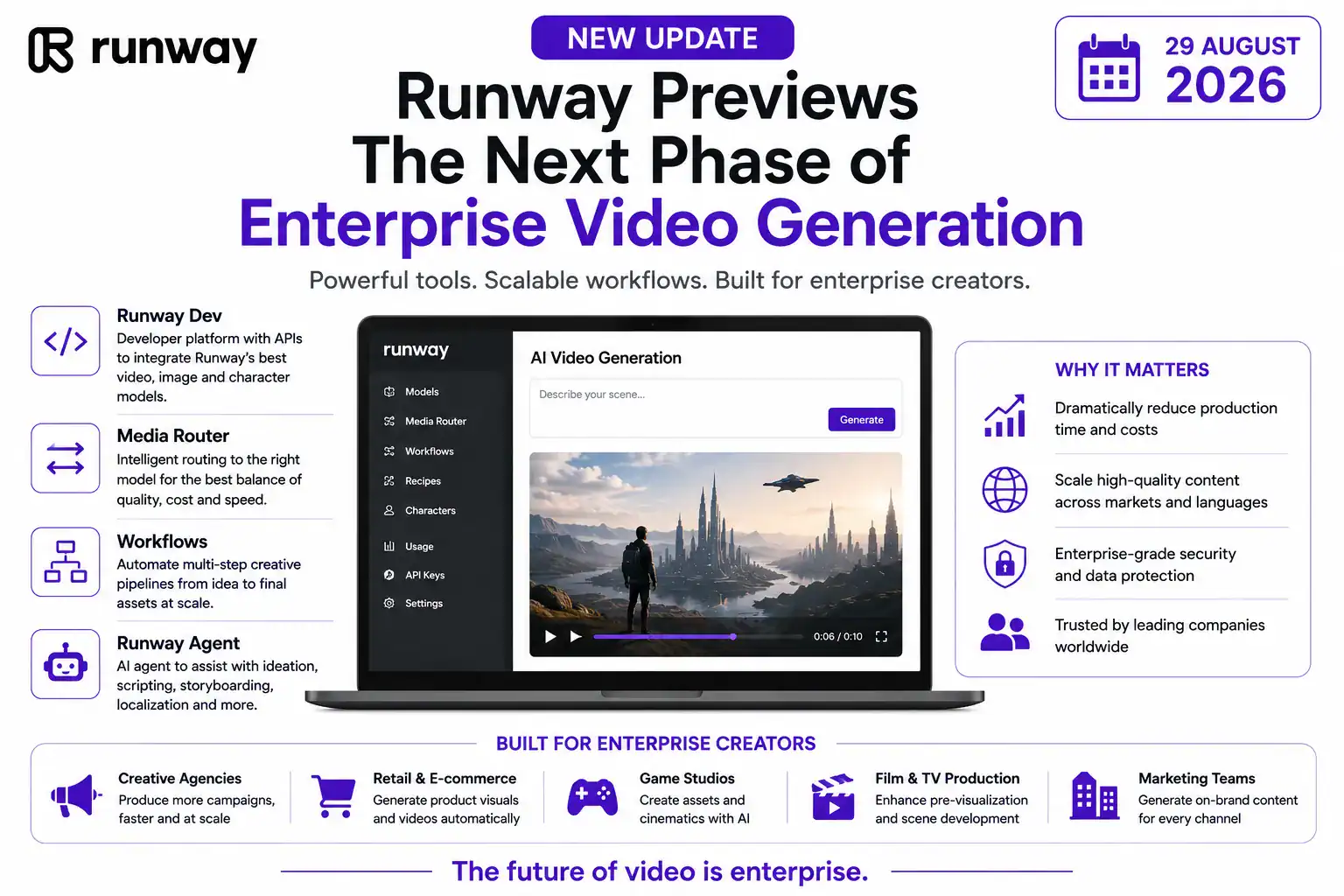
The future of Runway enterprise video generation is moving beyond simple text-to-video creation. Runway is increasingly positioning its technology as infrastructure that businesses can integrate directly into their creative and production systems.
On August 20, 2026, Runway published a major update titled “The Next Phase of Enterprise Video Generation,” outlining how the company sees enterprise AI video evolving. The announcement comes shortly after Runway launched Runway Dev and Runway Media Router on July 23, giving developers access to multiple media models, APIs, custom workflows and intelligent model selection.
The shift is significant because Runway enterprise video generation is increasingly focused not only on creating individual AI videos but also on helping businesses automate entire media-production pipelines.
According to Runway, its business has more than doubled during 2026, while its net revenue retention has exceeded 300%. The company says enterprise adoption has expanded among organizations including Amazon, Microsoft, Allstate, Adobe and Robinhood, while one Fortune 20 customer increased its use of Runway more than 17 times during the year.
These developments suggest that the next stage of Runway enterprise video generation could be less about individual creators experimenting with AI and more about companies integrating AI media production into their everyday operations.
What Is Runway Enterprise Video Generation?
Runway enterprise video generation refers to the use of Runway’s AI-powered media technology within large-scale business and production environments.
Rather than requiring employees to manually create every image or video, businesses can integrate Runway’s models and workflows into their existing software and operational systems.
This can include:
- Advertising production
- Product visualization
- E-commerce content
- Film and television production
- Game development
- Marketing campaigns
- Social media content
- Localization
- Pre-visualization
- Automated creative workflows
Runway’s Runway Dev platform provides developers with APIs for accessing Runway’s own models as well as selected third-party media models. The platform also includes Recipes, Workflows, Characters and Media Router capabilities.
This makes Runway enterprise video generation considerably different from a simple consumer-facing AI video generator.
The objective is to make AI-generated media part of a company’s infrastructure.
Runway Dev Brings AI Video Generation to Developers
One of the most important foundations of Runway’s enterprise strategy is Runway Dev, which was launched on July 23, 2026.
Runway describes Runway Dev as an AI media platform designed for professional developers and enterprise teams. It provides a single API through which developers can access image, video and character models.
The platform is designed to solve a common problem for businesses adopting generative AI.
Companies often need to integrate several different AI providers into their applications. Each provider can have a different API, billing structure, authentication system and technical implementation.
Managing multiple integrations can become complicated as new models are released.
Runway Dev attempts to simplify this by bringing multiple models and media capabilities into one platform.
For organizations developing Runway enterprise video generation applications, this could mean less engineering work and a simpler way to manage AI-generated media.
Runway says its platform is already used by teams at companies including Adobe, ElevenLabs, Shutterstock and Figma Weave.
Runway Media Router Could Simplify Enterprise AI Video
Another major component of Runway enterprise video generation is the company’s Media Router.
Runway launched Runway Media Router alongside Runway Dev on July 23. The system is designed to automatically select an appropriate image, video or audio model for a particular request.
This is increasingly important because the number of generative AI models is growing rapidly.
A developer may have access to several video models, but choosing the right model for every generation request can become difficult.
One model might provide better quality.
Another might be faster.
A third might be cheaper.
A fourth might perform better for a particular type of visual content.
Manually managing these decisions becomes especially difficult when a business is generating thousands or millions of assets.
Runway’s Media Router allows developers to define preferences around cost, quality and latency and then automatically select a suitable model based on those requirements.
For Runway enterprise video generation, this could become an important cost-management tool.
Why Model Routing Matters for Enterprise Video
Imagine an international retailer generating product videos for 100,000 products.
The company may not want every request to use the most expensive model.
For simple product previews, a faster and cheaper model might be sufficient.
For premium advertising campaigns, the company might prefer a higher-quality model.
With traditional integrations, developers would need to build this logic themselves.
Runway Media Router attempts to make this process more automated.
Businesses can establish rules and preferences, while the router evaluates eligible models and selects one based on the configured requirements. Runway also provides metadata showing which model was used and why.
This is particularly relevant to Runway enterprise video generation because production economics become increasingly important at high volume.
A small difference in cost per generation can become a significant expense when multiplied across millions of requests.
Runway Enterprise Video Generation Is Moving Toward Automated Workflows
Another major element of Runway’s enterprise strategy is Workflows.
Workflows allow developers and businesses to combine multiple models, media types and tasks into a custom pipeline that can be triggered through an API.
This could allow an organization to build a production process such as:
Marketing brief → Script → Storyboard → Image generation → Video generation → Localization → Final assets
Instead of requiring a person to manually perform every step, multiple parts of the process can be automated.
Runway says enterprise customers are already using Workflows for large-scale content production.
For example, the company says a major broadcaster uses an API-driven workflow that enables a five-person team to produce hundreds of advertisements annually across more than 50 studio labels.
A global retailer is also reported by Runway to generate more than 1,000 product images per month through an automated pipeline.
These examples demonstrate why Runway enterprise video generation is increasingly becoming a workflow and automation story rather than simply an AI video-generation story.
Runway Agent Adds Autonomous Creative Workflows
Runway’s August 20 enterprise announcement also highlighted Runway Agent.
The company describes Agent as an agentic creative partner that can help with tasks across branding, social media, advertising and product content.
The system is designed to automate repetitive parts of creative production, including workflow orchestration, pre-visualization, mood boards, scripting, localization and asset generation.
This is another major development for Runway enterprise video generation.
Traditional AI assistants generally help humans complete individual tasks.
Agentic systems attempt to complete a sequence of related tasks.
For example, instead of simply generating a video from a prompt, an AI agent could potentially help transform a creative brief into multiple assets through a connected workflow.
That could allow human creative teams to spend more time on creative direction and decision-making while AI handles repetitive production tasks.
Runway Says AI Can Dramatically Reduce Production Costs
Cost reduction is another major reason businesses are exploring Runway enterprise video generation.
In its August announcement, Runway said its AI Media Report found production costs falling by two to three orders of magnitude across hundreds of enterprises using the company’s technology.
Runway provided an example involving a financial-services brand whose television commercial historically cost more than $5 million to produce. According to Runway, the campaign was produced for a few thousand dollars using its technology.
Such claims come directly from Runway and should therefore be viewed as company-reported results rather than independent industry benchmarks.
Nevertheless, the broader idea is important.
Traditional video production can require:
- Locations
- Actors
- Camera crews
- Lighting equipment
- Sets
- Travel
- Post-production
- Multiple rounds of reshoots
AI-generated media could potentially reduce some of these expenses, particularly for digital advertising, product visualization and early-stage creative development.
This could make Runway enterprise video generation attractive to businesses that need to produce large volumes of visual content.
Data Security and Ownership Become Critical
As businesses move AI video generation into production, data security becomes increasingly important.
Companies may use AI systems with confidential product information, unreleased advertising campaigns, proprietary characters or customer data.
Runway says its enterprise offering includes security and data-protection measures, including contractual commitments not to train on enterprise customer data, zero-data-retention options and security certifications. The company also lists SOC 2 Type II, ISO-related standards, GDPR/CCPA support and enterprise access controls among its offerings.
For businesses considering Runway enterprise video generation, these issues can be just as important as video quality.
An enterprise customer needs to know:
- Who can access the data?
- Is customer content used for training?
- Where is data stored?
- How long is it retained?
- Who owns generated content?
- What happens if a third-party model is used?
These questions will become increasingly important as AI-generated media becomes part of corporate production infrastructure.
Runway Introduces the Idea of Model Ownership
One of the more interesting points in Runway’s August announcement is the company’s discussion of model licensing.
Most businesses currently “rent” AI intelligence through APIs.
A company sends a request to a cloud model and pays for usage.
But some organizations may prefer to host a model within their own infrastructure.
Runway says it is exploring model licensing arrangements in which customers can receive closed model weights and proprietary training and inference frameworks, allowing them to host and fine-tune models within their own environments.
This could be especially relevant for organizations with:
- Valuable proprietary intellectual property
- Sensitive data
- Large computing infrastructure
- Strict regulatory requirements
- Very high AI usage
- Specialized production requirements
For these businesses, Runway enterprise video generation could eventually involve owning or privately operating a specialized AI model rather than simply paying for access to a shared cloud service.
Runway Is Building a Multi-Model Enterprise Platform
Another significant aspect of the company’s strategy is that Runway does not want businesses to depend exclusively on one model.
Runway says its platform provides access to its own models as well as third-party systems such as Seedance, Kling, Veo, Nano Banana, GPT Image 2 and other models as they become available.
This is important because AI model performance changes quickly.
A model that is considered the best today could be surpassed by another model a few months later.
For enterprises, rebuilding their entire software architecture every time a new model appears would be impractical.
Runway’s model-routing approach is therefore designed to make the underlying model less important to the application developer.
The business can define its requirements while the infrastructure determines which model is most appropriate.
Who Could Benefit From Runway Enterprise Video Generation?
The potential applications are broad.
Advertising Agencies
Agencies could automate the creation of multiple campaign variations, languages and formats.
Retailers
Retail businesses could generate product images and videos for thousands of products.
Game Studios
Game developers could use AI-generated characters, environments and interactive media during development.
Film and Television
Production teams could use AI for pre-visualization, storyboarding and concept development.
Corporate Marketing Teams
Companies could produce localized advertisements and social-media content at much greater scale.
E-Commerce Companies
AI could help create product visuals without organizing traditional photo shoots for every variation.
These use cases demonstrate why Runway enterprise video generation could become an important category within enterprise AI.
What the Next Phase of Runway Enterprise Video Generation Could Look Like
The August announcement suggests that Runway believes the future of AI media will not be determined solely by which company has the best individual model.
Instead, businesses will care about the entire production system.
That includes:
Model quality — Can the system create professional media?
Workflow integration — Can it connect with existing business software?
Cost efficiency — Can companies generate content economically at scale?
Speed — Can large numbers of assets be created quickly?
Security — Can confidential information remain protected?
Model flexibility — Can companies access different models without rebuilding their systems?
Automation — Can AI complete multi-step production tasks?
Ownership — Can enterprises eventually control specialized models and their deployment?
Runway’s enterprise strategy increasingly addresses each of these areas.
Final Takeaway
The latest developments suggest that Runway enterprise video generation is moving into a new phase.
Runway is no longer positioning its technology solely as a creative website for individual users. Through Runway Dev, Media Router, Workflows, Recipes, Characters and Runway Agent, the company is building infrastructure designed to allow businesses to integrate generative media into their own products and production systems.
The August 20 announcement reinforces that direction.
The future of Runway enterprise video generation could involve companies generating thousands of videos automatically, routing individual requests between different AI models, building custom production pipelines and eventually deploying specialized models inside their own infrastructure.
For creative agencies, retailers, game studios, entertainment companies and corporate marketing departments, that could fundamentally change how visual content is produced.
The bigger trend is even more significant: AI video generation is moving from a creative tool toward enterprise infrastructure.
As models become increasingly similar in capability, businesses may care less about simply having access to the “best” model and more about having a system that is reliable, secure, flexible, affordable and easy to integrate.
That appears to be the opportunity Runway is targeting with its next phase of enterprise video generation.
Official Sources and Further Reading
- Runway – The Next Phase of Enterprise Video Generation: Read the official August 20 announcement
- Runway Dev: Read the Runway Dev announcement
- Runway Media Router: Read the official Media Router announcement
- Runway News: Visit Runway’s official News page
Disclaimer
Disclaimer: This article has been independently written using publicly available information from Runway’s official announcements and website. Company-reported statistics, customer examples and performance claims have been attributed to Runway and should not be interpreted as independent industry benchmarks. Product capabilities, availability, pricing, model access and enterprise terms may change over time. Readers should consult the official Runway sources for the latest information.