The artificial intelligence industry is entering a new phase in which the focus is no longer limited to building bigger models. Recent developments from the United States, China and Europe show three important trends emerging at the same time: AI is moving closer to personal devices, companies are spending enormous amounts on AI infrastructure, and governments are pushing for greater transparency around AI-generated content.
Here are three major AI developments making headlines this week.
Meta Introduces Muse Glimmer for Local AI
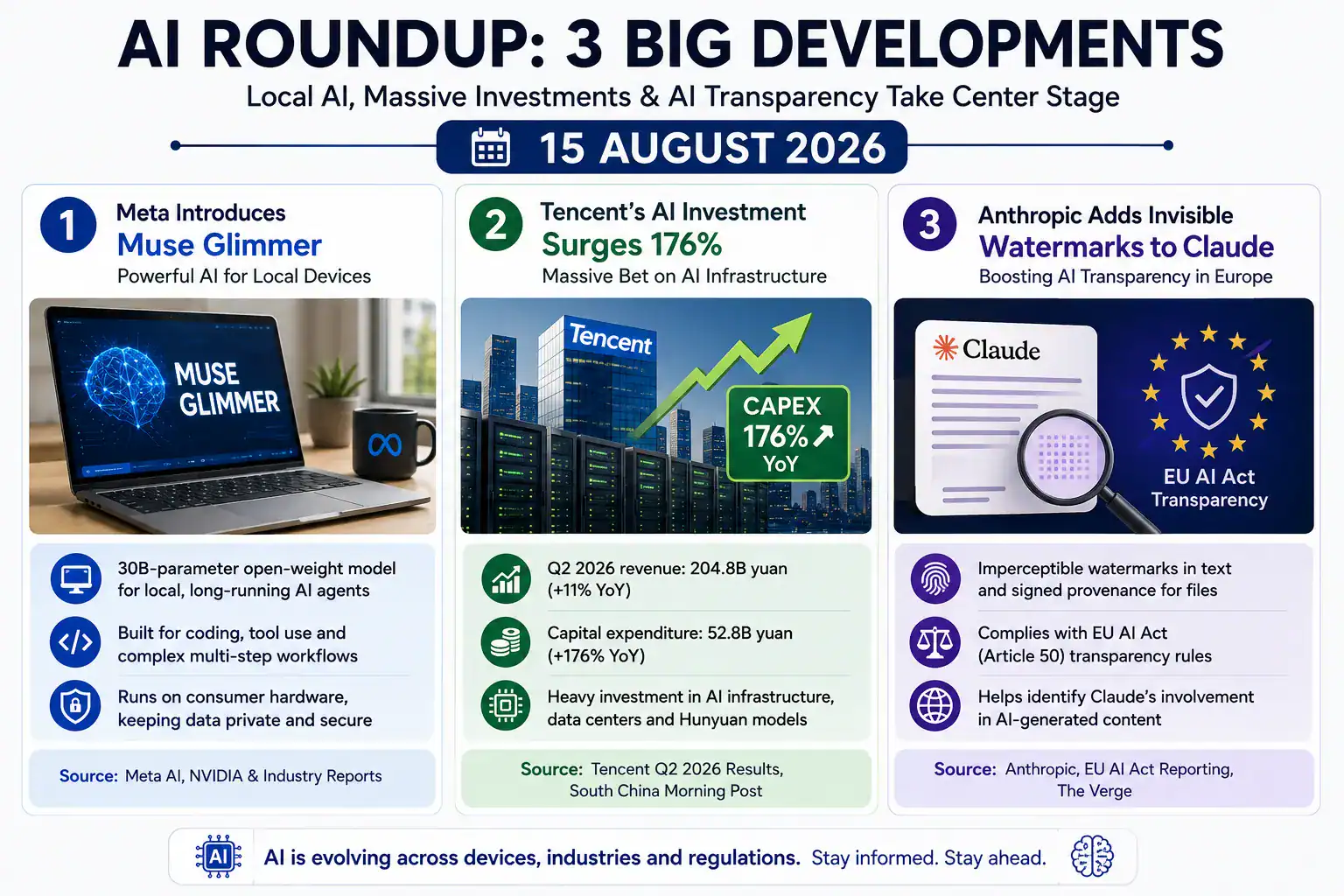
Meta has released Muse Glimmer, a 30-billion-parameter open-weight AI model designed specifically for local and long-running AI agent workloads.
The model is built to run on consumer hardware, with Meta targeting applications such as coding, tool use and autonomous AI agents. Unlike cloud-dependent AI services, local execution allows users to process information directly on their own computers.
Muse Glimmer has a context window of more than 120,000 tokens and is designed for complex, multi-step workflows. NVIDIA has also highlighted the model’s ability to run on a range of its platforms.
Why Local AI Matters
The shift toward local AI could have significant implications for privacy and data security. When an AI model operates on a user’s own computer, sensitive files and information do not necessarily have to be sent to a remote cloud service.
This could be particularly useful for software developers, businesses and professionals working with confidential information.
Meta’s latest release also reinforces the company’s continuing interest in open-weight AI. If powerful AI agents can increasingly operate on consumer computers, users may have more control over how and where their AI systems process information.
Source: Meta AI / NVIDIA / industry reporting.
Tencent’s AI Investment Surges as Capital Spending Jumps 176%
In China, technology giant Tencent is dramatically increasing its spending on artificial intelligence infrastructure.
Tencent reported second-quarter 2026 revenue of approximately 204.8 billion yuan ($30.4 billion), exceeding market expectations. At the same time, its capital expenditure climbed 176% year over year to 52.8 billion yuan.
The company’s aggressive investment in AI infrastructure contributed to negative free cash flow of 13.8 billion yuan during the quarter. Tencent said AI-related prepayments and infrastructure requirements were among the factors affecting cash flow.
China’s AI Race Gets More Expensive
Tencent’s spending illustrates how expensive the global AI race has become.
Building competitive AI systems requires much more than developing software models. Companies need powerful computing systems, data-centre capacity, advanced chips and other infrastructure to train and operate increasingly sophisticated AI models.
Tencent is investing in AI products and services across its ecosystem, including its Hunyuan models and AI-powered applications.
The company’s spending also highlights a broader trend across China’s technology industry, where major companies are committing substantial resources to AI in an effort to compete in the rapidly developing global market.
Source: South China Morning Post and Tencent’s official Q2 2026 results.
Anthropic Adds Invisible Watermarks to Claude AI Content
Meanwhile, Europe is pushing the AI industry in a different direction.
Anthropic, the company behind Claude, has introduced machine-readable marking for AI-generated content as new transparency requirements under the European Union’s AI Act take effect.
The system uses an imperceptible watermark in text, while certain files can contain digitally signed provenance information. The markings are designed to help determine whether Claude was involved in producing or processing content.
The requirements are connected to Article 50 of the EU AI Act, whose transparency obligations became applicable on August 2, 2026.
Importantly, Anthropic’s watermark does not necessarily prove that an entire piece of content was written by AI. The company says the technology is intended to indicate Claude’s involvement, and it acknowledges that detection has limitations.
A New Era of AI Transparency
AI watermarking could become increasingly important as synthetic text, images, audio and video become part of everyday digital communication.
Publishers, businesses, educational institutions and online platforms could potentially use such technologies to determine whether AI systems were involved in creating or modifying content.
However, the technology also raises questions about accuracy, privacy and authorship—particularly when AI is used only for tasks such as editing, proofreading or improving an existing human-written document.
Anthropic’s decision could encourage other major AI companies to adopt similar mechanisms as governments introduce stricter transparency requirements.
Source: Anthropic, European Union AI Act reporting and The Verge.
What These Three Developments Tell Us About the Future of AI
Although these developments come from different parts of the world, they reveal a common trend.
Meta is working to bring capable AI closer to the user. Its Muse Glimmer model demonstrates the potential for sophisticated AI agents to operate locally on personal hardware.
Tencent is demonstrating the enormous investment required to compete in AI. Its 176% increase in capital expenditure shows that the AI race is becoming increasingly dependent on computing infrastructure and financial resources.
Anthropic is responding to growing demands for transparency. Its watermarking technology shows how AI regulation is beginning to influence the design of commercial AI systems.
Together, these developments suggest that the next stage of the AI revolution will not be determined solely by who builds the most powerful model. Where AI runs, how much it costs to operate, and how users can identify AI-generated content could become equally important.
The coming years could therefore see a combination of local AI, massive cloud infrastructure and stronger regulatory oversight shaping how artificial intelligence is developed and used around the world.
Disclaimer
Top AI News Today: Meta’s Muse Glimmer, Tencent’s AI Spending and Anthropic’s AI Watermarks
Published: August 15, 2026
Artificial intelligence is rapidly moving into a new stage. The industry’s focus is no longer limited to building larger and more capable models. Increasingly, companies are looking at where AI runs, how much infrastructure it requires and how AI-generated content can be identified.
Three recent developments highlight these changing priorities. Meta has introduced a new open-weight model designed for local AI workloads, Tencent is dramatically increasing its investment in AI infrastructure, and Anthropic is adding machine-readable identification to content generated by Claude.
Here is a closer look at the three developments shaping the AI industry.
1. Meta Introduces Muse Glimmer for Local AI
Meta has launched Muse Glimmer, a 30-billion-parameter open-weight AI model designed for agentic workloads that can operate locally on consumer hardware.
The model is particularly interesting because Meta is targeting long-running AI tasks rather than simple question-and-answer interactions. Muse Glimmer is designed for activities such as coding, tool use and multi-step agent workflows. Reports indicate that its context length extends beyond 131,000 tokens, giving it the ability to work with large amounts of information during a single task.
Unlike many AI services that require users to send their prompts and files to cloud-based servers, a local model can process information directly on a compatible computer.
That could make local AI particularly attractive for developers, businesses and users who want greater control over their data.
Why Local AI Is Becoming Important
Cloud-based AI has played a major role in the growth of generative AI, but it also creates challenges involving cost, latency, connectivity and data privacy.
Local AI offers a different approach.
When an AI model runs directly on a user’s computer, sensitive documents and other information can potentially remain on the device rather than being transmitted to a remote AI service.
Muse Glimmer is also part of Meta’s broader push toward open-weight AI models. The company has increasingly emphasized giving developers access to models that can be adapted and deployed in different environments.
Meta’s broader Muse strategy includes models such as Muse Spark, which the company describes as being designed for agentic workflows, coding and computer use.
The arrival of a 30-billion-parameter model aimed at local deployment could therefore be important for the development of personal AI agents.
Instead of interacting with an AI assistant only through a website or smartphone application, users could eventually have AI systems operating continuously on their own computers.
What Could Come Next?
The growth of local AI could lead to more specialized personal assistants capable of working with local files, applications and development environments.
For developers, this could mean AI coding agents that work without continuously sending project data to external servers. For businesses, local deployment could offer another option for handling confidential information.
However, running a large model locally still requires substantial computing resources. Hardware availability, memory requirements and model optimization will remain important factors.
Read more about Meta’s AI models: Meta AI – Official AI Blog
2. Tencent Dramatically Increases AI Infrastructure Spending
China’s technology giant Tencent is significantly increasing its investment in artificial intelligence infrastructure as competition in the country’s AI sector intensifies.
Tencent reported second-quarter 2026 revenue of approximately 204.8 billion yuan, representing an 11% year-over-year increase. At the same time, the company’s capital expenditure reached 52.8 billion yuan, a dramatic increase compared with the previous year. Reuters reported that the spending was closely connected to Tencent’s growing investment in AI infrastructure.
Other market reports put the year-over-year increase in capital expenditure at approximately 176%.
The enormous increase illustrates just how expensive the AI race is becoming.
AI Requires More Than Software
Building an advanced AI ecosystem requires much more than training a language model.
Companies need powerful processors, large-scale data centers, networking equipment, high-bandwidth memory and significant amounts of electricity.
Tencent is investing across several parts of its AI ecosystem, including its Hunyuan AI models, AI assistants and cloud services.
The company has also been expanding its AI capabilities through products such as Yuanbao and WorkBuddy, while AI-powered advertising tools have contributed to improvements in its advertising business.
China’s AI Competition Is Intensifying
Tencent’s spending is part of a much larger investment wave across China’s technology industry.
Major Chinese technology companies are competing to develop increasingly capable AI models while simultaneously building the infrastructure required to serve millions of users and enterprise customers.
The challenge is particularly significant because AI infrastructure can require enormous upfront investment.
For companies such as Tencent, the calculation is therefore not simply whether an AI model performs well. The company must also determine whether the investment in computing infrastructure can eventually generate sufficient revenue through cloud services, advertising, consumer applications and enterprise AI products.
The Financial Cost of the AI Race
Tencent’s results also demonstrate the financial pressure associated with rapid AI expansion.
The company recorded negative free cash flow during the quarter, with increased infrastructure spending and AI-related investments among the factors affecting cash generation.
That does not necessarily mean the investment is unsuccessful. Technology companies often spend heavily ahead of major platform transitions.
However, it demonstrates that the next stage of AI development will require enormous amounts of capital.
Read Tencent’s investor information: Tencent Investor Relations
3. Anthropic Adds Invisible Watermarks to Claude AI Content
Anthropic is taking another approach to one of the biggest challenges created by generative AI: identifying AI-generated content.
The company has announced plans to add invisible, machine-readable watermarks and provenance information to content produced by Claude.
For text, Anthropic is using an imperceptible watermark embedded directly into the output. For images, the company plans to use provenance information based on the C2PA standard.
The move comes as new transparency requirements under the European Union’s AI Act take effect.
Anthropic says the identification mechanisms are designed to help determine whether Claude was involved in generating or processing content.
Why AI Watermarking Matters
Generative AI has made it increasingly difficult to determine whether text, images and other digital material were created by humans or AI systems.
That creates challenges for publishers, educators, businesses and online platforms.
Consider a document that has been heavily edited by AI but originally written by a human. Or an image that was created by a person and then modified using an AI tool.
Simply asking whether something is “AI-generated” may not provide enough information.
Anthropic’s approach is instead focused on identifying Claude’s involvement in the creation or processing of the content.
The company has also acknowledged that watermarking and provenance technologies have limitations. Metadata can sometimes be removed, and identifying AI involvement does not necessarily establish how much of the final content was produced by AI.
AI Transparency Could Become the New Normal
Anthropic’s move could be part of a much wider industry trend.
As governments introduce transparency requirements for AI systems, technology companies may increasingly build identification mechanisms directly into their models.
The result could be a future in which AI-generated material carries invisible technical signals that can be checked by platforms, organizations or specialized detection tools.
However, this approach will also raise questions about privacy, accuracy and authorship.
A watermark may indicate that an AI system was involved, but it may not tell us whether the AI wrote an entire article, generated a first draft, corrected grammar or simply helped edit a few sentences.
These distinctions could become increasingly important as AI becomes a normal part of everyday creative and professional work.
Read the latest reporting: The Verge – Anthropic’s AI watermark announcement
What These Three AI Developments Tell Us
Although Meta, Tencent and Anthropic are approaching AI from very different directions, their latest moves reveal three important trends.
1. AI is moving closer to personal devices
Meta’s Muse Glimmer demonstrates the growing potential of running capable AI models directly on consumer hardware.
Local AI could offer advantages in privacy, latency and customization while reducing dependence on cloud services.
2. AI infrastructure is becoming enormously expensive
Tencent’s spending illustrates the scale of investment required to compete in AI.
The industry increasingly depends on GPUs, memory, data centers, networking and electricity. As models and user demand grow, infrastructure spending is likely to remain one of the largest costs in the AI ecosystem.
3. AI transparency is becoming increasingly important
Anthropic’s watermarking initiative demonstrates that AI regulation is beginning to influence how commercial AI systems are designed.
As synthetic content becomes more common, governments, platforms and users will need better ways to understand how digital content was created.
The Bigger Picture
These developments show that the future of artificial intelligence will not be determined solely by who builds the most powerful model.
The location of AI processing, the cost of the infrastructure behind it, and the ability to identify AI-generated content could become equally important.
Meta is pushing AI toward personal computers and local agentic workflows. Tencent is investing heavily in the infrastructure needed to compete at scale. Anthropic is working to make AI-generated content more traceable.
Together, these developments point toward a future where AI becomes more distributed, more expensive to operate at scale and more closely regulated.
For users, developers and businesses, that means the AI landscape could become significantly more diverse over the next few years.
Final Takeaway
The latest AI developments reveal three very different sides of the industry’s evolution.
Meta’s Muse Glimmer represents the growing push toward local and open-weight AI. Tencent’s rising capital expenditure demonstrates the enormous financial commitment required to build competitive AI infrastructure. And Anthropic’s invisible watermarking highlights the increasing importance of transparency and content provenance.
The next phase of the AI revolution will therefore be about much more than model benchmarks.
It will be about where AI runs, who can afford to operate it, how securely it handles information and how easily people can determine when AI has been involved.
This article is provided for general informational and educational purposes only. It has been independently written and rewritten using publicly available company announcements and news reports. While reasonable efforts have been made to verify the information, AI-related developments, financial figures, product specifications and company announcements can change rapidly. Readers should consult the original sources before relying on any information for business, investment or other important decisions.
This article does not reproduce substantial portions of the cited source material. The underlying facts and news events remain attributable to their respective companies and reporting organizations. All trademarks, company names, product names and logos mentioned belong to their respective owners.
Sources
Reuters – Tencent Q2 2026 Results
The Verge – Anthropic Watermark Report
Original sources: South China Morning Post, Tencent, NVIDIA, Anthropic, The Verge and other cited sources.