The AI industry is entering a new phase in which money, geopolitics and regulation are becoming just as important as artificial intelligence model performance.
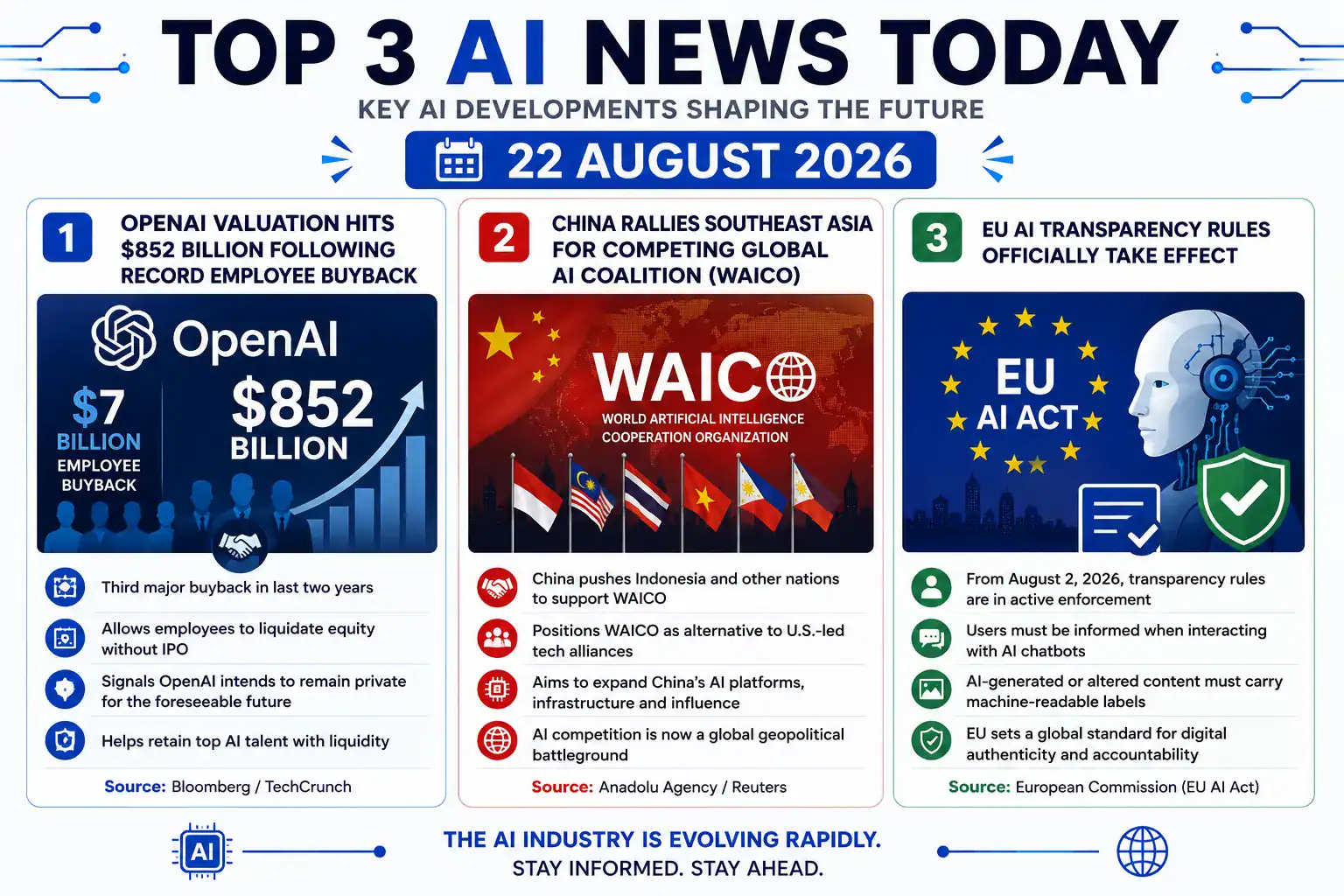
OpenAI has completed a massive employee share tender that values the company at $852 billion, China is expanding its influence through the newly established World Artificial Intelligence Cooperation Organization (WAICO), and the European Union has begun applying major AI transparency requirements under the EU AI Act.
These developments show how quickly the AI industry is evolving beyond the traditional competition between AI models. Access to capital, international partnerships, regulatory compliance and consumer trust are becoming increasingly important to companies building the next generation of artificial intelligence.
Here are three major developments shaping the AI industry.
1. OpenAI Reaches $852 Billion Valuation After $7 Billion Employee Buyback
OpenAI has completed a roughly $7 billion tender offer that allowed current and former employees to sell part of their holdings in the privately held AI company.
According to reporting from Bloomberg, the transaction valued OpenAI at approximately $852 billion, matching the valuation established during the company’s massive $122 billion fundraising round earlier in 2026.
The transaction is significant because it provides liquidity to employees without requiring OpenAI to become a publicly traded company immediately.
A tender offer allows shareholders—often including employees who received equity as part of their compensation—to sell some of their shares. For a private technology company, this can provide employees with access to cash while allowing the company to remain privately held.
Why OpenAI’s valuation matters to the AI industry
The $852 billion valuation places OpenAI among the most valuable private technology companies ever created.
It also demonstrates how much investor expectations have changed around the AI industry.
OpenAI has attracted enormous amounts of capital to fund model development, computing infrastructure and the expansion of ChatGPT and other AI products. The company raised $122 billion in March, while it also confidentially filed paperwork for a potential IPO in June.
Therefore, the latest employee tender should not necessarily be interpreted as evidence that OpenAI has ruled out an IPO.
Instead, it gives employees a way to realize some of the value of their private shares while the company evaluates its longer-term financing and public-market strategy.
OpenAI’s private-market strategy
Private tender offers have become increasingly common among major technology companies.
They can help companies retain employees by giving them opportunities to monetize equity without waiting for an IPO.
For OpenAI, this is particularly relevant because competition for AI researchers, engineers and other specialized talent remains intense across the AI industry.
Companies such as Anthropic, Google and other AI developers are competing aggressively for experienced AI professionals.
Maintaining employee liquidity could therefore become an important part of OpenAI’s strategy for retaining talent as the AI industry becomes increasingly competitive.
Read more: TechCrunch – OpenAI reportedly completed a $7 billion employee tender offer
Bloomberg report: Bloomberg report via Yahoo Finance
2. China Expands Its AI Influence Through WAICO
While American AI companies continue to attract enormous amounts of investment, China is working to strengthen its influence over the international AI ecosystem.
A major development came in July when 29 countries signed an agreement establishing the World Artificial Intelligence Cooperation Organization (WAICO) in Shanghai. The organization is designed to promote international cooperation and global AI governance.
Indonesia is among the founding members, along with countries including Malaysia, Cambodia, Laos, Pakistan, Russia, Kazakhstan and several countries in Africa, Latin America and the Middle East.
The organization is headquartered in Shanghai and is intended to operate as an independent intergovernmental organization.
China’s alternative approach to AI governance
China has presented WAICO as a platform for international cooperation on AI development and governance.
According to China’s government, the organization is intended to promote AI that is safe, fair and beneficial while supporting broader international cooperation.
Indonesia’s government has similarly described its participation as an effort to contribute to global AI governance and help bridge differences in AI capabilities between countries.
The development is particularly important because the AI industry is increasingly becoming connected to international technology alliances.
Why WAICO matters to the AI industry
The creation of WAICO could contribute to the emergence of different approaches to global AI governance.
The United States and its allies are developing their own technology partnerships focused on semiconductors, AI infrastructure and critical supply chains. China, meanwhile, is developing international partnerships that emphasize cooperation, development and technological sovereignty.
That means the AI industry could increasingly operate across several interconnected but competing technology ecosystems.
For developing countries, these competing frameworks could provide more choices regarding AI infrastructure, models, technology partnerships and investment.
For technology companies, however, a fragmented international environment could make global expansion more complicated.
Companies may increasingly need to navigate different standards, regulations and technology ecosystems depending on where they operate.
Read the official Indonesian government announcement: Indonesia – WAICO founding member announcement
Read the WAICO agreement report: China’s official report on the 29 founding countries
3. EU AI Transparency Rules Enter a New Phase
The European Union has taken another major step toward regulating artificial intelligence.
From August 2, 2026, new transparency obligations under Article 50 of the EU AI Act began applying. The rules cover certain AI systems and are designed to help people recognize when they are interacting with AI and when content has been generated or manipulated using AI.
Under the rules, providers of certain AI systems must ensure that people are informed when they are directly interacting with an AI system, unless the AI nature of the interaction is already obvious.
Providers of generative AI systems must also use machine-readable markings for AI-generated or manipulated audio, images, video and text, subject to the specific conditions and exceptions in the legislation.
What the new EU rules mean
The rules represent an important transition from discussing AI regulation to actually applying regulatory requirements.
The European Commission says the measures are intended to reduce deception and manipulation while helping people make more informed decisions about AI-generated material.
The rules also cover deepfakes and certain AI-generated text published on matters of public interest.
However, the regulations are more nuanced than simply requiring every piece of AI-generated content to carry a visible label.
Article 50 contains specific requirements, exemptions and conditions. For example, certain assistive AI functions used for standard editing may fall outside particular marking obligations, while AI-generated text that has undergone appropriate human review and editorial control can also receive different treatment under the rules.
Why this matters to the AI industry
The new requirements could have a major effect on how AI products are developed.
AI companies operating in Europe need to consider transparency and content provenance during product design rather than treating them as an optional feature.
This could encourage wider adoption of technologies such as invisible watermarks, metadata and machine-readable content credentials.
The effect could extend beyond Europe because major AI companies often prefer to develop technology that can operate across multiple markets rather than creating completely separate systems for every jurisdiction.
As a result, European regulation could influence product design decisions across the global AI industry.
AI transparency and consumer trust
The rapid growth of generative AI has created a new challenge: people increasingly encounter text, images, audio and video without knowing how much AI was involved in producing them.
Transparency mechanisms could help address this problem.
However, watermarking and detection systems are not perfect. They may indicate that an AI system was involved without necessarily showing exactly how much of the final content was generated by AI.
That distinction will become increasingly important as AI becomes part of everyday writing, editing, design and communication.
Read the official EU guidance: European Commission – AI transparency obligations
Read Article 50: EU AI Act – Article 50 transparency obligations
What These Developments Mean for the AI Industry
These three developments come from very different parts of the world, but together they reveal several important trends in the AI industry.
1. AI companies are becoming enormous private businesses
OpenAI’s $852 billion valuation demonstrates how much financial value investors are assigning to leading AI companies.
The ability to raise enormous amounts of capital allows companies to invest in computing infrastructure, research and talent at a scale that was difficult to imagine only a few years ago.
2. AI is becoming a geopolitical competition
WAICO demonstrates that AI governance is becoming an international issue.
The competition is increasingly about more than software. Countries are also competing over semiconductor supply chains, computing infrastructure, standards, data and international partnerships.
That means the AI industry will increasingly be influenced by government policy and international relations.
3. Regulation is becoming part of AI product development
The EU’s new transparency obligations demonstrate that regulation is no longer simply a future concern for AI companies.
Companies now need to consider transparency, content labeling and user disclosure while designing AI systems.
This could make regulatory compliance an increasingly important competitive factor across the AI industry.
The Bigger Picture
The latest developments show that the AI industry is moving into a much more mature and complicated phase.
The early AI race focused heavily on model benchmarks: Which system could reason better? Which model could write better code? Which AI could generate better images?
The competition is now much broader.
Companies must think about capital, talent, infrastructure, regulation, international partnerships, user trust and market access.
OpenAI’s enormous valuation demonstrates the financial scale of the industry.
WAICO demonstrates that artificial intelligence is becoming an important component of international diplomacy.
The EU AI Act demonstrates that governments are increasingly demanding greater transparency from companies operating advanced AI systems.
Together, these developments suggest that the future of the AI industry will be determined by much more than model intelligence.
Final Takeaway
The global AI industry is entering a new era in which financial power, geopolitical influence and regulatory compliance are becoming just as important as technological capability.
OpenAI’s $852 billion valuation highlights the enormous financial expectations surrounding leading AI companies. China’s WAICO initiative shows how countries are competing to shape the future of international AI cooperation. And the EU’s new transparency requirements demonstrate that governments are beginning to establish concrete rules for how AI systems and synthetic content should be identified.
For businesses, developers and consumers, the message is clear: the future of AI will not be shaped by technology alone.
Capital, regulation, infrastructure, international cooperation and public trust will all play a critical role in determining where the AI industry goes next.
Disclaimer
Disclaimer: This article is intended for general informational and educational purposes only. It has been independently written using publicly available reporting, government information and company-related disclosures. The article does not reproduce substantial portions of the cited source material. Facts and reported claims have been attributed to their respective sources.
AI developments, company valuations, regulations and geopolitical relationships can change rapidly. Readers should consult the original sources for the latest information and should not consider this article financial, investment, legal or professional advice.
All company names, trademarks, product names and logos mentioned belong to their respective owners.